Space weather—the everchanging conditions in space, influenced by the Sun—causes a range of different effects on Earth. These happen in many different timeframes for people, technologies, and societies. One such effect is the aurora: the Northern and Southern Lights. Usually, they occur in high-latitude rings around the North and South Poles called auroral ovals, but sometimes they expand and move further toward the equator, bringing beautiful dancing lights to lower latitudes. March and September tend to be good months for it, especially during the active years of solar maximum. But in order for aurora to happen a whole lot has to go just right, so auroras are notoriously challenging to forecast. Sometimes, information goes viral long before accurate predictions are realistically possible. Rule of thumb: if it’s widely publicized, doublecheck the timing and see what scientists are saying! Read on to learn more.
In this blog post, we’ll give you a beginner-level timeline for what to expect when you want to see aurora. There are several kinds of solar activity that can cause auroras at mid-latitudes (like the northern US) and lower latitudes (like the southern US). These include coronal mass ejections, fast solar wind, and more. These originate from features on the Sun like sunspots and coronal holes. To keep it simple, in this post we will use “solar storm” to refer to all of them. The timings below are calculated out from when aurora might be visible.
Others may have other methods which we’d also like to hear about.
Aurora chasing is always a game of chance
Aurora forecasting models usually look at whether there will be aurora somewhere on the planet, not necessarily in a specific place. Most importantly for lower latitudes, while there are a number of research models studying space weather, the only official prediction service in the US is NOAA’s Space Weather Prediction Center (SWPC), pronounced “SWIP-see” for short. SWPC itself predicts space weather for their main stakeholders, but the general public is not usually part of that group. This can lead to gaps. That said, if aurora is publicized but SWPC hasn’t said anything, be sure to wait for their analysis.
The aurora is also fickle; the data can look great and it doesn’t show up, or the data can look disappointing and it puts on a beautiful display. And the data are constantly changing! In addition, where aurora is predicted to occur in the upper atmosphere is not necessarily the same as where it is visible; extra-high-altitude aurora can be seen from a long way off. With all these variables, aurora chasing is always a game of chance—and that’s part of the fun!
5 days ahead: keep an eye out for possible activity on the Sun
 You may see space weather forecasters talk about conditions on the Sun having the potential to give off solar storms. For example, there might be a nice coronal hole that they’re watching carefully. This is not an aurora prediction; what they are looking at is the possibility of the Sun doing something that might in turn cause more auroras. There are still many steps that have to go just right for widespread auroras to actually happen.
What to do:
- Keep an eye on resources created for the general public, like Dr. Tamitha Skov, the Space Weather Woman and Spaceweather.com.
- Find your local aurora chasing group on social media. Experienced aurora chasers have very deep knowledge of how auroras manifest in your area, and are often able to help translate scientific models. They may also be able to recommend favorite resources, like local aurora cameras. If you don’t have a local group, try one of the larger international groups like the Alberta Aurora Chasers.
- Create an Aurorasaurus account, which will send you an email notification when other aurora chasers spot auroras near you or when a leading aurora model predicts aurora may be visible near your location.
2-3 days ahead: keep an eye on forecasts for solar storm arrival
A solar storm occurs and leaves the Sun about 2-3 days before it arrives at Earth. Skilled scientists called space weather forecasters observe its direction, speed, and other characteristics. Then, they use computer models to analyze the likelihood of it coming to Earth, and what it might be like when it does. Auroras cannot accurately be forecast at this point: this is a heads up to watch and wait. For all models, exact arrival times have some uncertainty: they can be early or late by several hours to a day.
What to do:
- Be patient! Keep an eye on information from experts like SWPC, space weather scientists, and your local aurora chasing group. Be skeptical of highly-publicized predictions, and doublecheck them.
- Check your local weather forecast. Aurora glows high above the clouds, and clouds will block the view. If there is aurora, are you likely to be able to see it from a location accessible to you?
Intermission: a solar storm is on the way, prepare a plan
 Once a solar storm leaves the Sun, it is zooming along the 93 million miles to Earth like it’s on a curving roadtrip. Just like any kind of travel, it may run into unexpected traffic and be slowed or weakened, or it might get a boost from something along the way. It may change substantially or stay the same: we won’t know until it arrives and impacts satellites closer to Earth. As in the previous section, auroras cannot accurately be forecast at this point.
What to do:
- Use this time to make a general plan for how you would safely chase auroras, if and when the time comes. If the solar storm fizzles this time, you can use the plan another time.
- Connect with others.
- Continue to keep an eye on your aurora chasing group to find out what scientists and aurora chasers are saying about when the solar storm arrives.
- If you are a beginner, you may want to plan to go with a more experienced chaser at first. As always, it’s important to make safe choices, both about chasing and connecting!
- Decide on a safe spot to watch the aurora.
- Choose a location with dark skies and a good view toward the pole (North Pole for the northern hemisphere, South Pole for the southern hemisphere). It’s important that the place be safe and legal to be in at night. Check with your local aurora chasing group for ideas.
- Continue to watch the weather.
- Pack up your aurora chasing kit.
- Always be prepared for temperatures, weather, wildlife, etc in your aurora chasing location. Safety always comes first. Talk with your aurora chasing group to find out what to bring for your area.
- Charge any camera batteries, and check to see if you have night mode on your smartphone camera. Depending on the strength of the aurora, it may be more visible on camera than to the naked eye, and night modes on newer smartphones are capable of photographing auroras.
- Get gas, and/or do any other preparation you need.
- Read up on the science behind the aurora.
- New to aurora terms? Check out our beginner-level wordlist!
- Check through the links in this post, and take a look at the resources on our blog. The posts will give you a better understanding of what’s happening scientifically, and what you can realistically expect.
- Check out our new printable card game, which helps to answer the surprisingly complex question, “how can I see aurora?” Educators will also find a worksheet for classroom use.
- Take a virtual aurora tour for preparation!
- Connect with others.
A few hours ahead: make a decision
 A few days after leaving the Sun, the solar storm may arrive at a pair of satellites named ACE and DSCOVR, floating in space at a special location called L1. At the speed the solar storm travels, this location is about one hour away from Earth. These space weather satellites take scientific measurements and watch for confirmation of the storm’s arrival, which can look like sudden shocks or jumps in data. This is the point at which we start to have data about whether there will likely be aurora happening on Earth in about an hour’s time.
Just like Earth weather, space weather has “watches” and “warnings” issued by SWPC. To borrow a metaphor from the Normal, IL, fire department, a dinner watch means we have the ingredients for dinner. Keep an eye out, it may come soon! A dinner warning means we are having dinner NOW. SWPC issues a warning if they observe a solar storm happening at L1.
One type of data you may hear discussed is the direction of the solar storm’s magnetic field, called “Bz”. The Sun, solar storms, and Earth all have magnetic fields, and these are important for auroral conditions. Solar storms coming off the Sun carry bits of the Sun’s magnetic field with them. When they reach Earth, they interact with the magnetic field surrounding our planet. Just like with regular magnets, opposites attract. If Bz is “north” or “positive” (the same as the direction the Earth’s magnetic field points, at a special place where the two fields “reconnect”), the solar storm can mostly deflect off of the Earth’s magnetic field, disappointing aurora chasers. If Bz is “south” or “negative” (the opposite of the Earth’s magnetic field), the solar storm’s magnetic field and Earth’s magnetic field can “reconnect” and inject energy for a more exciting aurora display. The constantly-varying interaction of these magnetic fields is a normal part of the the way energy is balanced in the relationship between the Sun and Earth.
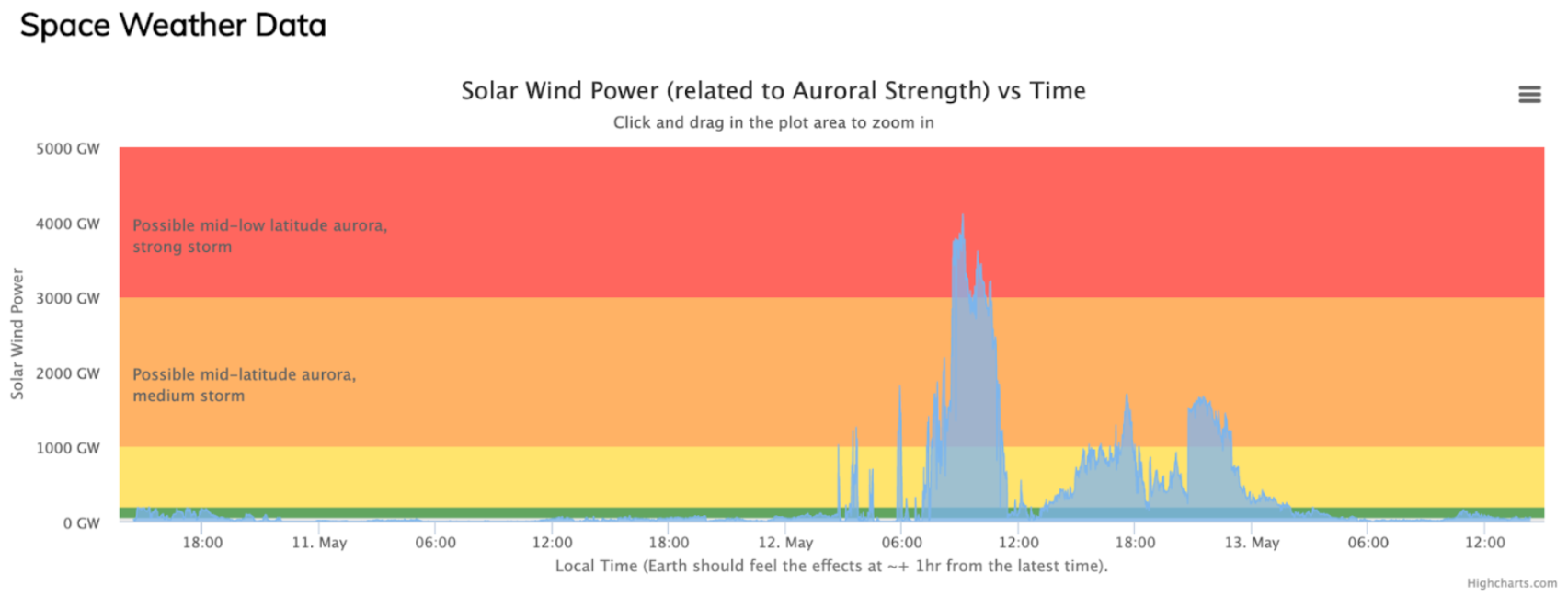
Even if the data is good, whether the aurora will be visible near you still depends on a number of things, like when the solar storm arrives and whether it will be active when the sky becomes dark enough for your area to see auroras. One place to check is SWPC’s Aurora Forecast model, which provides a 30- to 90-minute forecast of the location and intensity of aurora that occurs overhead. To make it even easier to get a sense of the chances for your time zone, we’ve made a simple chart of the data: the Aurorasaurus Storm Tracker. The descriptions on the left side of each band of color help translate what the data means. It’s important to remember: the aurora is fickle and you need a dash of luck along with all the other variables, but that’s part of what makes questing for aurora fun!
What to do:
- Keep an eye on SWPC’s 30 minute forecast.
- Check the Aurorasaurus Storm Tracker for a 1-hour heads up in your time zone.
- Watch aurora chasing groups on social media. The Earth turns underneath the aurora, so chasers in the timezones east of you seeing aurora is a good sign, if the storm lasts long enough for your location to rotate underneath it.
- Keep an eye on webcams, which will show when the aurora appears in real time.
- Doublecheck the weather for clouds, temperature, etc. Be in touch with your aurora chasing buddies.
- If it looks good, you can choose to safely chase the aurora!
- Whether or not you see aurora, don’t forget to make reports to Aurorasaurus for science!
One final note
Aurora science always has a “but wait, there’s more!” which is part of what makes it infinitely fascinating. In this case, fun fact: the Sun rotates, making a full rotation every 27 days.
What does this rotation mean for aurora?
If there was something on the Sun—for example, a sunspot—that gave us really nice aurora the last time it was facing us, you may see scientists and aurora chasers eagerly watching it rotate back around to see if it will do it again. Sometimes the same features continue to be active, and the question is whether the activity will last long enough and be strong enough for more aurora on Earth. While you may hear talk about potential auroras a month out, importantly, this is not an aurora prediction, but rather the start of the process of watching the feature to see whether it will give us the ingredients for aurora. The thing to do is to start the journey in this blog post from the top.
And there you have it! Long story short: friends don’t let friends chase aurora too soon.
This post was inspired by an incident earlier this year in which a long-range academic model intended for scientists went viral as if it were a public forecast. It was criticized and walked back, but there ended up being aurora anyway when the Sun sent out unrelated, Earth-directed space weather. The Sun is tricky like that! Thanks to all of the dedicated space weather analysts out there!
It’s important to know that aurora is very different from comets or star conjunctions; you can’t set your alarm for an aurora until one hour ahead, and even then the aurora might be fickle and not show. It takes effort and luck to see aurora—part of the joy of the chase—and your efforts will be rewarded someday.