STEVE has likely been observed for millennia, but it was not until photographers began to question it that modern science took notice and began to study it. Photographers bring to scientific inquiry different skillsets than traditional scientists. This collaboration can be described in terms of a theory from the field of psychology called “Multiple Intelligences.” In other words, far from science solely being the domain of people with one kind of logical-mathematical intelligence, everyone can take part in science by bringing their unique blend of intelligences to the table and investigating science questions from multiple angles. This is a particular strength of a participatory science approach to research. In this post, we will walk through what Multiple Intelligences means, and how it applies to participatory science.
(Note: Multiple Intelligences is different from the idea of learning styles, and intelligence can grow like a muscle rather than being static. In this post, we use MI loosely as a reminder of the importance of multiple skillsets and perspectives.)
Intelligence comes in different flavors
In 1983, developmental psychologist Howard Gardner published a book called Frames of Mind: The Theory of Multiple Intelligences that proposed that intelligence was not a single quantifiable ability, but rather a range of abilities that interact with one another. Everyone has all abilities, but they are weighted in different areas (an idea familiar to any gamer who has ever filled out a character sheet.)
Gardner proposed roughly nine malleable categories:
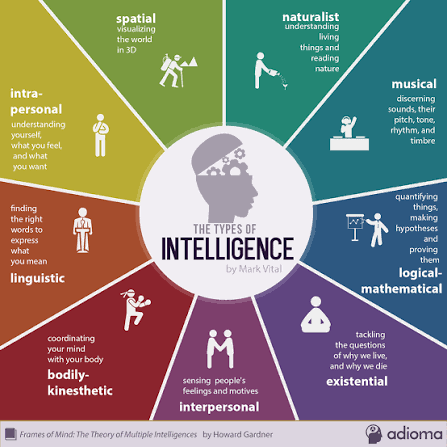
Complementary intelligences
The field of informal education loosely adopted this theory as a reminder that people come to an idea with different experiences and ways of knowing, and an educator’s job is to meet them in that space, respecting their intelligence. This is especially true in participatory science; the beauty and strength of participatory science is the way in which participants bring vastly different skillsets and intelligences to bear on a subject like aurora. Instead of valuing only the perspective of professional scientists, participatory science values the spatial and existential intelligence of photographers, the naturalist intelligence of those who live beneath the aurora, the logical-mathematical intelligence of those who love charts and models, and more. By bringing these different, valuable intelligences together, we can understand our world more completely than if we valued only one or two.
Intelligences for aurora outreach and education
It’s also true for giving presentations about aurora; to reach lots of people, we can reference multiple kinds of intelligence so they have the chance to see their own. For example, project manager Laura had a difficult time with algebra in high school and struggled with getting her ham radio license until she realized that the vibrations of the Earth’s magnetic field were metaphorically similar to music. She was able to apply her musical intelligence to math and achieve her license. She has also been able to better approach other physics concepts by applying knitting and beading, crafts that she loves.

By including activities, visuals, sounds, stories, metaphors, and more in a presentation, a presenter can resonate with many intelligences in their audience. It can be an affirming experience for those who have deep intelligences beyond the logical-mathematical often referenced in science. Approaching participatory science by recognizing more kinds of intelligence helps bring the broader community together to study the aurora.
One of the most fun applications in the scientific world is the Dance Your PhD contest, hosted by Science since 2008. In this annual event, PhD students and recent graduates—many of whom are also dancers—combine spatial, musical, logical-mathematical, bodily-kinesthetic, and interpersonal intelligences to choreograph and perform a dance that expresses their PhD research. For example, in 2017 Dr. Samira Tasnim entered “Generalized Theory of the Solar Wind” to the Physics category:
Combining art and science can better communicate a concept to an audience, inspire new generations, and draw attention to the process of science, as well as potentially provide new perspectives and insights into research. You can see this year’s Dance Your PhD winners here.
Our own intelligences
Lastly, the Theory of Multiple Intelligences can be a positive self-reflection tool. Gardner made it clear that while his chart covered some types of intelligence, there were likely more he hadn’t listed. What categories in Gardner’s model resonate with your skills, interests, and intelligences? Are there others that you would add? How have those changed over time for you? What are some ways that those different perspectives and skillsets can help with understanding the beautiful aurora?


