Skip to content

Uncategorized

Black and white image shows five bands of aurora stretching upward from the mountainous horizon at the bottom center.

Listening for the sound of aurora—in the historical record

A question we often get is “does the aurora make sound?” Observers sometimes note a crackling, rustling, whooshing, or similar noise when they watch aurora, but there has not been a lot of conclusive scientific study and anecdotal reports can be met with skepticism in the scientific community. In this blog post, we dive into… Read More »Listening for the sound of aurora—in the historical record

The Heliophysics Big Year logo with its half sun are placed against a hilly orange landscape to look like a sunset or sunrise. Silhouetted people are scattered about, and Parker Solar Probe flies across the Sun in the sky. Further from the Sun in the top corners are stars and a full moon.

Helio Big Year: More Ways to Celebrate!

Note: This blog post contains and links to eclipse imagery.  The April 8, 2024 eclipse was an amazing experience for millions, and inspired more than 36,000 people to #DoNASAScience! While the solar eclipse is now over, eclipse participatory science projects are going strong. In addition, the Heliophysics Big Year—a global celebration of solar science and… Read More »Helio Big Year: More Ways to Celebrate!

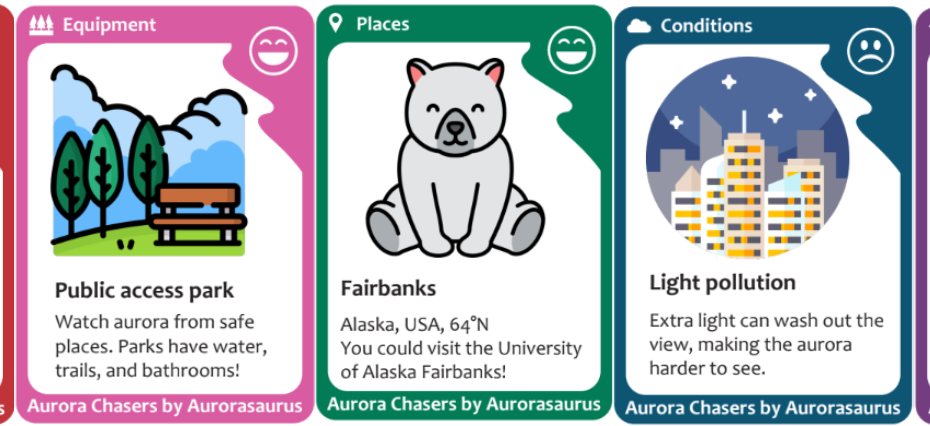
Five cards in a row. 1. Bears! Aurora chsers are guests in wild animals' habitats: practice caution and respect. 2. Public access park: Watch aurora from safe places. Parks have water, trails, and bathrooms! 3. Fairbanks, Alaska, USA 64 degrees North. You could visit the University of Alaska Fairbanks! 4. Light pollution: extra light can wash out the view, making the aurora harder to see. 5. Citizen scientists are seeing aurora. Aurora chasing is best with friends! Get alerts from aurorasaurus.org.

Aurora Chasers: The Game!

One of the questions we get most often is, “how can I see the aurora?” The answer is surprisingly complicated and can be difficult to explain to students. In order to help explain, we made a collaborative, role-playing card game!  With a special deck of printable cards and a dash of imagination, players work together… Read More »Aurora Chasers: The Game!

Photo with logos

Be a Rocket Citizen Scientist: Help Study Pulsating Aurora!

On February 24, running through March 10, 2022, the watch begins for the perfect opportunity to launch a sounding rocket into a common but rarely-viewed type of aurora: the pulsating aurora. The NASA Loss through Auroral Microburst Pulsations (LAMP) mission will send instruments high above the auroral light. Read on to find out what the… Read More »Be a Rocket Citizen Scientist: Help Study Pulsating Aurora!

A group of people aurora chasing

From Science to Society and the Sun to the Earth: An AGU 2021 Roundup

This has been quite the year. But while Aurorasaurus staff attended an online version of the American Geophysical Union conference, the biggest conference in the space physics field, one thing stayed the same: we were blown away by the work our colleagues have done! Here’s a roundup to share with readers of the amazing presentations… Read More »From Science to Society and the Sun to the Earth: An AGU 2021 Roundup

Aurorasaurus, 10 Years Later

On October 24, 2011 a solar storm brought beautiful auroras that lit the skies with red colors visible as far south as Alabama! “I had heard of Twitter,” remembers Dr. Liz, “so I got online that night and could see a lot of people recording their observations.” For the first time, solar maximum—the most active… Read More »Aurorasaurus, 10 Years Later

A young man works on an enclosed camera that points toward the horizon

“What if North Dakota had its own aurora camera?” 

Meet the North Dakota Dual Aurora Cameras (NoDDAC)! This project is led by university student and Aurorasaurus Ambassador Vincent Ledvina in collaboration with Aurorasaurus, the University of North Dakota (UND), and LiveAuroraNetwork. Using both a north-facing and an allsky camera, NoDDAC provides aurora chasers with live views of the night sky from North Dakota. During… Read More »“What if North Dakota had its own aurora camera?” 

Animated gif showing how a user can turn the camera toward the sky to focus on dfiferent areas

Eyes on the Aurora, Part 3: Exploring Over a Thousand Nights of Aurora on Your Phone

Guest post by Jeremy Kuzub Attending AGU 20? Jeremy will be presenting Keogramist as a poster in The MacGyver Session: The Place for Novel, Exciting, Self-Made, Hacked, or Improved Sensors and Software Solutions to Understand Space Weather eLightning on December 15, 2020 at 6:00 AKT/7:00 PT/8:00 MT/9:00 CT/10:00 ET/15:00 UTC. There will be a Q&A element, so bring any questions… Read More »Eyes on the Aurora, Part 3: Exploring Over a Thousand Nights of Aurora on Your Phone