by Tanya Melnik and Laura Edson
The aurora follows a “life cycle” called a substorm. We know the feeling of waiting for the most dynamic part of the substorm to light the sky with green and red ribbons, but sometimes it seems to take forever. In this post we’ll go over a couple of reasons why the aurora may not be actively dancing. Since we’re writing from a particularly toasty Northern Hemisphere summer, we’ll use a metaphor that can double as a demo and help with staying cool! As with all metaphors, it’s a simplified way of understanding a complex concept. While it’s not perfectly accurate, it’s useful.
The aurora acts like an enormous splash bucket
Water parks sometimes feature a large bucket that fills with water and then tips over, dousing delighted visitors.
A tipping bucket like this is a common metaphor for thinking about how an auroral substorm slowly builds energy and then bursts into a short, dynamic auroral display:
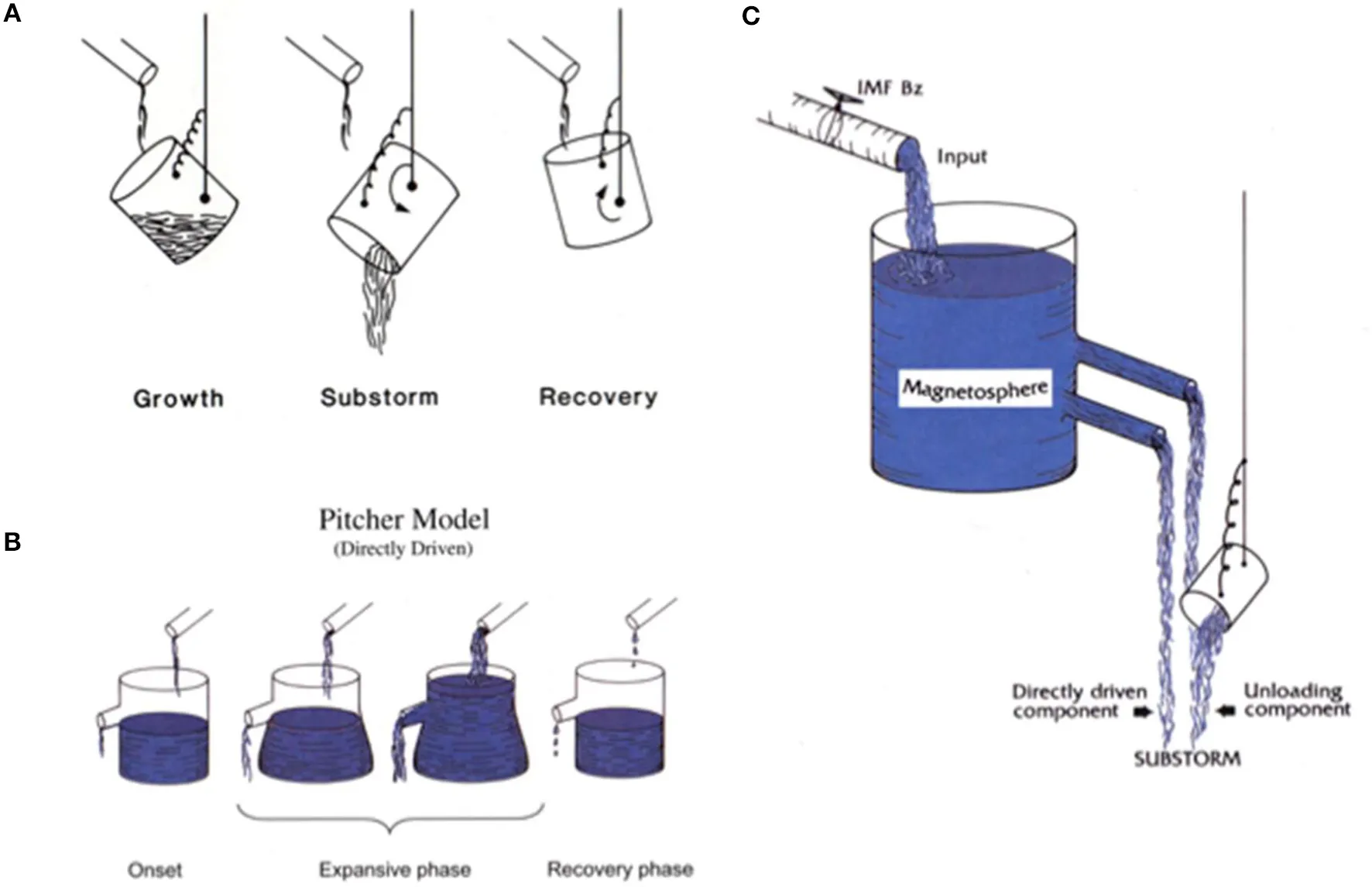
There are four main phases to a substorm, and the total time between substorms is usually about three hours.
- The growth phase, which can last a few hours
- The onset or breakup phase, which lasts about 10-15 minutes
- The expansion phase, which lasts 15-30 minutes.
- The recovery phase, which can last an hour or more
During the growth phase, the Earth’s magnetic system fills up with energy that it spends during the breakup and expansion phases. In other words, in the growth phase the bucket is filling; in the breakup phase it tips; in the expansion phase it spills; and in the recovery phase it rights itself, ready to fill again. During the breakup and expansion phases, the aurora can be seen further toward the equator, which is especially helpful for aurora chasers at lower latitudes. The processes that trigger breakup and expansion are hotly debated but still not fully understood.

The growth phase looks like quiet, ribbonlike discrete auroral arcs without much motion within the structures, that gradually move toward the equator. In the breakup phase, the quiet arcs get more active and start to cover more of the sky, and sometimes there are auroral beads: a row of brighter spots or stripes in line along an auroral arc that last seconds to minutes. The expansion phase can include spectacular ribbonlike shapes, bright colors, and active movements. STEVE typically occurs at the end of the expansion phase, about one hour after the breakup phase. During the recovery phase, the aurora becomes diffuse and cloudlike, usually dim with much slower motion, but there can be pulsating patches. Sometimes the recovery phase marks the finale of a night of an aurora, but sometimes another substorm happens right afterward, especially on active nights.
This pattern usually happens in a fairly regular way, but on occasion we find ourselves stuck in the growth phase, waiting impatiently. What’s going on?
Sometimes the bucket takes a long time to fill
When the solar wind first arrives, we feel eager to see that beautiful expansion phase. But filling a giant space bucket from empty takes a long time, and how long it takes has to do with how quickly the metaphorical water is pouring in. There are conditions that can slow the flow.
For example, Bz is the direction of the incoming space weather’s magnetic field. If it is the same as Earth’s magnetic field (which is in the Bz north direction), it deflects and not as much energy flows into the system that drives aurora. If it is the opposite of Earth’s magnetic field (Bz south), it reconnects with Earth’s magnetic field and pours lots of energy into the system.

It’s a little like a spigot valve that can close or open, changing how much water flows into the bucket. If Bz is fluctuating a lot, it’s like someone turning the spigot valve off and on over and over, and the bucket will fill more slowly. If Bz has been north for a while and then suddenly turns south, more water begins to flow into the bucket, but it will still take time to fill all the way. The growth phase can take several hours and patience is important. Figuring out when a breakup is about to happen is one of the most debated topics in auroral physics. Bz switching from south to north is a likely sign of this, and there is about an hour’s travel time needed for that Bz impact to reach Earth. Seeing auroral beads is another very good indicator that a breakup is imminent within a few minutes.
Sometimes the bucket leaks
Sometimes there is already some aurora visible, but it is diffuse, misty, and featureless. This can indicate a state of “steady magnetospheric convection” or “SMC”. In this case, energy is flowing into the system but dissipating instead of building up, like water in a leaky bucket.

SMC can come into play in several situations, but typically happens when Bz is persistently southward for much longer than an hour. SMC can last for 4-6 hours and feel like an excessively long growth phase. It’s a perfect opportunity for practice, though. While the arc is slowly simmering in the sky, it gives an aurora chaser plenty of time to do photography test shots and to find a good composition. That way, when the breakup phase finally kicks off, the chaser is fully prepared.

Isle Royale webcam, northern Michigan, July 4, 2025. Credit: US National Park Service. On this night, the aurora looked very still, like a growth phase arc, and did not develop for several hours (Sergeev et al., 1996).
Patience is key
The aurora is driven by a complex system of matter, magnetism, and energy out in space, and is notoriously hard to predict. Being able to recognize the phases of a substorm and understanding the process of our celestial “bucket” filling can help to set expectations for an aurora chase. Sometimes it may take hours for an aurora to build—a great opportunity for a cup of coffee, a chat with a friend, or a timelapse photo of the stars.
In addition, when scientists talk about substorms they tend to refer to everyday, high-latitude aurora caused by normal solar wind. Auroras from larger space weather events like coronal mass ejections and fast solar wind can sometimes evolve in a similar pattern like substorms, but they can also behave in surprising ways that don’t follow the same pattern. One of the reasons the dataset you help create with Aurorasaurus is so valuable is that it helps document both large and small events and the times when the aurora might (briefly) dance at lower latitudes. Together, we can learn more about this fascinating system!


