While the Sun appears constant, in terms of heliophysics the Sun varies naturally and goes through significant daily variations. With solar maximum in the recent past, a common question about auroras is: are they caused by sunspots? As with a lot of aurora science, the answer is somewhat complicated, and includes several phenomena that are easily mixed up. In this post, we’ll investigate the answer, and walk through the differences between similar-sounding, sunspot-related phenomena. The answer reveals more about the part of the solar cycle we are in now, when a mix of events on the Sun can drive different types of storms.
Sunspots vs. Coronal Holes
Both sunspots and coronal holes are relatively cooler areas on the Sun that look like dark patches in pictures. To non-scientists, they can look similar. However, there are important differences in how they form and influence auroras.
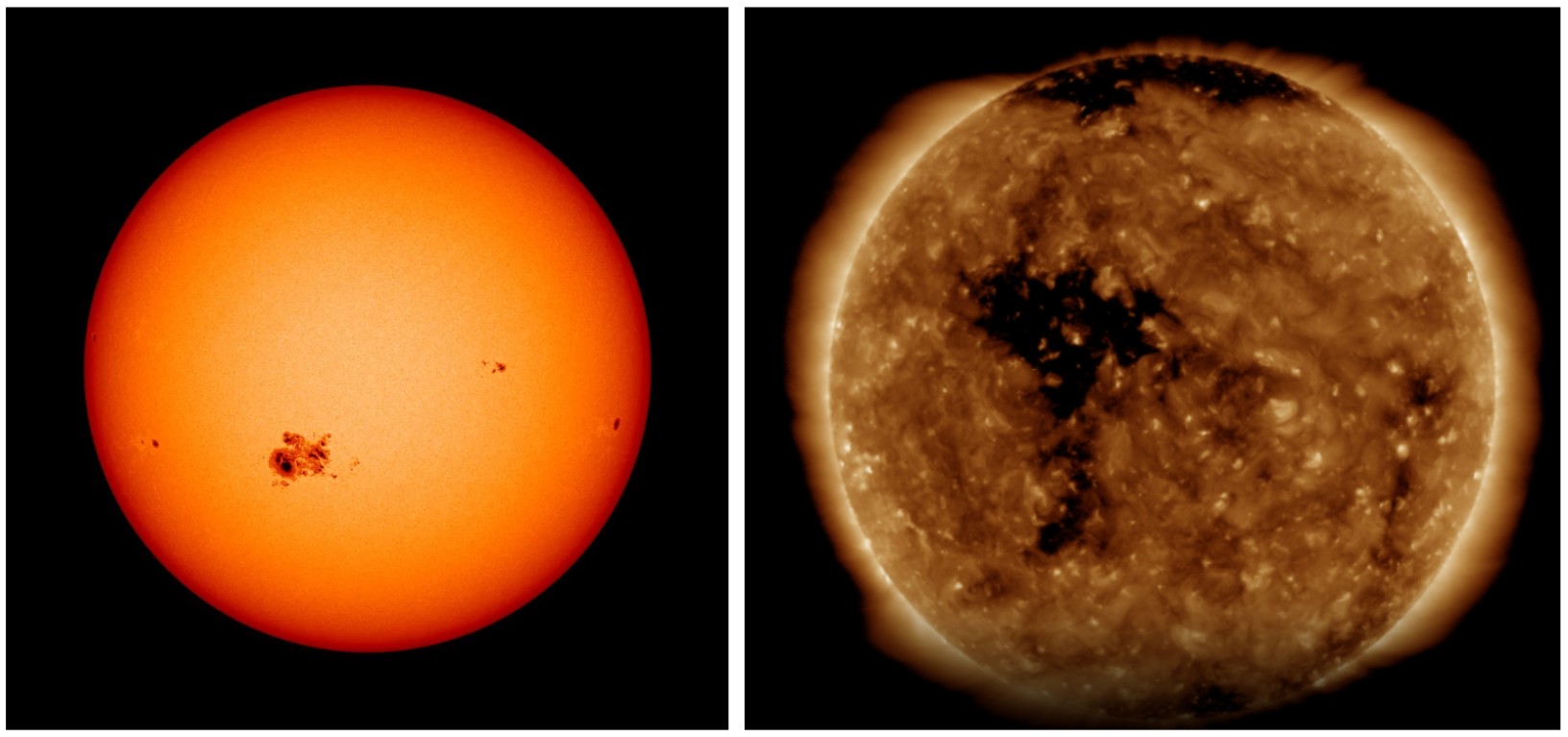
Sunspots form in areas where the Sun’s magnetic fields are especially strong: so much so that they keep some of the heat inside the Sun from reaching the surface. The strong magnetic fields near sunspots can suddenly reorganize and trigger solar flares and CMEs, which we’ll discuss later in this post.
In addition, the Sun’s entire magnetic field undergoes a solar cycle that lasts about 11 years. The phases of the solar cycle are often tracked by observing the sunspots that appear on the side of the Sun that faces Earth. During solar minimum (the most quiet phase) the Sun tends to display few to no sunspots, while during the more active solar maximum, the Sun tends to have lots of sunspots. While auroras occur throughout the solar cycle, they are more frequently spectacular during solar maximum. More sunspots means more chances for storms.
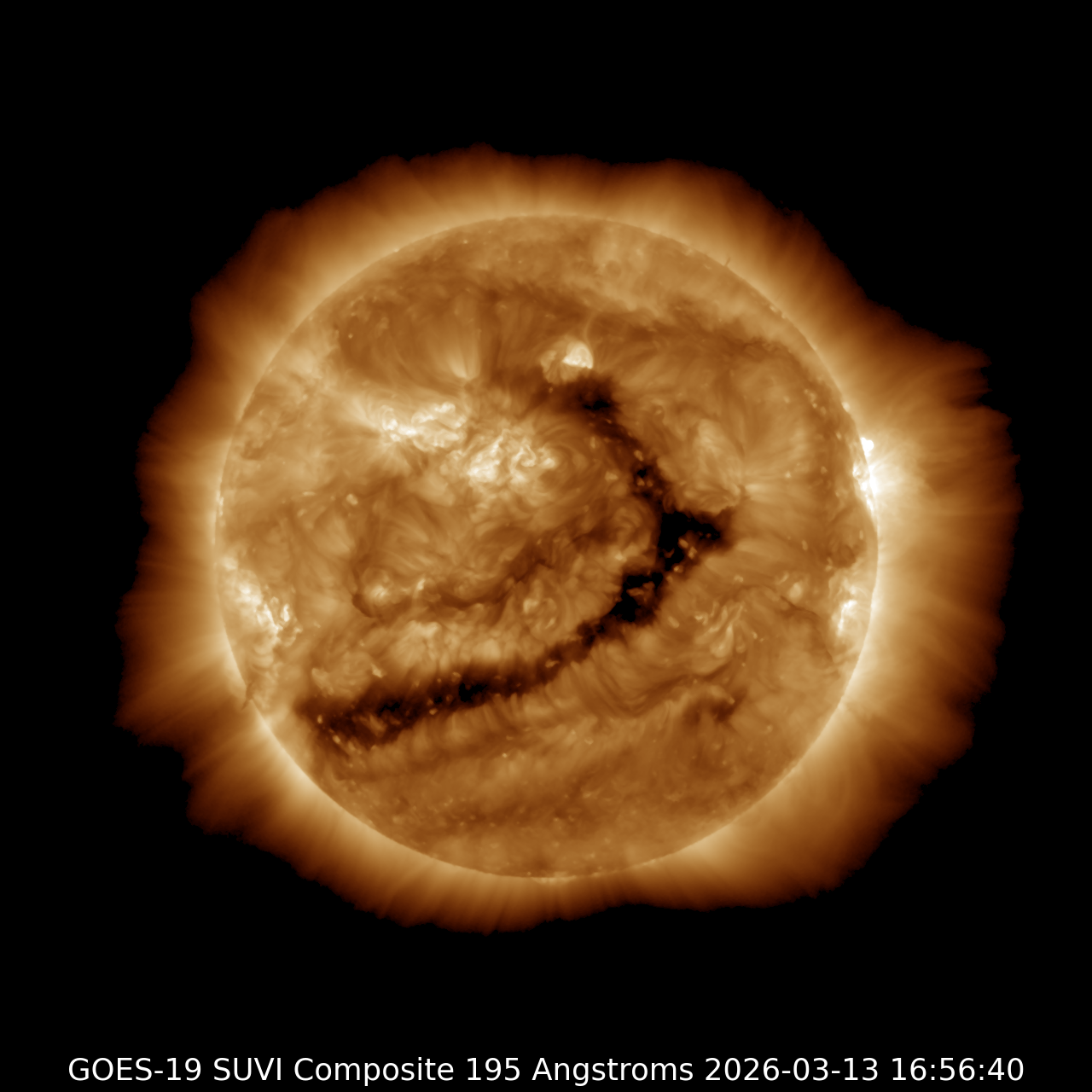
Coronal holes are regions on the Sun where the Sun’s magnetic field is open to the solar system, sending charged particles and magnetism (also called the solar wind) streaming out at especially high speeds. The Sun gives off regular solar wind all the time in all directions, driving daily, high-latitude auroras. However, fast solar wind (sometimes called a high-speed stream) emanating from coronal holes can drive auroral activity that pushes auroras to lower latitudes, with more dynamic displays. Coronal holes appear throughout the solar cycle, on different parts of the Sun at different times. This is because the Sun’s magnetic field is generated by a “solar dynamo” that causes it to flip every 11 years. Roughly halfway through the flip, which is solar maximum, the Sun’s magnetic field is messy, allowing for coronal holes to stretch across the middle of the Sun. During solar minimum, when the magnetic field is calmer and more defined, coronal holes tend to hang out around the poles. These coronal holes can exist for longer periods of time, since the magnetic fields are more stable. Scientists sometimes refer to a related term, “corotating interaction region” (CIR), when fast solar wind bumps into slower solar wind and the two move around the Sun together. CMEs drive larger storms than CIRs, but CIR storms, while small, are known for lasting several days with strong substorm activity. Thus they can drive different types of aurora and magnetospheric response (something Dr. Liz studied way back in 2010). Aurorasaurus Ambassador Tanya Melnik says, “Auroras can be somewhat less predictable during CIRs. They may stall without substorms, or stand around like a band in the sky, or come in sporadic bursts. Visibility is usually best at high latitudes, where the aurora can be very dynamic and change rapidly. CME storms can move the auroral oval further away from the poles, and auroras can be visible at mid-latitudes—sometimes even overhead. But when CMEs have a stable, favorable magnetic field, it can be slow with substorms about every three hours. It does not always equal spectacular aurora all night.”
Solar flares vs. CMEs
The way magnetic fields near sunspots move and change can sometimes cause sudden explosions. Some of these emit charged particles that drive auroras, and some do not (because they only emit light). Here’s the difference:
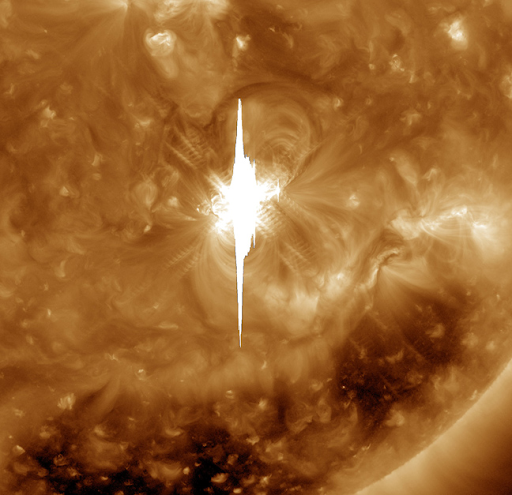
A solar flare is a burst of energy that releases large amounts of radiation into space. In scientific imaging of the Sun through special filters, a solar flare is a bright flash of light. Flares travel at the speed of light, arriving at the Earth in about eight minutes. If a solar flare is very intense, the radiation it releases can interfere with radio communications on Earth. They do not, however, cause auroras. Click here to find out more about how scientists develop ways to predict solar flares. When aurora scientists keep an eye on a flare, they are also looking for another phenomenon that might launch from the Sun soon after.
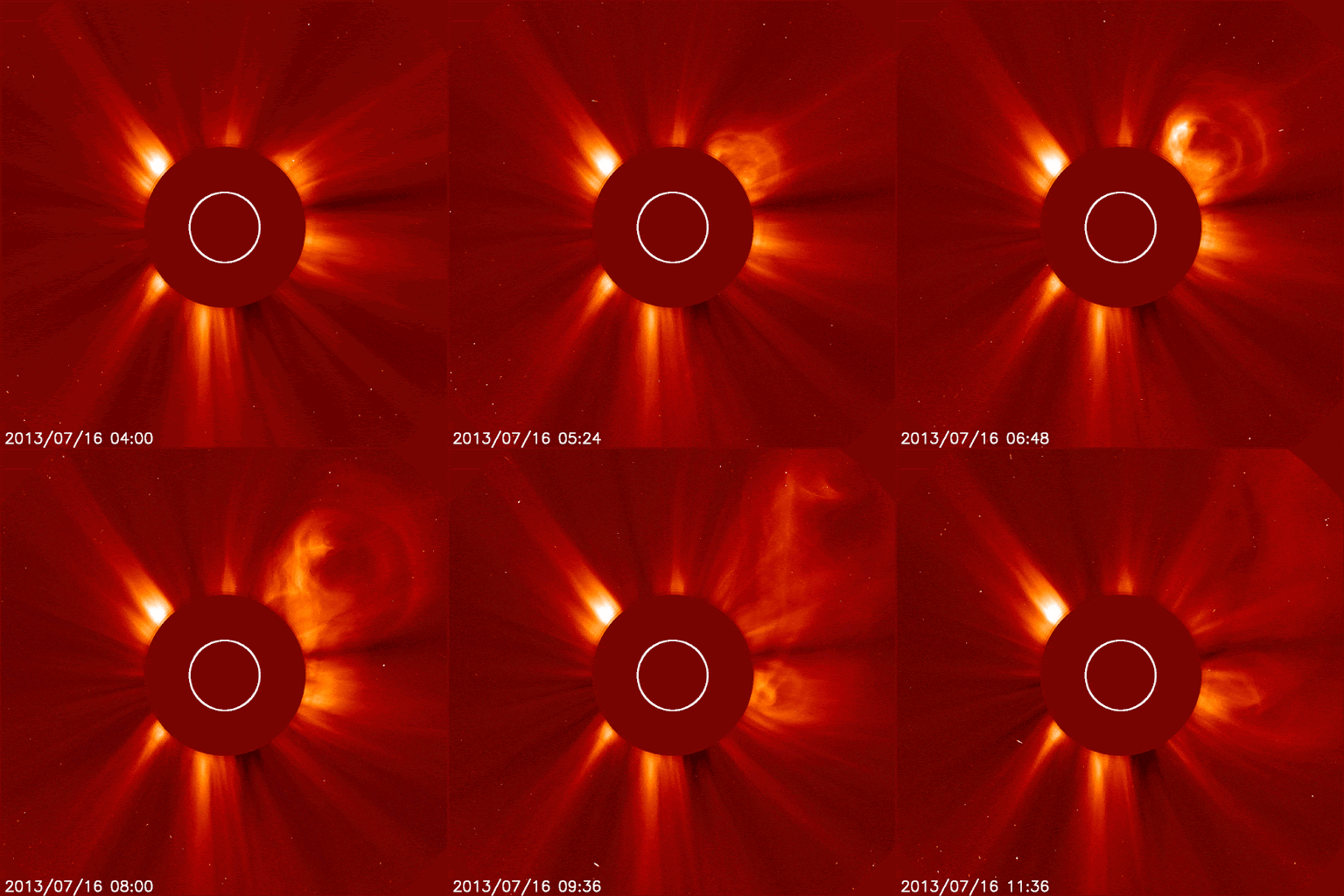
Solar flares are sometimes—but not always—accompanied by Coronal Mass Ejections (CMEs) that can cause aurora. A CME is a huge bubble of radiation, particles, and magnetism from the Sun that explodes into space at very high speed when the Sun’s magnetic field lines suddenly reorganize. They are fast, but much slower than flares, arriving at Earth hours to days after they occur. Forecasting CME arrival times is by its nature difficult to do with high accuracy. Until an hour or so before the storm arrives at Earth, there can be a window of uncertainty for the CME’s arrival time of plus or minus 12 hours—a whole day in total! When charged particles from a CME meet the Earth’s magnetic field, they can trigger auroras. CMEs can drive large solar storms, especially in combination with coronal holes, so in addition to driving beautiful auroras they can be a risk for severe space weather. The largest incidents are rare, but scientists constantly monitor the Sun just in case. Click here for a video about the journey of an extremely large CME that occurred in 2012!
So, do sunspots cause auroras?
By themselves, sunspots do not directly cause auroras. However, as with most aurora science, there’s more to the story! Sunspots form with strong magnetic fields that can produce solar flares and CMEs, so seeing a lot of sunspots can tell us the Sun is more likely to erupt. Solar flares do not cause auroras, but sometimes flares signal that the Sun is about to produce a CME. CMEs can drive auroras—sometimes spectacular auroras! Both sunspots and coronal holes can last for multiple solar rotations, so they can indicate the possibility of aurora when they rotate back toward the Earth again. The CMEs that can come with sunspots can make for big activity, while coronal holes can drive smaller but longer-lasting auroras with lots of substorms. The two types can even combine for spectacular auroras! In addition, sunspots are important indicators of the Sun’s 11-year solar cycle. For example, we are heading out of solar maximum toward solar minimum now, so we can expect to see fewer sunspots, but we’ll still see coronal holes. Long story short, overall, the solar cycle affects auroras.
Sunspots and coronal holes can appear as darker, relatively cooler areas on the Sun. Unlike sunspots, though, coronal holes produce fast solar wind, which can lead to particularly exciting auroras. For aurora chasers, sunspots and coronal holes are signals to watch and wait for CMEs or fast solar wind, respectively, especially since they can last longer than it takes the Sun to rotate. This means that if a sunspot or coronal hole rotates away from the Earth, there might be a chance for more activity 27 days later when the Sun completes a rotation. You can read more about what to expect from aurora forecasts and solar activity in our post, “When Can I See the Aurora?” And if the Sun’s everchanging activity interests you, try out some of our sibling NASA participatory science projects! With the new project Shock Detectives, search for clues at the place where the Sun’s solar wind collides with Earth’s magnetic shield.


