by Laura Edson, MAT in Museum Education

A question we have received more and more at Aurorasaurus is, “Do you have any suggestions for presenting auroras to the public?” The aurora is a really fun topic to share; it is instantly engaging and technically challenging, artistically beautiful and scientifically fascinating. But it can also be dry and jargon-filled, so how can you be sure to make a connection? In giving presentations about auroras to various audiences, I’ve found myself drawing on tools from museum education grad school that are specifically aimed at engaging audiences. My experience centers on “informal education,” which is an umbrella term for any learning opportunity that is not based in a classroom environment (think museums, libraries, conferences, family science nights, aurora tours, TV programs, science magazines, aurora chasing groups, science podcasts, conversations with friends, etc.) However, these tools are also used in “formal education” classroom environments. In this post, I’ll give you an introduction to three techniques I find especially helpful for giving presentations about the aurora, especially when working with slides.
Visual Thinking Strategies (VTS)
First, let’s put the Art in STEAM (Science, Technology, Engineering, Art, and Mathematics) by checking out a technique from the art museum field. Visual Thinking Strategies, or VTS, was co-developed by psychologist Abigail Housen and museum professional Phillip Yenawine, who was then head of education at the Museum of Modern Art (MoMA) in New York City. The two fused their interests in visual literacy and engaging programming. They aimed for something that did not require much prior knowledge about art, and developed the evidence-based technique of VTS.
VTS is easy to learn, but it takes a little practice to get used to. The technique starts by asking a group to look at a piece of art quietly for a few minutes so that everyone can take it in. Then, the facilitator starts a conversation based on the following questions:
- What’s going on in this picture?
- What makes you say that?
- What else can we find?
During the discussion, the facilitator’s goals are to:
- Paraphrase each participant’s observation in a neutral way
- Point at what they are describing
- Make connections with prior knowledge
Here’s what that looks like when adapted to other kinds of photography:
For aurora presentations, I like to include a photo of an aurora for participants to examine. I tweak the questions slightly to:
- What is something you notice about this picture?
- What makes you say that?
- What other things do you notice?
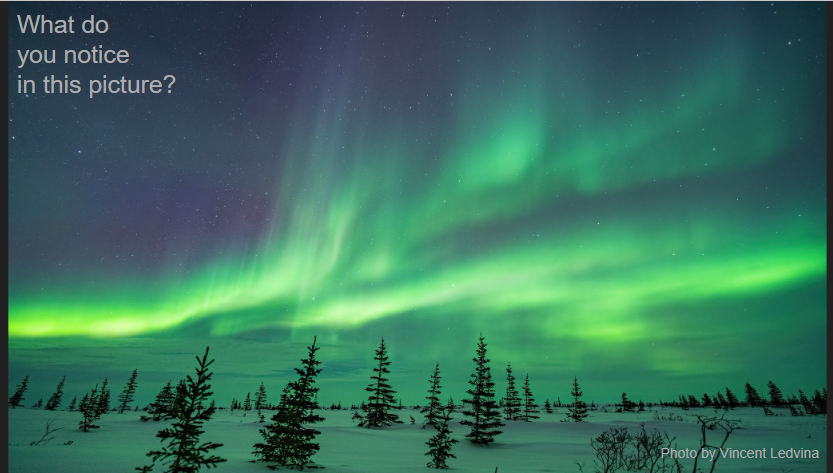
It gives the audience an opportunity to share their thoughts, adds interactivity to the presentation, and helps develop rapport by encouraging engagement. VTS is particularly strong for aurora presentations when combined with the next technique.
Entrance and Exit Narratives
Many people have a story of how they fell in love with the aurora. Perhaps they saw it in person or were mesmerized by a picture. Maybe a friend told them about it, or they read about it in a book. When they come to a presentation, they bring with them stories, knowledge, and emotional connections. For example,
“Museum visitors are not ‘blank slates’ on which we write. They attend a museum or an exhibition usually because they already have some level of interest in the subject and some knowledge and opinions about it. The internal story line that visitors enter with, which we can call their ‘entrance narrative,’ has three distinct components:
- a basic framework, i.e., the fundamental way that individuals construe and contemplate the world
- information about the given topic, organized according to that basic framework
- personal experiences, emotions, and memories that verify and support this understanding” (Doering and Pekarik, 1996).
By the same token, when people have experienced a presentation and leave, they carry with them an “exit narrative” that includes all they learned and felt during the presentation. As facilitators, we can learn a little bit about their entrance and exit narratives by asking our audience the same question at the beginning and end of a presentation, and seeing how their responses change.
This benefits the presenter:
- A core motto of informal education is “Know Your Audience.” When we’re giving a presentation to strangers, we can use the entrance and exit narrative technique to find out more about them so that we can tailor the information we present in real time.
- It demonstrates to the audience that we are interested in them and builds rapport.
- We can use it as an informal evaluation of our presentation. How did their answers change from entrance narrative to exit narrative? What does that tell us about things to keep or change for next time?
It also benefits the audience:
- Entrance and exit narratives provide opportunities for participation so that the presentation is more of a collegial, two-way conversation and less of a didactic, one-way lecture. This helps make the presentation more interesting and memorable.
- This technique helps the audience recognize their own growth. People are often surprised by how much they have picked up between the entrance and exit narrative questions.
I like to combine entrance and exit narratives with VTS by showing the same photograph at the beginning and end of a presentation, combined with the VTS question set. It works well: for example, an entrance narrative of “I see a lot of green” can become an exit narrative of “the aurora is green because it is made of oxygen, and that tells us how high up it is.” Participants tend to get excited because they feel more knowledgeable on a subject that interests them, and are able to communicate that knowledge.
Another technique that we use at Aurorasaurus to get a sense for entrance narratives in larger groups is a quick show of hands:
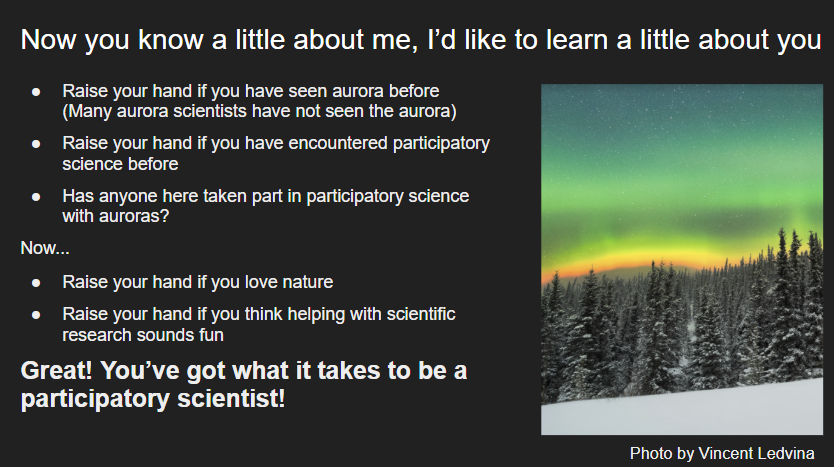
While we don’t find out everyone’s individual entrance narratives, this gives us a better sense for the audience as a group in terms of experience with auroras and participatory science.
Aurorasaurus Ambassador Beth Miller has a set of questions that she uses to learn about the entrance narrative of her audience. She starts simple by asking:
- How many of you have seen the northern lights/aurora?
- How many of you have seeing the northern lights/aurora on your bucket list?
Then, depending on the audience and time, she asks for further details. For example:
- Who lives in a location where seeing the northern lights/aurora is relatively common?
- Who has traveled/wants to travel to a “distant” location to see the northern lights/aurora?
- Why is seeing the northern lights/aurora important to you? What do you find fascinating about them?
- What’s the weirdest thing you’ve heard/read about the northern lights/aurora?
- If you could pick just ONE thing you would want to learn from this presentation, what would that be?
- Does anyone have an unusual northern lights/aurora story they’d like to share?
Setting aside a few minutes at the beginning and end of your presentation to engage with your audience can help everyone connect more deeply.
Object Facilitation
As the high-altitude, visible representation of invisible magnetic fields, auroras are not tangible objects. That said, we can apply some of the techniques of object facilitation to examining auroras.
When I worked in museums, John Hennegar Shuh’s classic article “Teaching Yourself to Teach With Objects” was one of the first things I gave new education hires. It’s a fun read that features turtles and hamburger boxes, and is also one of the quickest ways to access the kind of thought process that comes with informal education. Shuh approaches objects with humble curiosity, asking students what they notice and responding with more questions. This approach not only provides students with information about a subject, but “it gives them the chance to develop their capacity for careful, critical observation of their world” (Shuh, 1982). While we can’t pick up the aurora or ask what it feels or smells like, we can apply these principles with questions like:
- How would you describe an aurora?
- What do you notice about its color?
- If you have already discussed how auroral colors occur, you can follow up with “What are some things that the aurora color tells you?”
- What do you notice about its shape?
- If you are looking at the aurora live or on a video, you could follow up with “What do you notice about the way it moves?”
- What else do you see?
- If you are out chasing aurora, you could expand this to include other senses. “What does the air feel like?” “Do you notice any changes in the sounds around you (animals, other sounds?)”
- To include other senses beyond the visual, you could provide sonifications of aurora, recordings of ham radio signals bouncing off aurora, or a 3D Printed Magnetosphere Model.
- What are some things that make auroras important to humans?
Each of these questions can lead to a deeper discussion, and they are particularly useful when applied to entrance and exit narratives.
There are no wrong answers
In informal education, we are often a person’s first deep encounter with our subject. Because we provide that early impression, we have the power to either fuel or snuff out the spark of interest. For this reason, we always want to encourage people to engage with the subject and are careful never to shut them down or make them feel stupid or embarrassed.
There are two parts to this practice: we ask questions that don’t have right or wrong answers, and we validate all responses we receive. It can sound a little scary at first (no one wants to affirm something incorrect), but keeping our approach open ultimately leads to deeper connections.
Notice that in each of the above techniques, the questions are worded such that there is nothing to get wrong. If I ask, “what do you notice?” a participant may notice something that I’ve never seen, or interpret something in a way I would not. But I didn’t ask for a scientifically correct answer, I asked for their perspective.
By inviting participation rather than posing a right/wrong quiz question on a subject they’ve come to us to learn about, we affirm that they are welcome and that engaging with us and the subject matter won’t be scary or embarrassing. This is especially important with a topic as complex as auroras. It takes courage to speak up in a group, especially to an expert, and our goal is to acknowledge and appreciate that courage so that they will continue to be part of the learning. In addition to paraphrasing, we can encourage the thought process itself. For example:
- You’re thinking deeply about auroras
- You are connecting auroras with your own experience
- That’s an interesting way of looking at auroras
By validating participation, we can encourage more people to share the love of auroras and to feel comfortable delving more deeply into the amazing science behind it.
I hope these techniques help with your next presentation! If you use and build upon them, we’d be interested to know. Tag us on social media (X/Twitter or Facebook) or drop us a line by email.
References
Doering, Zahava D. & Pekarik, Andrew J. (1996) Questioning the Entrance Narrative, Journal of Museum Education, 21:3, 20-23, DOI: 10.1080/10598650.1996.11510333
Hennigar Shuh, John. “Teaching Yourself to Teach with Objects.” Journal of Education 7(4) (1982): 8-15.
Housen, A. (2002). Aesthetic Thought, Critical Thinking and Transfer. Visual Understanding in Education. Arts and Learning Research Journal, 18, 99-132.


