By Laura Edson, MAT in Museum Education
When I first joined Aurorasaurus six years ago, I had a steep learning curve ahead of me. I’d struggled with algebra and calculus in high school, I hadn’t touched physics for 15 years, and words like “magnetohydrodynamics” were pretty intimidating. I was able to learn because Dr. Liz and my colleagues met me where I was and patiently walked me through the content I needed to know, step by step. It’s a gift that I will always appreciate, and is built on solid educational theory.
When presenters introduce the aurora to the public, they are likewise often walking members of the audience into unfamiliar science. This can make participants apprehensive; about 93% of American adults report experiencing some level of math anxiety, and 54% of American adults have low literacy skills. As presenters, we have the power to fuel or extinguish a participant’s spark of interest, so the way that we approach engagement is critically important. In this post, we’ll walk through some best practices for presenting to the general public.
Knowing our audience
What does it mean to serve the general public? Generally speaking, the public refers to a broad group of people: anyone and everyone, including kids, adults, and multigenerational groups, from a variety of backgrounds and with a range of experiences. An important piece of informal education (any form of learning outside a classroom) is remembering that participants took time out of their lives to seek out what they can learn from you: they chose to spend time with you. It’s both an exciting opportunity and a big responsibility to make sure they are glad they did.
In my grad school program, we learned as informal educators in the US to aim public materials to a 5th-8th grade level regardless of the age of your audience. We act as translators between subject matter experts and the public: choosing a broad level helps us be understandable to a range of ages, life experiences, multilingual approaches, experts in other fields, etc. We want to be sure that our written materials, especially, are comprehensible at that level.
Tip: A quick way to check reading level is a readability checker, which will give you a grade level score.
Make it easy to understand
Everyone uses jargon, or technical terminology, to talk with colleagues, fellow aurora chasers, etc. In some contexts, especially among people who use the same jargon, it can make someone seem authoritative or knowledgeable. However, it is not as useful when working with the public.
“Speaking in a ‘language’ which only a few people can understand will always make people feel unwelcome or even ‘not-smart enough’ to be part of the conversation. Jargon will always, unintentionally, alienate an audience that you are having conversations with. It can also lead to misunderstanding or a misconception if people can’t follow or understand what you are trying to talk about” (Lickley, 2025).
When introducing a new subject, important goals are to convey information as accurately as appropriate, and avoid making learners feel stupid or embarrassed. Learning to translate jargon to plain language takes practice, but being able to discuss a topic in a range of ways is a useful skill. A good example is WIRED 5 Levels of Science, in which an expert explains a topic in ways that are geared toward five different audiences.
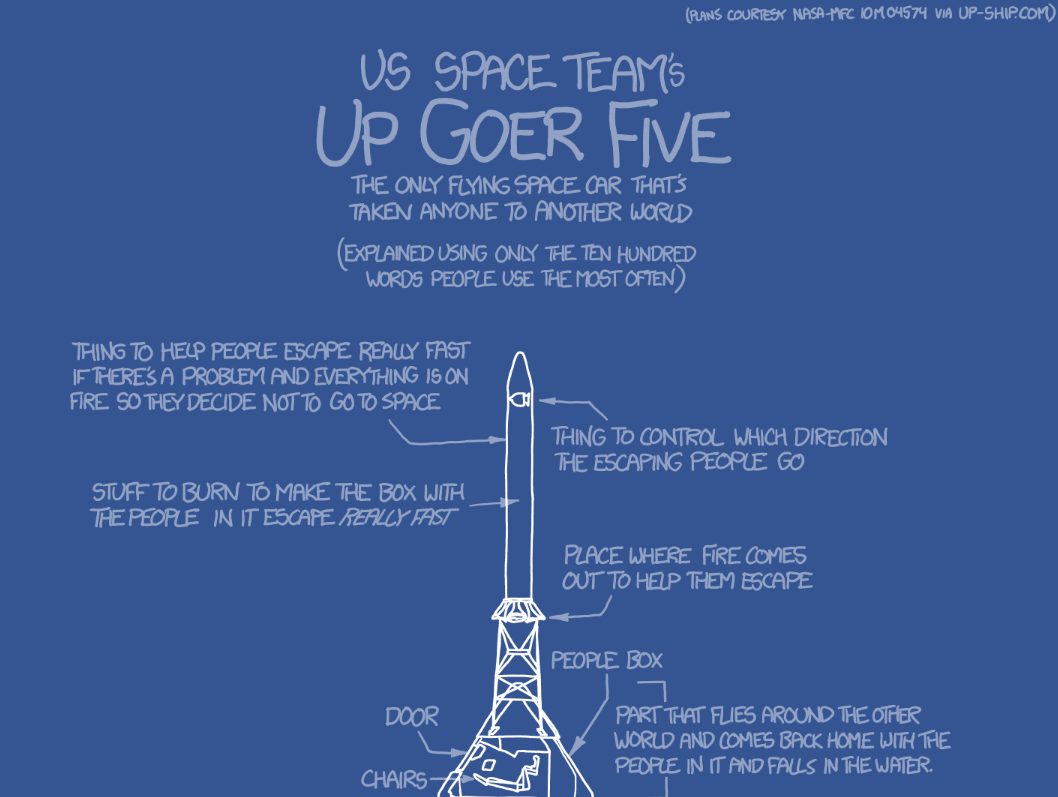
A fun way to practice plain language translation is to try the Up Goer Five Challenge. This activity is based on an iconic xkcd comic that presents the Saturn V rocket as “Up Goer Five” using the thousand most common words in the English language. The challenge to “explain your science” with common words is often done at scientific conferences like AGU and EGU. You can check out some examples of aurora science Up Goer presentations on our blog. Up Goer oversimplifies vocabulary a bit too much for conversation, but by doing so provides the opportunity to be thoughtful about what can be added back in.
A rule of thumb is to introduce 1-3 new vocabulary words per presentation: beyond that, listeners can get overwhelmed and tune out. Learning to translate to plain language provides the opportunity to select the most important new vocabulary words. For example, if you want to introduce a big word like “magnetohydrodynamics,” keep the language around it simple so that your audience feels more confident.
We know this is a huge challenge for aurora concepts! If premade language would be helpful, please feel free to draw from the Aurorasaurus blog, especially our aurora terms glossary. These descriptions have been developed by both science and education subject matter experts with the goal of being resources for engagement.
A plain language description of how auroras form that can be used in public presentations.
Scaffolding is key
When constructing a building, workers put up scaffolding around the building site. The scaffolding gets taller with each successive floor, but the lower floors have to be built first. This serves as a classic metaphor for education. Learning happens in stages, and knowledge must be built from the ground up. Just as you can’t build the second floor of a building without the first, you can’t communicate a complex topic without foundational principles. In education this is called “scaffolding.” Another way to think of it is like climbing a staircase: it’s important to take one step at a time. If you try to jump too many at a time, the learner trips and doesn’t grow.

Psychologist Lev Vygotsky imagined this idea as three zones. One zone consists of the things that a learner could do unaided. In another were the things a learner could not do. Between the two was what he called the Zone of Proximal Development (ZPD): things that a learner could do with help. Ideally, the ZPD is always shifting as a learner grows. An educator’s goal is to find the ZPD and help the learner grow so that they can do more unaided.
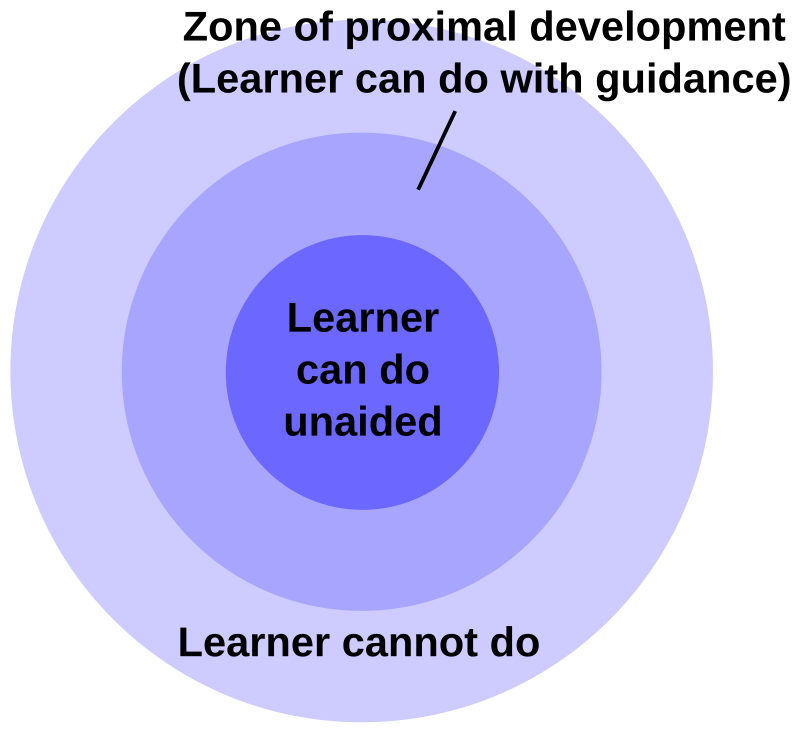
When Dr. Liz and my colleagues helped me learn about aurora physics, they were practicing scaffolding. They found my ZPD and we kept expanding it until I was able to confidently present about auroras and answer most questions. It’s also entirely okay to respond to a question with “I don’t know, I’ll get back to you.” It demonstrates that no one knows everything, and that even experts continue to learn. I’m still growing and learning; shifting the ZPD is a neverending process.
Likewise, learning on the Aurorasaurus website is scaffolded.
- The Learn section is written at a basic level.
- The blog is aimed toward a beginner-intermediate audience
- The YouTube channel is more intermediate and provides deep dives into a variety of topics.
One easy way to reach the next Zone of Proximal Development is to tie what you’re talking about to things that a learner already understands through analogies. These work best when they link the topic to common, concrete things rather than abstract concepts. It’s okay if an analogy isn’t perfect; it doesn’t need to represent everything about the topic you want to explain. Best practice is to choose 1-2 aspects to illustrate, and be specific.
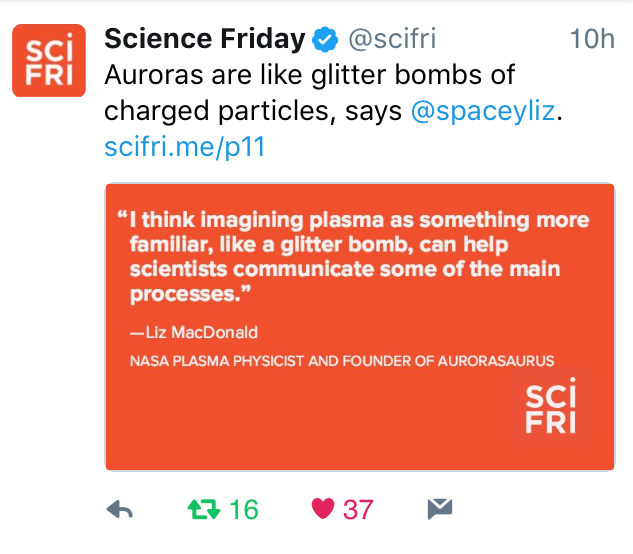
An aurora is like glitter in that it is made of many tiny pinpoints of light that rain down, and that’s plenty for the metaphor. The two things don’t need to be created in the same way, or function using the same physics. Saying to your audience, “just like something glittery, when you look at the aurora you see many tiny points of light” provides an evocative illustration that helps people understand an aspect of how the aurora works.
When introducing the general public to the aurora, we have a golden opportunity to stoke their interest, clear up misconceptions, and help them feel comfortable in participatory science. Using proven techniques from the field of informal education can help with accomplishing all of these, as well as giving a great talk. Especially for auroras, the explanations continue to deepen, and we continue to learn more as expertise grows.
I hope these techniques help with your next presentation! If you use and build upon them, we’d be interested to know. Tag us on social media (X/Twitter or Facebook) or drop us a line by email.


