The AU ribbon is a classroom-sized model of the distance between the Earth and Sun that can be used for demonstrations and activities in classroom and informal education environments, with students middle school age and up. It can also serve as a demo that a student can create for an assignment, science fair, or other presentation. As with any activity involving a long ribbon, use safely and with adult supervision.
Why does a solar flare’s light reach Earth in a matter of minutes, while aurora-causing solar wind and coronal mass ejections take days? While the short answer is the speed at which these different phenomena travel the huge distance between the Sun and Earth, it can be hard to truly imagine this expanse. Fortunately, with a few simple materials we can illustrate the scale of the 93 million miles* between the Earth and Sun, also known as 1 astronomical unit (AU).
Materials
- About 26 ft or 8 3/4 yards of natural or white cotton twill tape (these are usually sold online inexpensively in rolls of 50+ yards. The demo photos are of 2” wide natural cotton twill tape.)
- Permanent markers in a variety of colors
- Fabric labels (stickers similar to Avery 40720)
- Measuring tape or yardstick
- Scissors
- Optional: school glue or clear nail polish to prevent the twill tape fraying
- Optional: our handy dandy calibration calculator to help you measure distances and mark objects along the AU ribbon. Metric calculations are included

How to Make the AU Ribbon
- First, we want to calibrate our twill tape. In weaving, thread goes in two directions: the warp, which are the very long strands that run the length of the tape; and the weft, which is woven in along the shorter axis. For this demonstration, we are mostly concerned with counting rows of weft, each of which represents 10,000 miles.
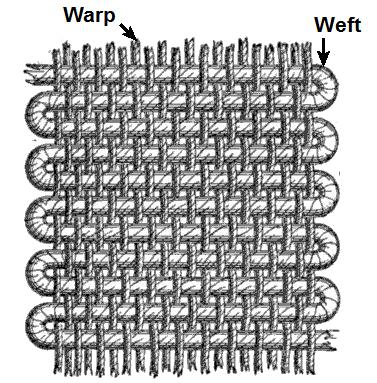
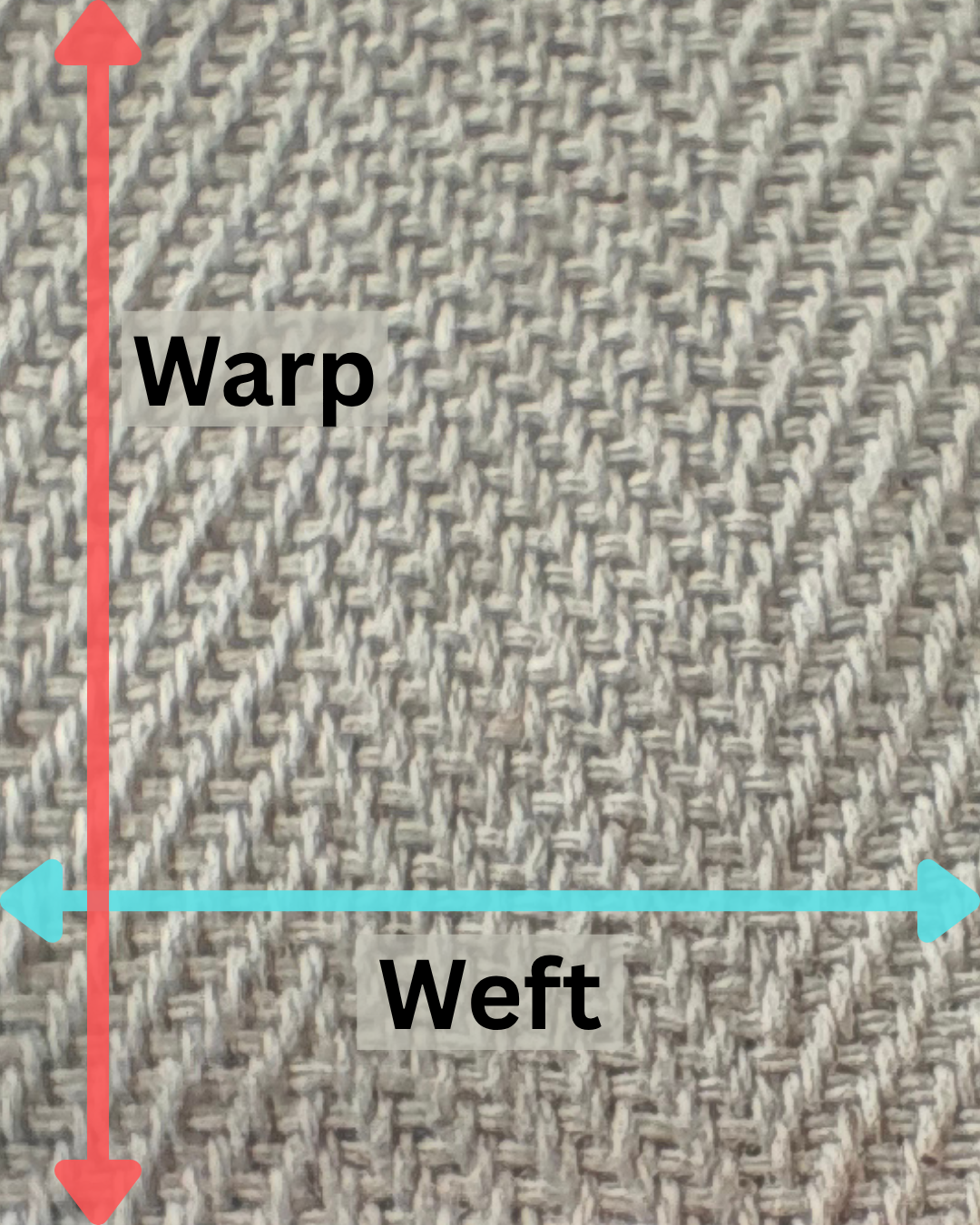
- Measure 1 inch along your twill tape and count the rows of weft. Mine totaled about 30, but yours may vary. If your number varies, use the calibration calculator to adjust the numbers for instructions 4 and 8 below.
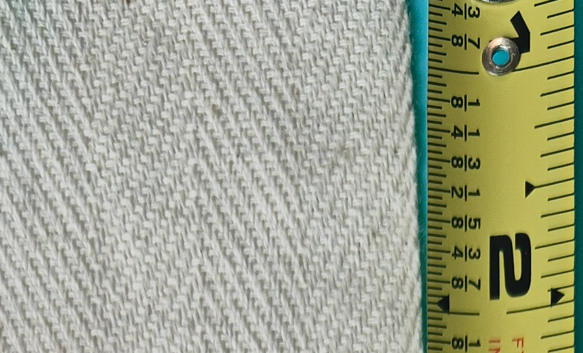
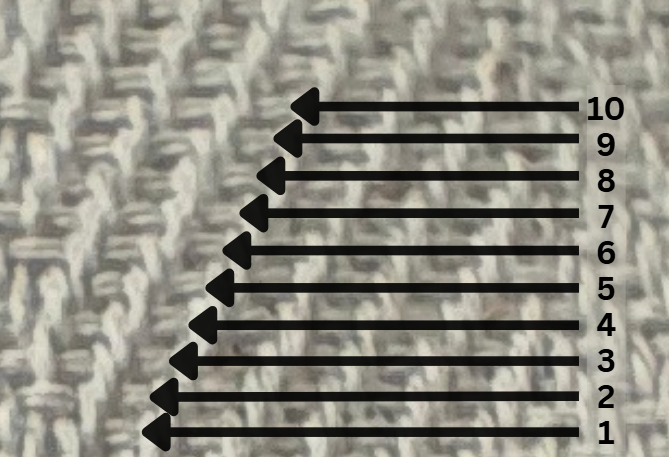
- Each row will represent 10,000 miles distance. For reference, if we think in terms of distance on Earth, 10,000 miles is about the distance from London, UK, to Perth, Australia. If we think in terms of altitude, 10,000 miles away is in space.

The Earth on Nov. 9, 1967, taken by the uncrewed Apollo 4 spacecraft as it orbited about 10,000 miles away from Earth. Credit: NASA - Next, work out how much twill tape we need. You can use the calibration calculator for this, or do the math by hand.
Showing our work:
- If 1 row is 10,000 miles and there are 93,000,000 miles between the Earth and Sun, we need a total of 9,300 rows. (93,000,000/10,000=9,300)
- If 1 inch of twill tape has 30 rows, we need 310 inches of twill tape. (9,300/30=310)
- This comes out to 25.8 feet (310/12=25.8) or 8.6 yards (25.8/3=8.6) of tape.
- For reference, if 1 inch = 30 rows, 10 inches = 300 rows (10*30=300). If 1 row = 10,000 miles, 10 inches = 3,000,000 miles (300*10,000=3,000,000)
- Measure and cut the tape to 26 feet. One way to do this is to lay out both the twill tape and measuring tape. Line up the starting edge of both, and measure a length shorter than your armspan. Make a small pencil mark at that length. Then, move the twill tape so that the mark is at the start of the measuring tape, and measure and mark the length again. Repeat as needed until the lengths you have measured and marked add up to the total length you need. Remember: measure twice, and cut once.
- Carefully trim the starting end of your twill tape so that you have an undamaged stripe of weft. Optionally, dab a little glue or nail polish on this neat end to prevent fraying. This will be the Earth end.
- With a permanent marker, carefully color in just the first stripe of weft. This will represent Earth. Starting with the Earth row, count four rows and mark the weft with a different color (refer to the purple line in the image below.) This will represent the edge of the Earth’s magnetic field, the Sun-facing magnetopause. From the Earth row, count and mark the 24th row in a different color (the yellow line in the image below.) Add fabric labels to denote each mark as shown.
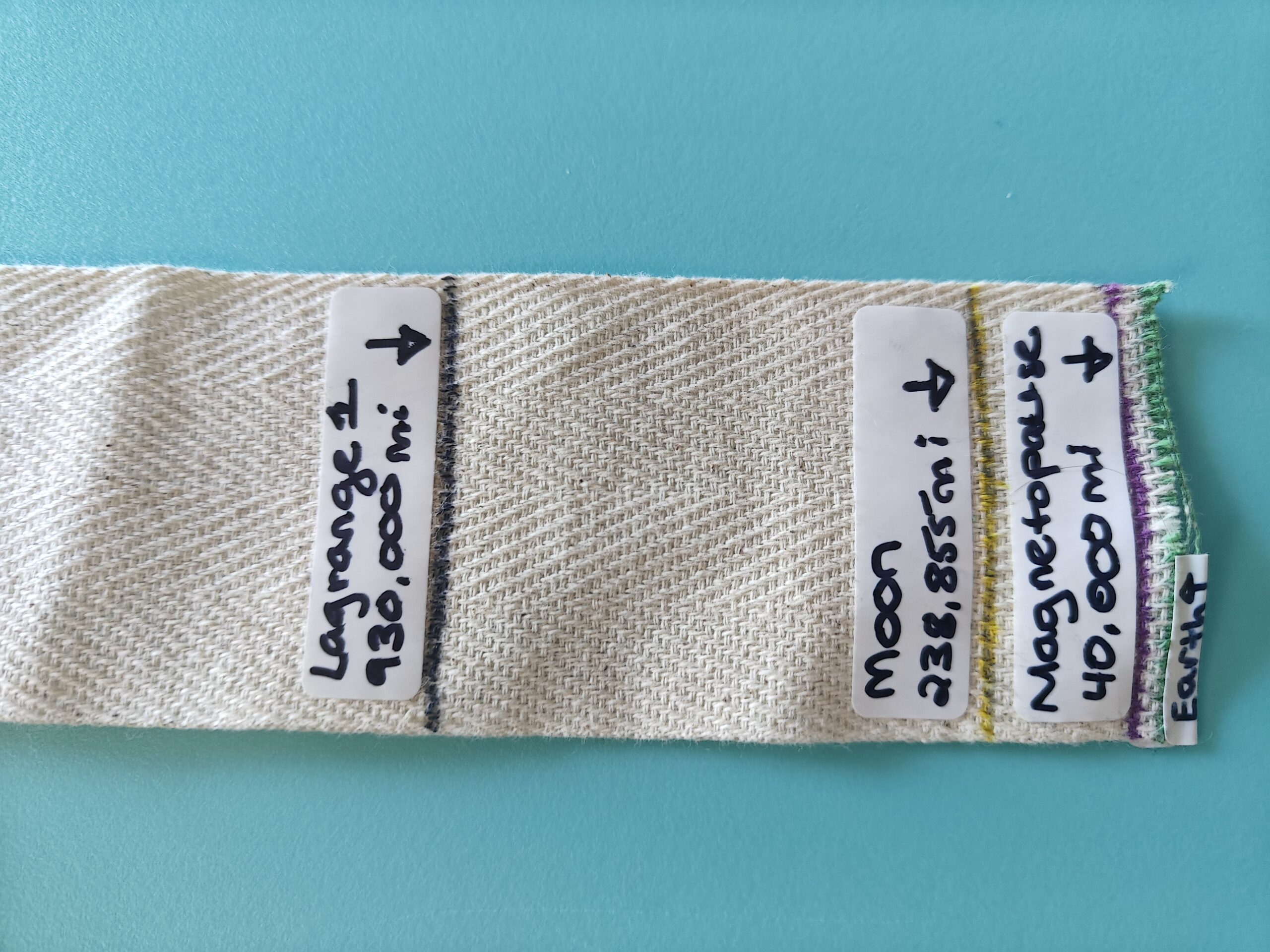
- Continue to measure, mark, and label the following objects. When row counting becomes impractical, you can approximate by measuring in inches with your measuring tape. At 30 rows per inch, I marked at the following distances, but you can recalculate yours with the calibration calculator.
| Object | Distance from Earth | Row | Measurement (at 30 rows per inch) |
| Earth | 0 | 1 | 0 in |
| Magnetopause (Sun side), the edge of the Earth’s magnetic field | 40,000 miles | 4 | 0.13 in |
| Moon | 238,855 miles | 24 | 0.8 in (measure to ¾ inch, then go one row further) |
| Lagrange Point 1 (L1), where the SOHO, ACE, DISCOVR satellites live. | 930,000 miles | 93 | 3.1 in |
| Venus | 24,000,000 miles at nearest approach | 2,400 | 80 in, which is 6.7 ft or 2.2 yds |
| Mercury | 48,000,000 miles on average | 4,800 | 160 in, which is 13.3 ft or 4.4 yds |
| Parker Solar Probe | 88,765,000 miles at its closest approach to the Sun | 8,877 | 296 in, which is 24.6 ft or 8.2 yds |
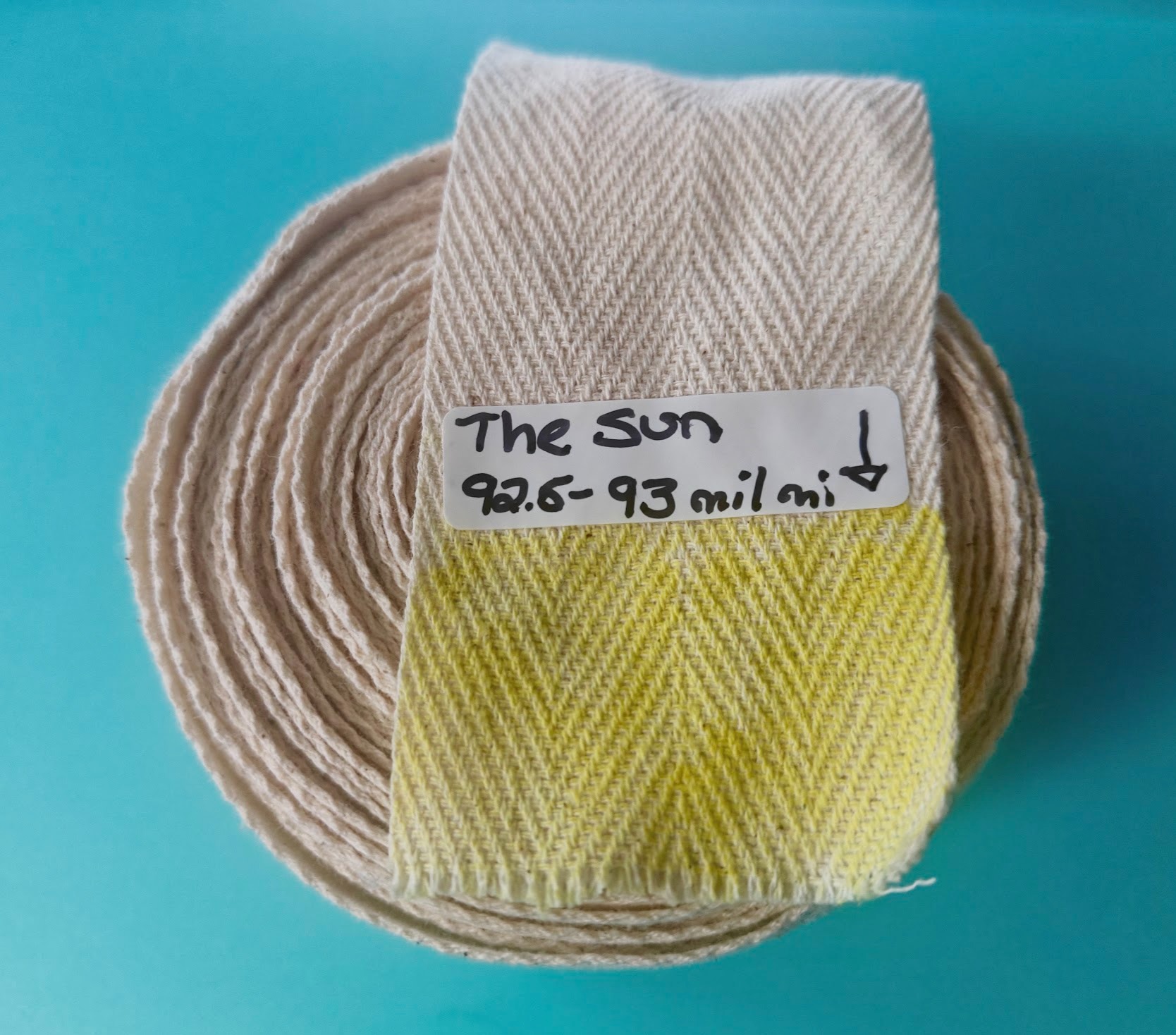
| The Sun | 92,565,000 miles at the surface of the Sun to 93,000,000 miles at the center of the Sun | 9257 to 9300 | 308.6 to 310 in, which is 25.7 to 25.8 ft or about 8.6 yds, and about 1.4 in long |
- When you have marked the Sun, carefully cut any extra rows beyond the marked area off the end, being careful so that you have an uninterrupted weft, and optionally add glue or nail polish to keep the edge from fraying. You’ve completed your AU ribbon!
What does this have to do with auroras?
When space weather leaves the Sun, we are often asked when it will arrive and what it will be like when it does. Solar flares, which do not directly cause aurora, are flashes of light, and therefore take only about 8 minutes to reach Earth at the speed of light. While the solar wind and coronal mass ejections (CMEs) can travel quite fast, they are slower than the speed of light as theyare made of much heavier charged particles. They can drive the formation of auroras, but usually take 2-3 days to travel between the Sun and Earth. That said, 93 million miles is such a huge distance that it’s extremely difficult to picture exactly how fast a solar storm can move. Breaking it down into imaginable quantities like 10,000-mile increments can help to drive home the incredible journey that space weather undertakes, as well as the awe-inspiring celestial power of the Sun.
The AU ribbon also helps to explain why space weather prediction is such a complex and critical science, and demonstrates how impressive space weather forecasters are. Space weather forecasting is a career that uses physics, math, measurements from amazing satellite instruments, and computer models to estimate the arrival time and characteristics of solar storms so that we can protect technology at Earth. Space weather forecasters measure space weather as it leaves the Sun, and then again as it arrives at a special point near Earth called Lagrange Point 1 (L1), but there are currently no dedicated satellites that monitor the huge distance in between. We sometimes explain that it takes time for the solar wind or a CME to travel from the Sun to the Earth, and as on a long roadtrip, a lot can happen along the way to speed it up or slow it down. It’s easy to mentally skip over that distance until it is demonstrated as a visual or tactile.
Activity ideas
- Demonstrate the distance: ask for a volunteer to hold the Earth end of the AU ribbon, then slowly unfurl the length across the room, noting the labeled objects along the way. For example, based on how quickly the solar wind usually travels, L1 is about an hour away from Earth. Those who need a tactile way of engaging with the concept can experience it by touch.
- For reference, the farthest extent of the solar wind is about 80-100 AU from the Sun. Different scientists define the edge of the solar system differently. Some use the distance of the solar wind, and some use the farthest reaches of the Oort Cloud at the very edge of the Solar System, somewhere between 10,000 and 100,000 AU from the Sun. Considering the length of the AU ribbon, can you imagine this scale?
- Reenact a Coronal Mass Ejection (CME): ask volunteers to hold the Sun and Earth ends of the AU ribbon, stretched to full length. Ask for a volunteer to play a CME, a burst of mass and magnetism from the Sun. CMEs can move anywhere from less than 155 miles per second (250 km/s) to nearly 1,860 miles per second (3000 km/s). Very fast CMEs can take 15-18 hours to arrive at L1, while slower CMEs can take 2-3 days. Ask the CME volunteer to walk slowly and then more briskly from the Sun end to the Earth end of the AU ribbon.
- Reenact space weather prediction: ask volunteers to hold the Sun and Earth ends of the AU ribbon, stretched to full length. Ask for a volunteer to be the space weather forecaster, and a volunteer to play the CME. When a CME leaves the Sun, space weather forecasters get a brief glimpse of it from a satellite called SOHO.
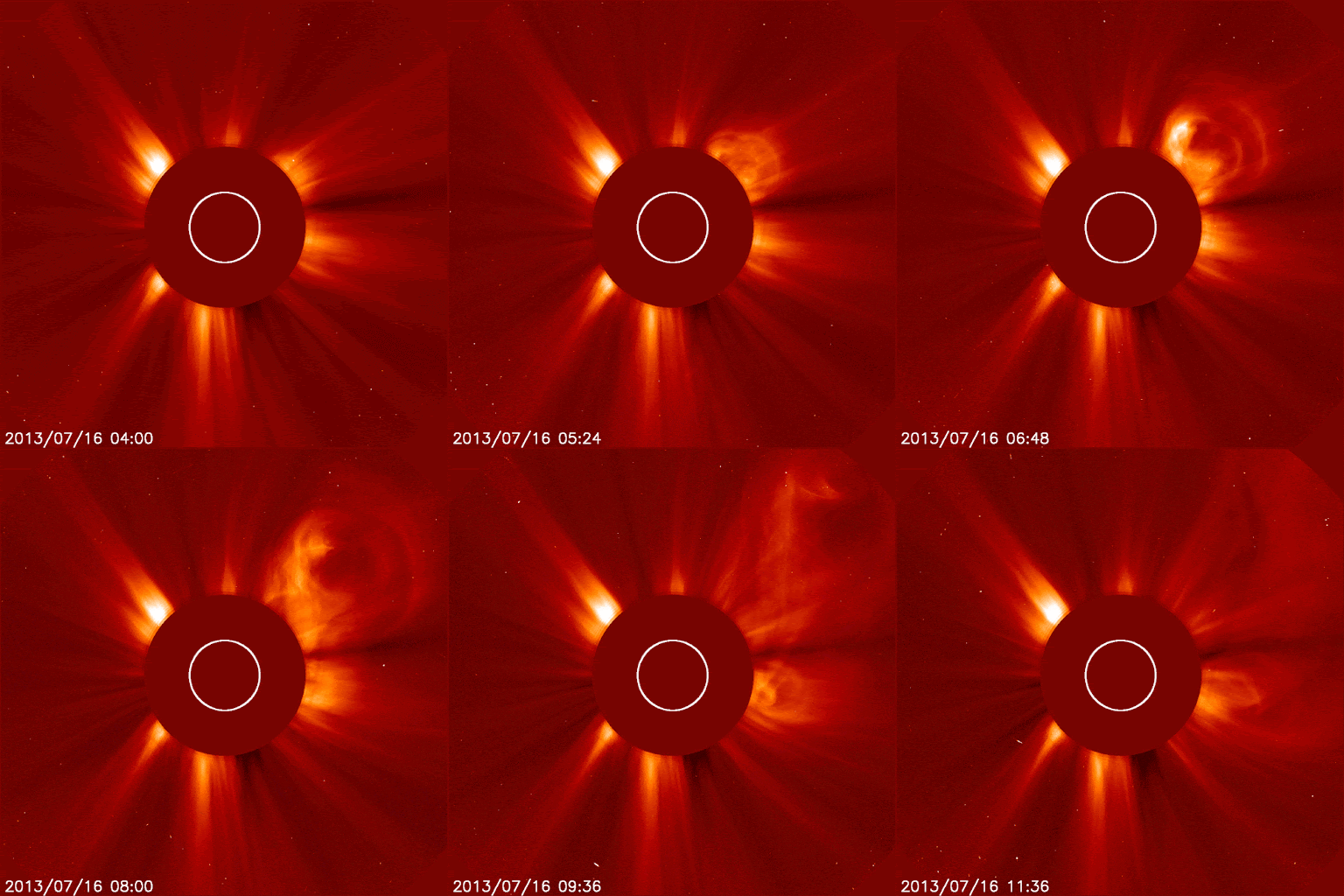
The European Space Agency/NASA Solar and Heliospheric Observatory (SOHO) captured this imagery of a coronal mass ejection as it left the sun in the direction of Earth and Mercury on July 16, 2013. Image by ESA&NASA/SOHO
Space weather forecasters use computer models, scientific research, satellite measurements, and knowledge to estimate when CMEs will arrive.- Ask the CME to start walking from the Sun to the Earth at a steady pace, running their hand along the AU ribbon. The space weather forecaster may watch the CME for a count of two seconds, conceptually representing the view from SOHO. Then, the space weather forecaster must turn around and close their eyes while the CME approaches. The space weather forecaster will clap when they think the CME has reached the spot marked L1 on the AU ribbon. You can rotate who is playing the CME, and who is playing the space weather forecaster.
- Variation: CMEs don’t always move at a consistent speed, as they run into solar wind, matter, and energy in the space between the Sun and Earth. Ask the CME to start tiptoeing from the Sun to the Earth, but this time the CME can speed up or slow down along the way. The space weather forecaster still only gets a two-second view, and must clap when they think the CME has reached L1.
- Variation: Sometimes multiple CMEs happen in succession. Ask for 2-3 volunteers to play CMEs. One by one, CMEs start approaching the Earth. Each must stay behind the CME in front of them and keep their hand on the AU ribbon, but they can spread out or bunch up as they choose, as each moves at a different speed. Have the space weather forecaster guess again.
Math challenge: have students use basic algebra to calculate the speed of CMEs
- CMEs can move at different speeds, and one task of the scientists who study them is to calculate their arrival times. Using three real-life CMEs that drove major aurora storms, students will use the formula s=d/t (speed equals distance divided by travel time) to calculate the speed of each CME.
- d= the distance between L1 and the distance of the surface of the Sun: 91,635,000 miles. You can use the AU ribbon to find the surface of the Sun and L1, which are close to each end, then stretch out the ribbon to illustrate the distance between the two points.
- Provide the following real-world examples to students:
- May 10-11, 2024 aurora storm: one of several CMEs left the surface of the Sun on May 8, 2024 at 12:24 UTC and arrived at L1 52.2 hours later.
- This CME likely combined with several others and together triggered the famous Gannon storm.
- Answer: s=d/t, s=91,635,000/52.2, s=1,755,459.8 mph or 1.8 million miles per hour!
- Oct 10-11, 2024 aurora storm: a CME left the surface of the Sun on October 9, 2024 at 02:12 UTC and arrived at L1 36.6 hours later (t=36.6).
- This CME sparked a widely viewed aurora storm.
- Answer: s=d/t, s=91,635,000/36.6, s=2,503,688.5 mph
- January 19-21, 2026 aurora storm: a CME left the surface of the Sun on January 18, 2026 at 18:09 UTC and arrived at L1 24.8 hours later (t=24.8).
- This was an unusually fast CME that was measured by a spacecraft at L1 as going ~1000 km/s, which is ~2,237,000 mph.
- Answer: s=d/t, s=91,635,000/24.8, s=3,694,959.7 mph
- May 10-11, 2024 aurora storm: one of several CMEs left the surface of the Sun on May 8, 2024 at 12:24 UTC and arrived at L1 52.2 hours later.
We have not tested this activity with learners yet, but we’d love to hear from you if you have any feedback.
*Please note that while we calculated the math in this post in miles, it can also be converted to kilometers. Because we are working with very large numbers, everything about this project is an approximation, not an exact representation. We are looking to get a feel for enormous distances rather than create a perfect scale model.


