Aurora 101
by the Aurorasaurus Team
The entries below are beginner-level starting points to explore complex subjects, so there are links in each for finding out more. Be sure to also check out the growing Heliopedia! For an intermediate-level list of definitions, visit the SWPC Space Weather Glossary. It’s also important to note that while Aurorasaurus is writing from the context of Western science, there are many ways of knowing about the aurora.
Let’s get started with some basic terms used by aurora chasers and citizen scientists.
|
|
Aurora chaser: A person who loves to watch the Northern or Southern Lights. They like to stay up late at night, find a safe place with a good view of the sky, and watch the aurora. Sometimes they drive long distances to find good places to watch the Northern or Southern Lights. Some aurora chasers are skilled at photographing the aurora. They capture beautiful and scientifically useful photos! |
|
|
Astrophotography: the practice of taking pictures of the night sky, including auroras. Chasers also talk about taking pictures of the stars when no auroras are visible. Even without a fancy digital camera, adults or students accompanied by adults can still take part! Check out this free smartphone astrophotography guide from NASA. |
 Citizen scientists and Aurorasaurus Ambassadors Vincent Ledvina and Andy Witteman chasing auroras in Alaska. Photo by Vincent Ledvina |
Citizen science: NASA’s citizen science projects are collaborations between scientists and interested members of the public. Through these collaborations, volunteers (known as citizen scientists) have helped make thousands of important scientific discoveries. The term “citizen science” is in the process of changing and we are interested in its evolution to something more inclusive. For example, one misconception about citizen science is that you have to be a citizen to participate—anyone can take part! As that conversation is actively underway, we will use NASA’s term for this post. |
|
|
Aurorasaurus: A collaborative science project that maps the aurora in real-time using volunteer reports. This helps scientists with aurora data, and helps the public see whether and where the aurora is shining in real time. The project has made a number of discoveries, including that social media is effective for detecting large natural events; that crowdsourcing the verification of citizen science data works; and that space weather alerts are more accurate when combined with citizen science data. |

Aurora chasers tell us that one of the things they love most is that each aurora is different.
To make this wide variety easier to study, scientists classify the Lights into different types. Here are some basic categories—but there are many more types!
|
|
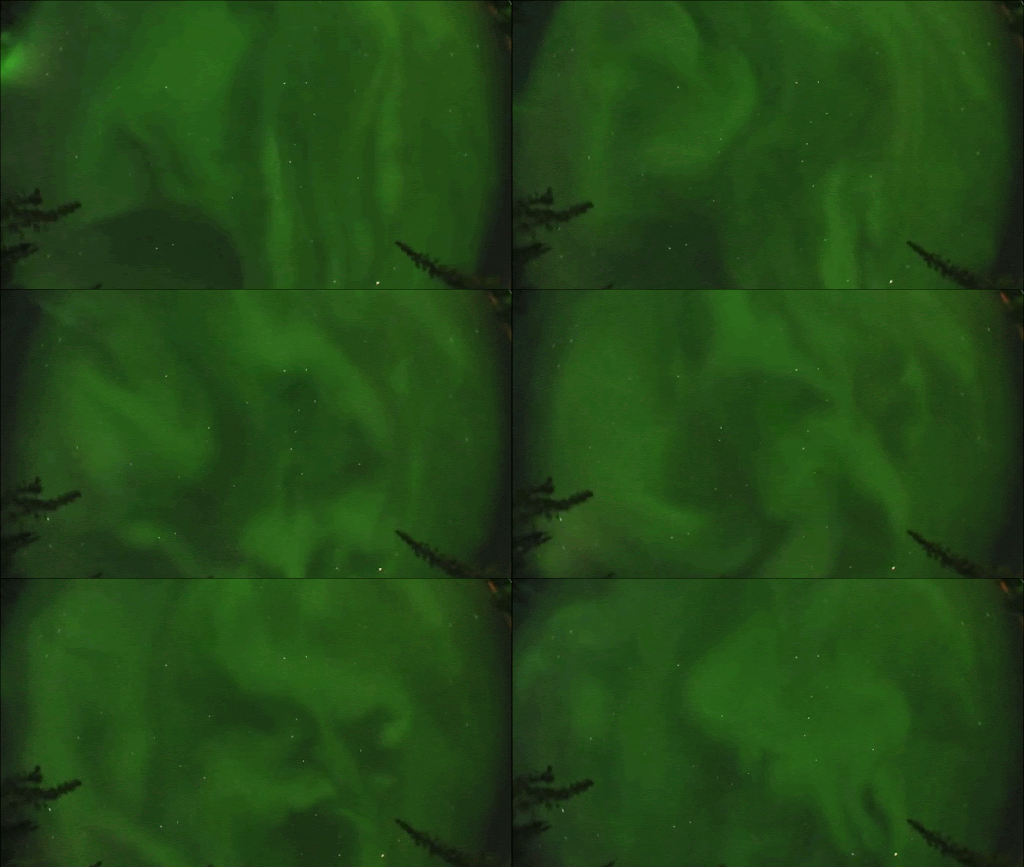
Diffuse aurora: these usually have little motion, are quite dim, and might even be confused with clouds. (But if you can see stars through the glow, then it is likely an aurora, not a cloud.) They can be green, whitish, or blood red and spread over a wide area, typically closer to the equator than the “discrete” auroras described below. Diffuse red glows can be visible at great distances because they are so high in altitude. |
|
|
Discrete aurora: Discrete auroras are bright thin bands — most common pictures of auroras are of this type. They typically have a definite lower border and can stretch high into the sky, like curtains, when viewed from the side. From below they are very narrow. They can wave slowly or race across the sky, particularly on the part closest to the Earth’s nearest pole. They are broadest, brightest, and/or most active around midnight local time! We ask about types of aurora on our collaborative science report form, because each is caused by a different process. |
|
|
Pulsating aurora: diffuse auroras can have pulsating patches which occur on the equatorward side of the auroral oval and turn on and off every few seconds. Video photography may be best for seeing them. They also have irregular shapes that reappear. They are quite dim and usually occur late in the night/early in the morning, after the main arcs have subsided. Some of what causes these unique shapes is unknown. |
|
|
Subauroral phenomena: these occur closer to the Earth’s equator than regular diffuse or discrete auroras and are more rarely studied; however, new cameras are aiding in documenting them. STEVE is an example of one type, and proton aurora is another. Keep reading to find out more about both! |
|
|
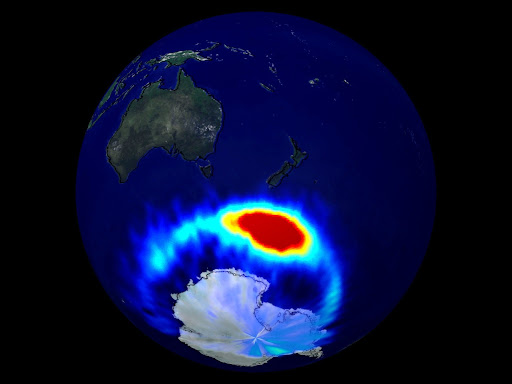
Proton aurora: a rare kind of aurora that is usually extremely dim to the human eye. Aurora chasers originally thought the mysterious STEVE might be some kind of proton aurora, but the differences between what they saw and proton aurora caught the interest of aurora scientists and led to research and discoveries. |
|
|
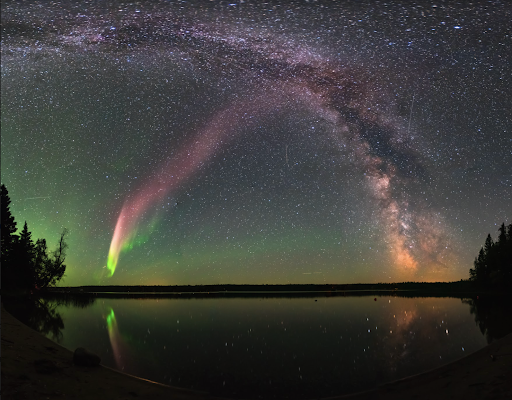
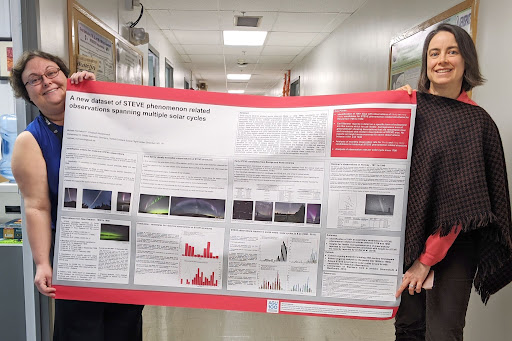
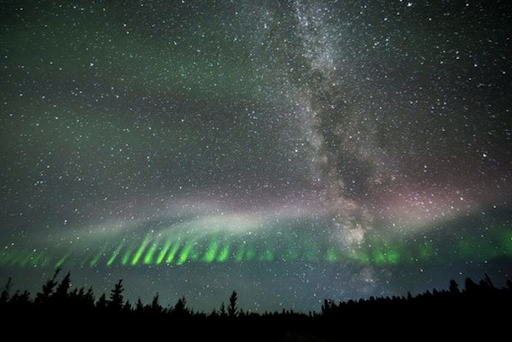
STEVE: a purplish arc with green stripy features that runs east to west and appears closer to the equator than regular aurora. The name “STEVE” stands for “Strong Thermal Emission Velocity Enhancement.” While this phenomenon has been observed for centuries by both laypeople and scientists, in 2018 a team of citizen scientists and scientists published the first scientific paper on it. Collaborations involving citizen scientists are still discovering new things!
A NASA video that describes the story of STEVE. |



We are often asked, “How can I see the aurora?”
In order to answer this question, let’s dive deeper into some of the science behind the Lights.

Space is not empty!
In our solar system, it is a soup of dancing plasma, carried by the solar wind.

|
Plasma: the fourth state of matter. When a gas is superheated, its atoms split apart into electrons (negatively charged) and “ions” (positively charged). The charged particles move on their own, dancing to magnetic fields in space. Some people call plasma “ionized gas.” While in our daily lives we might encounter it in fire, lightning, or electric sparks, it actually makes up the vast majority of the universe. Click here to listen to a podcast interview about plasmas in the universe with plasma physicist Dr. Doug Rowland! |
|
|
Solar wind: a gusty stream of material that flows from the Sun in all directions, all the time, carrying the Sun’s magnetic field out into space. While it is much less dense than wind on Earth, it is much faster, typically blowing at speeds of one to two million miles per hour. The solar wind is made of charged particles — electrons and ionized atoms — that interact with one another and the Sun’s magnetic field.
|

The Earth is surrounded by a magnetic bubble called the magnetosphere.
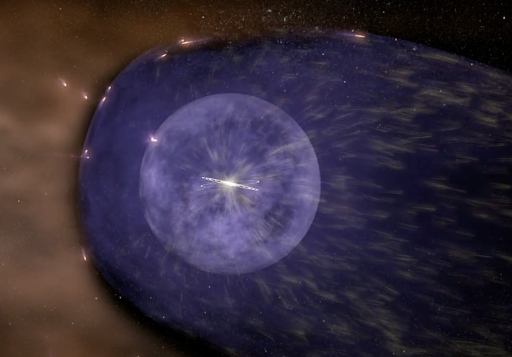
It exists inside a larger magnetic bubble called the heliosphere. This in turn is formed by the flowing “interstellar medium” of outer space.
|
|
Heliosphere: the space environment that originates in the Sun and surrounds the solar system. Made up of the flowing solar wind, which ultimately travels past all the planets to three times the distance to Pluto, the heliosphere is defined by the furthest reaches of the Sun’s magnetic field in space. The heliosphere is filled with radiation as well as magnetic fields that trail all the way back to the Sun. The heliosphere itself acts as a giant shield for the solar system, protecting the planets from radiation coming from the rest of space. The NASA Voyager 1 and Voyager 2 spacecraft flew to the edge of the heliosphere and beyond—click here to follow their ongoing adventures! |
|
|
Magnetosphere: the Earth has a magnetic field, or “magnetosphere,” with a north and south pole, kind of like a bar magnet or “dipole.” Solar wind plasma blows from the Sun and squishes the sunward side of our magnetic field. The plasma stretches the side farther away from the Sun into a long “magnetotail.” The magnetosphere’s outer boundary is where the solar wind meets the Earth’s magnetic field. Click here to explore an Aurorasaurus blog post about a 3D printed model of the magnetosphere, and find out more about how scientists study the magnetosphere here. |
|
|
Space Weather: there is weather on Earth, and there is weather in space. Instead of clouds, rain, or snow, it’s the way the space around Earth is always changing as the Sun sends energy, matter, and magnetic fields toward our planet. Scientists study and forecast these ever-changing conditions in the solar system. While the Earth’s magnetic field mostly protects the planet, some space weather can interfere with satellites and other technology. NOAA’s Space Weather Prediction Center (SWPC, pronounced “SWIP-see”) tracks space weather and issues alerts for a number of different customers. Some of these are relevant for Aurora chasers. Other agencies also employ space weather forecasters. For people who are interested in graphs and charts, a list of scientific space weather resources is available here. |


The terms “solar storm” and “geomagnetic storm” are often used to mean the same thing.
However, solar storms are shorter releases of matter, magnetism, and energy from the Sun, while geomagnetic storms are their longer-lasting effects on Earth. Not all solar storms hit Earth or cause geomagnetic storms.
|
|
Solar storms: eruptions of mass and energy from the solar surface. These launch hot plasma and magnetic fields out from areas near the surface of the Sun into the solar system. Sometimes these particles make it all the way to the Earth and beyond by flowing along the Sun’s magnetic field. |
|
|
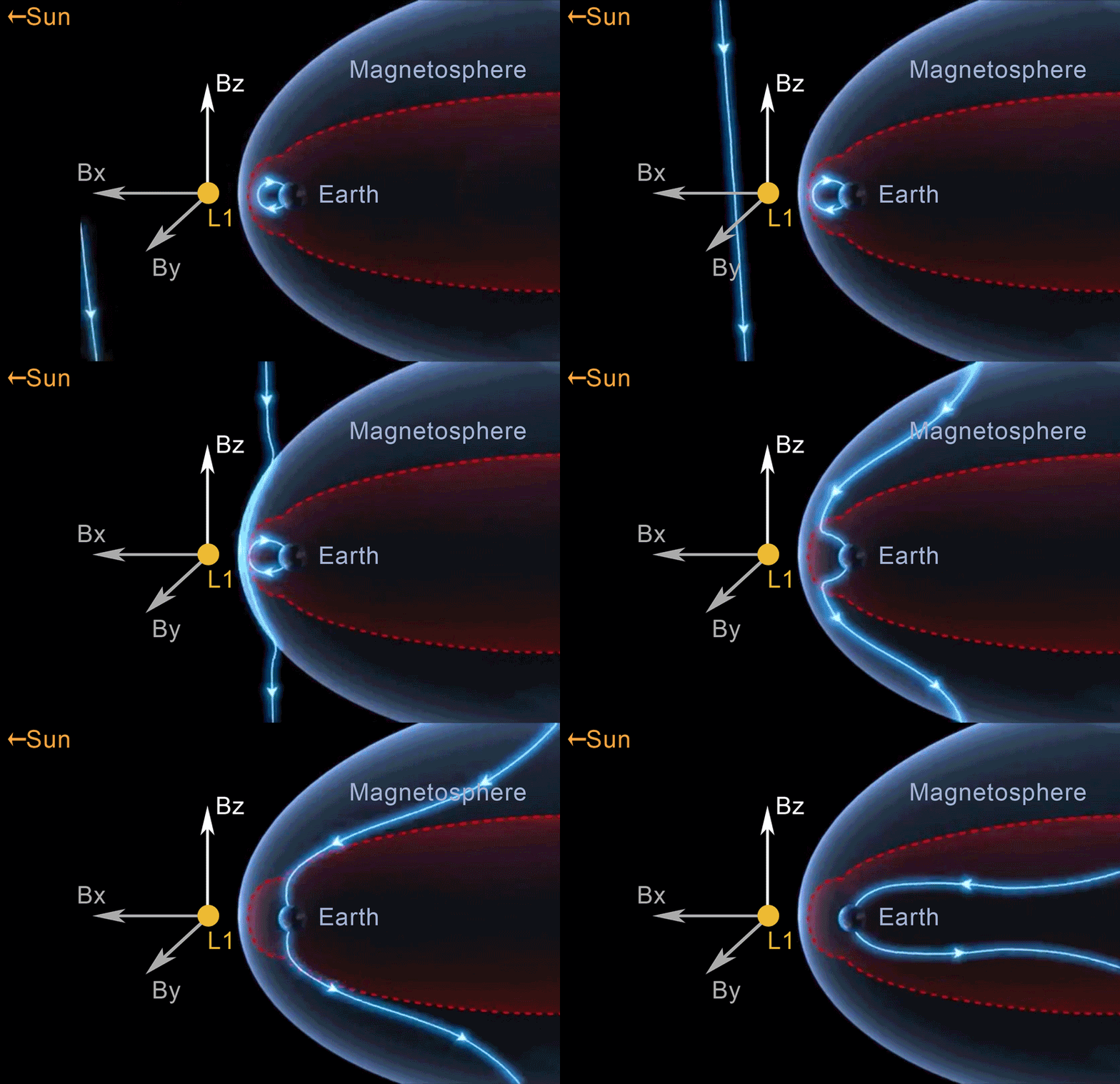
Geomagnetic storm: when a large space weather event arrives at Earth, it pushes and wobbles the magnetosphere more than usual. If the magnetic field arriving from the Sun is directed southward, it interacts strongly with the northward-facing magnetic field of the Earth (see Bz). The Earth’s magnetic field is then peeled open like an onion, allowing energetic solar wind particles to stream down and hit the atmosphere over the poles. Geomagnetic storms can be measured by instruments on the Earth’s surface. There is a very small decrease in magnetic field strength that lasts about six to twelve hours, after which the magnetic field gradually recovers over a period of several days. Click here for more info about geomagnetic storms from the Space Weather Prediction Center, which monitors them. |
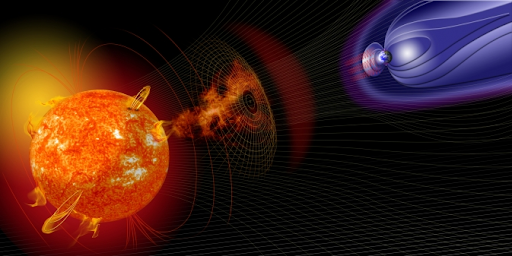
The Sun drives solar storms. Sometimes—but not always—a solar flare can herald the launch of a CME toward Earth.
Solar flares can be seen by scientific instruments, but we can’t always tell if a CME is on the way to Earth, so we have to wait until it reaches a place where our satellites can detect it and the direction of its magnetic field (called Bz). Forecasting CME arrival times is by its nature difficult to do with high accuracy. Until an hour or so before a geomagnetic storm, there can be plus or minus 12 hours of uncertainty for when the CME will arrive—a whole day in total!
|
|
Coronal mass ejection (CME) Video about the journey of an extremely large CME that occurred in 2012! |
|
|
Solar flare: the way magnetic fields on the Sun move and change can sometimes cause a sudden explosion of energy called a “solar flare” that releases large amounts of radiation into space. In scientific imaging of the Sun through special filters, it looks like a bright flash of light. If a solar flare is very intense, the radiation it releases can interfere with radio communications on Earth. Solar flares do not cause auroras, but they can sometimes—but not always—be accompanied by CMEs that can cause auroras. Click here to find out more about how scientists develop ways to predict solar flares. |

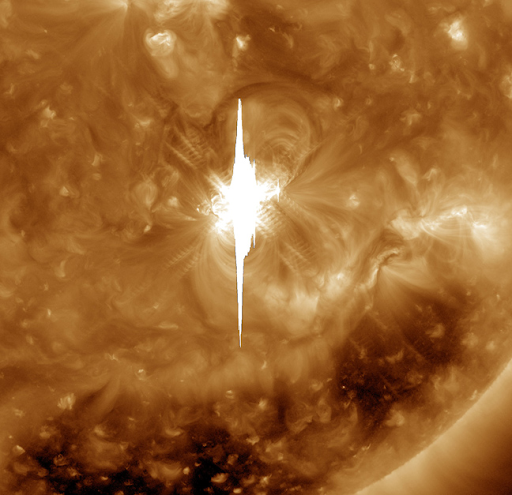
When particles arrive at Earth, they are caught and accelerated in the magnetosphere.
They then stream down through the upper atmosphere near the North and South Poles, driving the aurora.
|
|
Ionosphere: the Earth’s ionosphere is a layer of the atmosphere made up of charged particles, or plasma. It is the place in the upper atmosphere where auroras occur. It occurs between about 50 to 400 miles (80 to 640 kilometers) in altitude, far above clouds and planes. It overlaps the top of the regular (electrically neutral) atmosphere and the edge of space.
Fun video about the ionosphere |
|
|
Aurora: The aurora is a display of light in the night sky resulting from the raining down (precipitation) of electrons and protons from the magnetosphere into the Earth’s upper atmosphere. The aurora borealis and aurora australis — also called the Northern Lights and Southern Lights — occur at the Earth’s North and South Poles. Solar wind particles funnel around to the long tail of the magnetosphere, where they become trapped. The particles are then accelerated toward Earth’s poles, driven by a process called magnetic reconnection:
At the final step of the process in Earth’s upper atmosphere, they bounce off of atoms and molecules, providing them with extra energy that is released as a burst of light. These interactions continue at lower and lower altitudes in the ionosphere until all the incoming energy is lost. When we see the glowing aurora, we are watching a billion individual collisions, lighting up the invisible magnetic field lines of Earth. Find out more about aurora science on the Aurorasaurus Learn page and blog! |
|
|
Auroral oval: because of the way the Earth’s magnetic field is shaped, auroras occur in a roughly oval shape around the north and south magnetic poles. The ovals can expand toward the equator during strong geomagnetic storms, but usually sit at about 65-70 degrees latitude. The Earth rotates beneath the auroral ovals. In order to see auroras, you need to be underneath or close to the nearest auroral oval. Scientists created a forecasting tool and real-time model of the auroral oval called OVATION Prime. |
|
|
Substorm: a word for the daily, natural progression of auroras. They happen every few hours and take place at high latitudes in the auroral oval. Substorms are the natural results of the magnetosphere taking in, storing, and releasing energy. They were explored in the 1950’s by Dr. Syun-Ichi Akasofu of the University of Alaska Fairbanks, who figured out some of the ways that auroras behave across the world. These were later confirmed by images from satellites. The peaks of substorms are the times that the aurora dances most brightly and at the lowest latitudes, but the timing of the peaks is very difficult to predict, and it is not forecast by SWPC! |
|
Bz: an important term for aurora chasing. Magnetic fields, which physicists call “B“, are carried through the heliosphere by the solar wind and are constantly changing direction and strength. The most important direction to aurora chasers is “Bz” (the part of B parallel to the Earth’s poles) because of the way it interacts with the Earth’s magnetic field. There is a special location between the Earth and the Sun (close to the Earth) called L1. There are two space weather satellites there called DSCOVR and ACE, which measure the interplanetary magnetic field, solar wind velocity, and other things. From this location, it takes the solar wind about an hour to reach Earth so information from DSCOVR and ACE is especially helpful for aurora chasers. At L1 a coordinate system is used in which “positive Bz” (also called “Bz north”) is in the same direction as the Earth’s magnetic field. Why does this matter? Just like with magnets, opposites attract and the same polarity pushes apart. If incoming solar wind has a “Bz north” or “positive Bz” orientation—the same as the Earth’s—it is mostly pushed away by the planet’s magnetic field. If the solar wind near Earth has a “Bz south” magnetic orientation, also called “negative Bz,” it is the opposite of the Earth’s magnetic field. That makes it more likely to connect with the Earth’s magnetic field and drive processes that can cause aurora. In other words, for aurora chasing, Bz south is a good thing! There are more details in our blog post on Bz. |
|
|
Kp Index: a worldwide scale of disturbances in the Earth’s magnetic field. It uses numbers from 1-9 where 1 is very weak and 9 is very very strong. It is based on measurements of the Earth’s magnetic field from Earth at certain latitudes where geomagnetic storms cause changes. Higher numbers mean stronger activity, by a factor of 10. Since the Kp Index applies to the entire planet, it helps predict the presence of auroras on Earth, but can’t tell you if auroras will show up in any specific location. You can find out more in our blog post, and explore a visualization on the Kp Fox site by Aurorasaurus Ambassador Jeremy Kuzub. Click here to explore the official Kp Index website! |
|
|
Solar Wind Power: a measurement of the strength of the solar wind, based on real-time measurements from the ACE satellite, which sits between the Earth and the Sun and provides about an hour’s notice of activity. Like Kp Index, Solar Wind Power applies to the entire Earth. So while it can’t predict whether the aurora will show up at your location, the plot is color-coded to tell you what the levels may mean for your latitude. Solar wind power also is calculated more frequently than Kp, and takes into account the varying effects of Bz and solar wind speed on driving aurora. You can see the current Solar Wind Power on the Aurorasaurus website. A similar estimate is “hemispheric power,” the power of the aurora in either the northern or southern hemisphere, measured in gigawatts (GW). It is measured by the OVATION Prime aurora model and is a good estimate for how strong the aurora is overall: higher values of hemispheric power or “hem pow” correspond with higher chances of seeing aurora. |

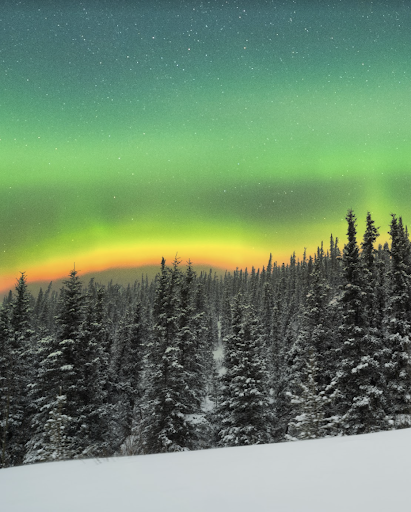
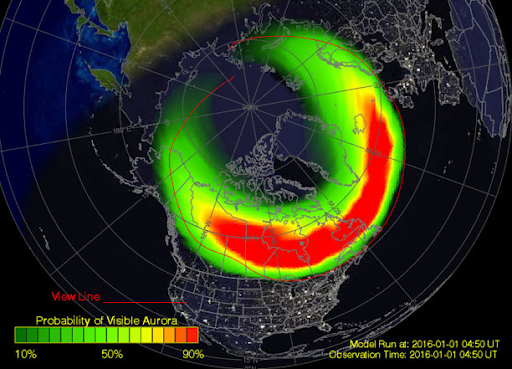
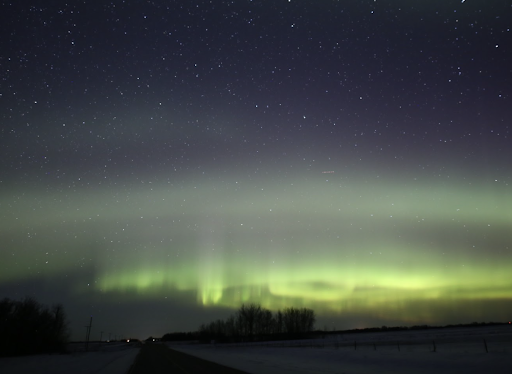

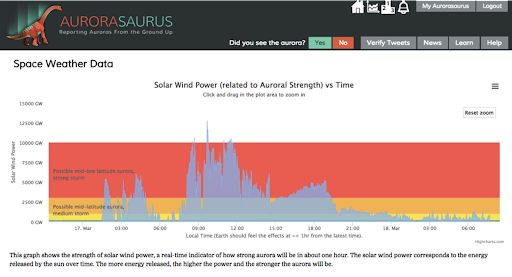
Because of all these things, the question “when can an aurora chaser see the aurora?” turns out to be surprisingly complicated. The short answer is: there’s no way to know for sure, so the goal for aurora chasers is to be in the right place at the right time, with fingers crossed! They can use estimates like the Kp Index and Solar Wind Power about an hour ahead of time to see if space weather and Bz might be good. They can then find a location under the auroral oval with a good view toward the nearest pole and clear, dark sky. They’ll keep an eye on Aurorasaurus and aurora chasing groups to see if others are seeing the aurora. Even when everything looks good, aurora chasing requires luck—and the aurora can also put on a surprise show when the science doesn’t look promising. The uncertainty is part of the sport and fun of chasing the aurora.
I hope these help you start to explore the amazing science of auroras! There are many more resources to explore on the Aurorasaurus blog. If you ever join a trusted adult for aurora chasing, we hope you have a safe, well-prepared, and wonderful time!


