With special thanks to Dr. Janet Kozyra for her generous contributions to this post.
After a big storm sends aurora to lower latitudes—southward in the Northern Hemisphere, and northward in the Southern Hemisphere—questions abound. One of the most common is “I thought the aurora was green. Why does it look red?”
Red auroras have been observed throughout history, although in the historical record it is difficult to tell which type of red aurora is which. For example, they were described as “pheasant tails” in 7th-century Japan. They have been mistaken for fire from 1st-century Rome to the 19th century and beyond: during the famously enormous 1859 Carrington event, people saw blood-red skies as far south as the Caribbean, and fire crews were sent to look for forest fires on the horizon.
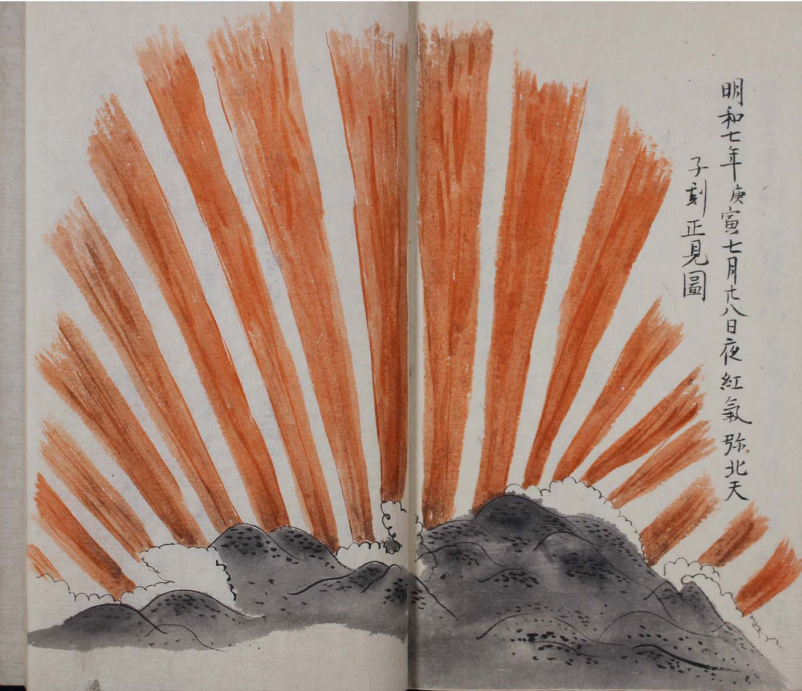
As technology advances, cameras are becoming increasingly good at capturing faint features in red auroras. During the Halloween Storm of 2003, blood-red aurora were photographed as far south as Texas in the United States, and photographers caught red aurora during the March 23, April 23, and November 5, 2023 storms.
There can be four ways for auroras at lower latitudes to glow red: one involves regular auroras, and the others involve special, rare events. In this post, we’ll introduce all these types, our valentines from the sky!
With regular auroras, location is everything
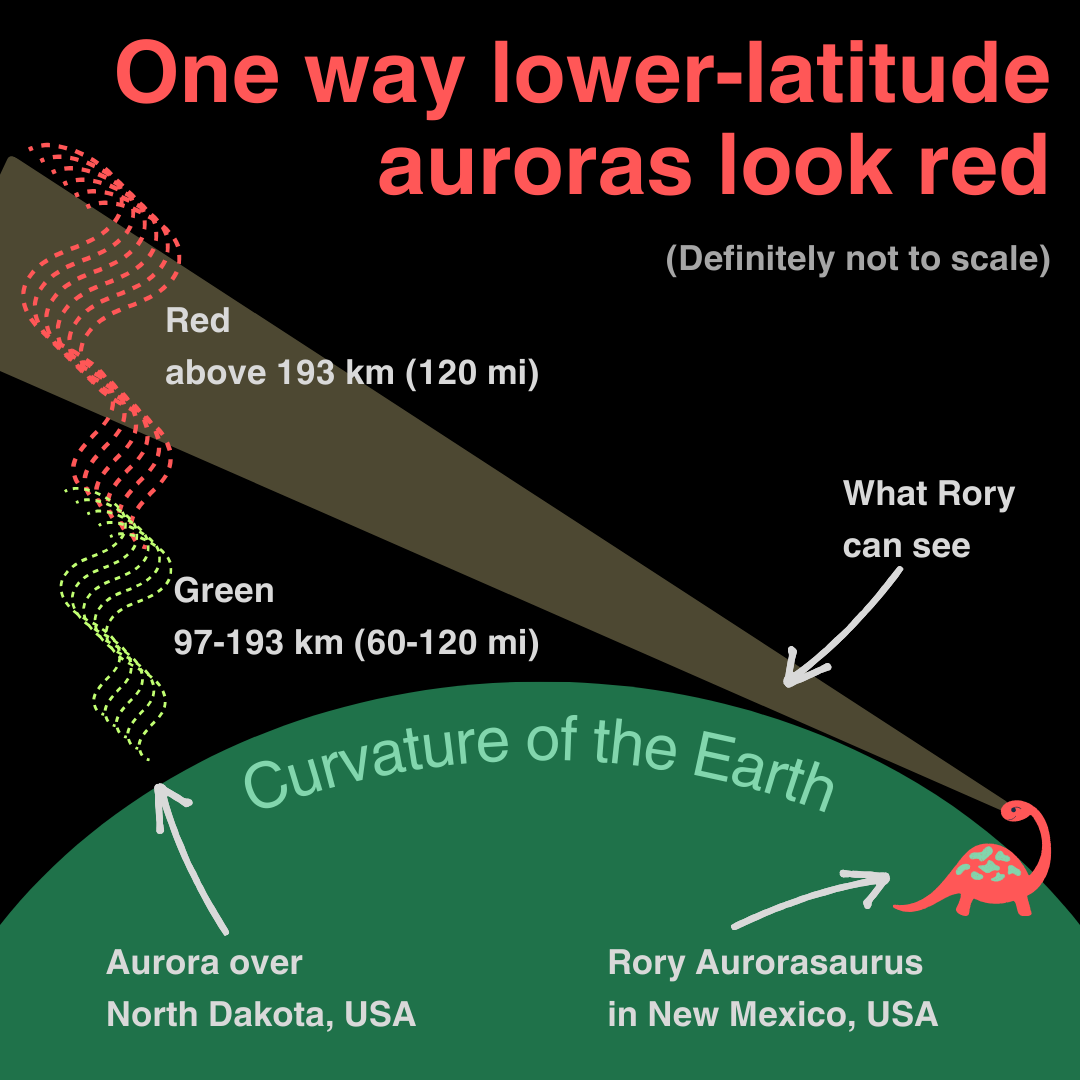
The aurora dances high in the upper atmosphere. Particles from the Earth’s magnetic field fill atoms and molecules with extra energy that the atoms and molecules give off as light. Because of the way atoms and molecules are layered in the atmosphere, the colors in auroras are also layered. The highest, least dense area, which has oxygen atoms, shines red, and stretches above 120 miles (200km) up.
When something is very high in altitude, it is easier to see from a greater distance. So the taller the aurora, the further away it can be seen. At the same time, the surface of the Earth curves, blocking part of the view. So even if an aurora is especially tall and bright, from far away you may only see the top of it: the high-altitude red over the horizon.
Great Red Auroras are distinct, storm-time phenomena
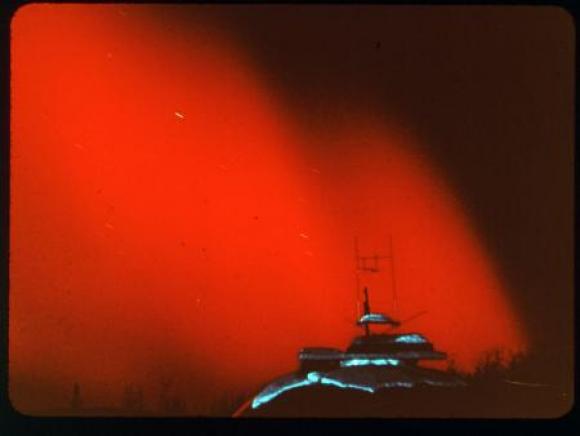
Great Red Auroras (also called “Type A” aurora) tend to occur with some particularly intense storms as bright, short-lived phenomena at the peak of the storm. We don’t know exactly why, but scientists have some ideas. Great Red Auroras are associated with large amounts of low-energy electrons. When these electrons enter the upper atmosphere, most don’t have enough energy to go deeper than the uppermost, red layer. So they light up only that uppermost layer of oxygen atoms. In addition, this intense rain heats up the upper atmosphere, changing the chemistry that creates light. The ruby color created is as pure as a blood red laser pointer, and unusually bright. Because they are so high up, Great Red Auroras are easier to see from far away than green aurora. Sometimes, Great Red Auroras can have a bit of green beneath them, but like regular auroras like these are hard to see at great distances because they are blocked by the curve of the Earth.
SAR Arcs are lower latitude and dimmer
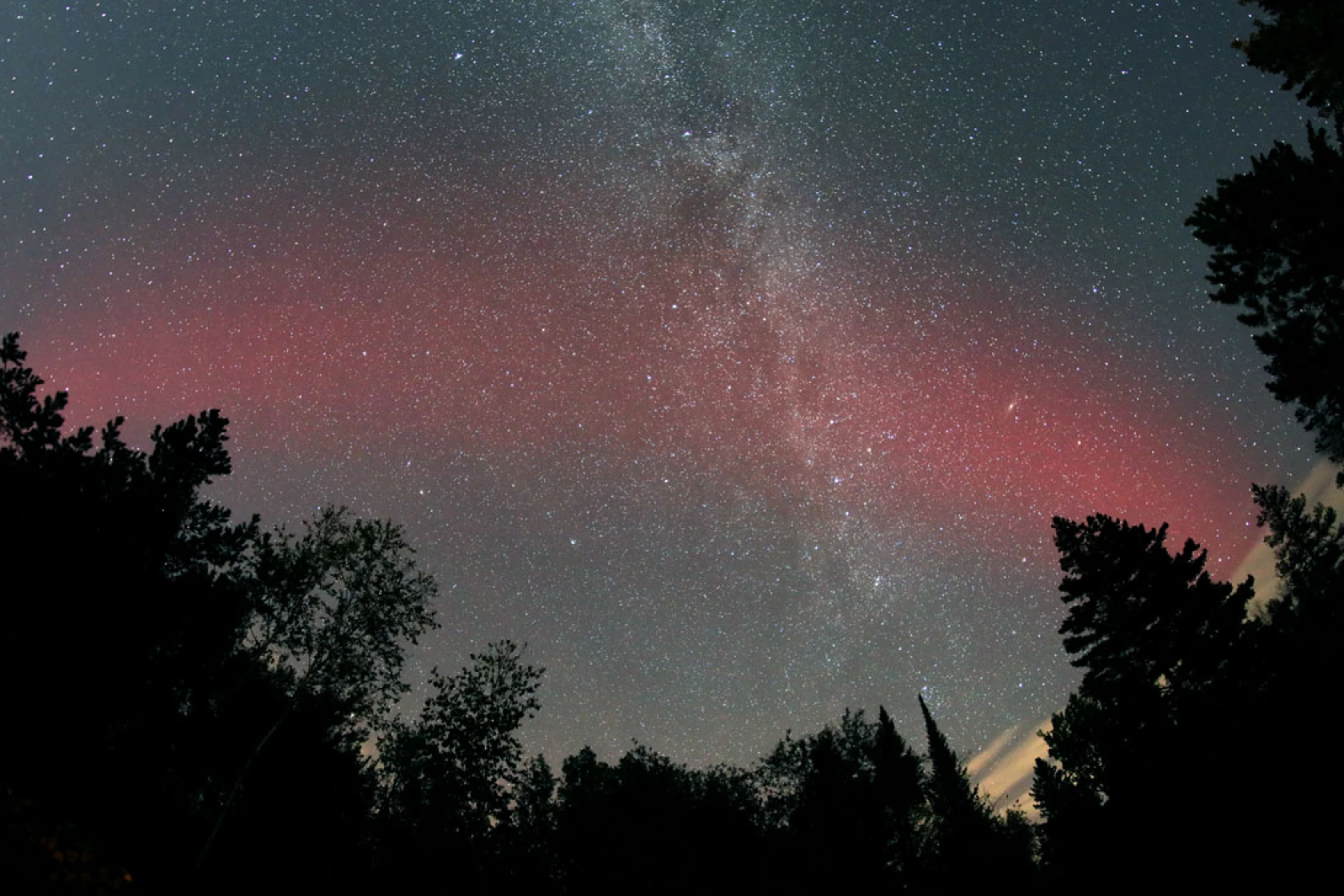
The third low-latitude red auroras are called Stable Auroral Red arcs, or SAR arcs. Most of the time these are diffuse, dim, and invisible to the human eye—so much so that they weren’t studied until 1956. With increasingly sensitive consumer cameras, though, participatory scientists are more empowered than ever before to catch them! In fact, the “Stable” part of its name came from early observations in which it didn’t change much, but now that there are more observations that understanding is evolving. During particularly intense storms, they can even become bright enough to be seen by the unaided eye.
Like the other two types, the red of SAR arcs is made from high-altitude oxygen, but the mechanics that bring it about are different and have to do with heat and chemistry in the upper atmosphere and the inner part of the Earth’s magnetic field. A SAR arc occurs equatorward of the aurora, in a band that stretches east to west. Sound familiar, STEVE fans? There has even been a study on SAR arcs evolving into STEVEs! Dr. Carlos Martinis, the lead author, gave a presentation on the study to the Aurorasaurus Ambassadors, watchable online on the Aurorasaurus YouTube channel. That said, SAR arcs are wider and more red than STEVEs, and that’s two ways to tell them apart.
Equatorial Red Airglow is elusive and exciting
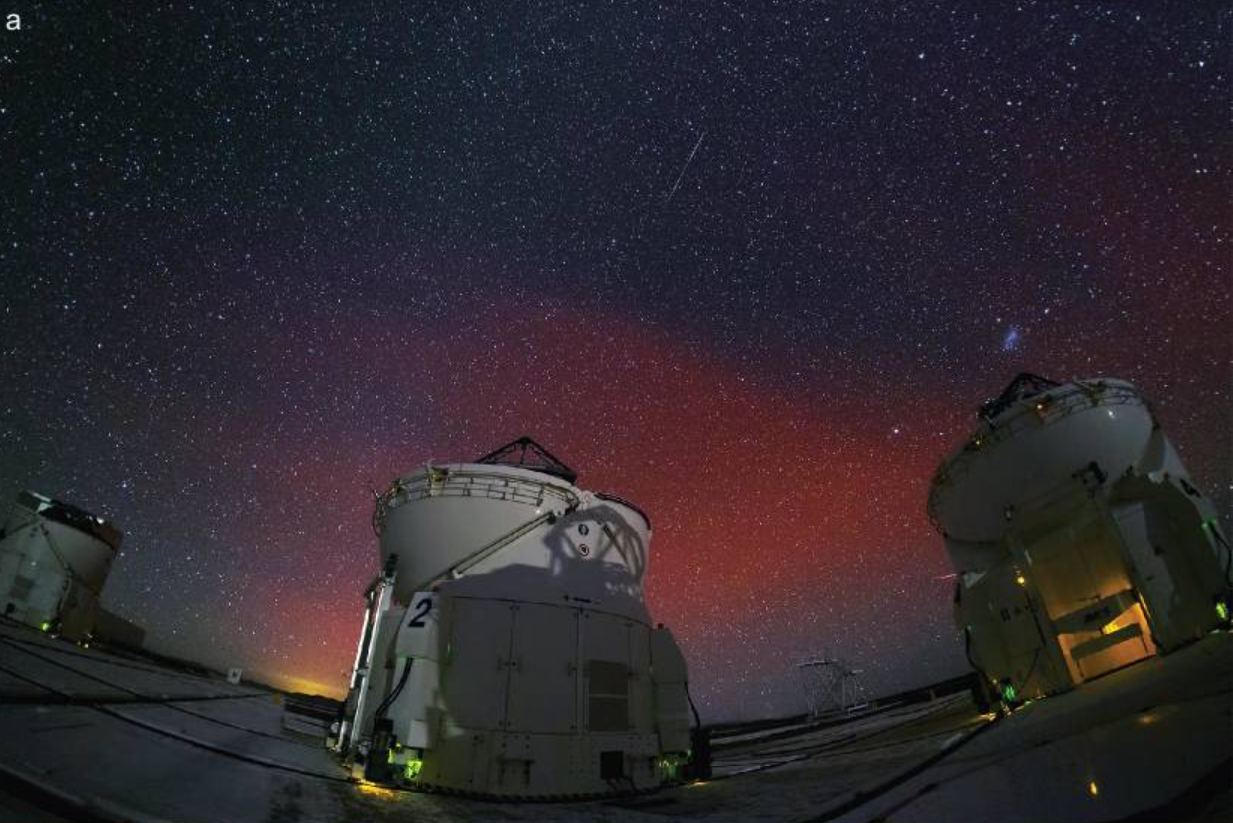
Sometimes, a low-latitude red glow in the night sky might not be aurora after all. Especially during strong solar storms, historical accounts from ships, balloons, and airplanes flying through equatorial regions have noted visible red and green glowing lights in the sky. These lights have also been photographed from observatory sites, and are a different phenomenon called “airglow” that is caused by chemistry in the upper atmosphere and natural quirks in the Earth’s magnetic field (He et al., 2020). Airglow can also be enhanced, or made more intense, by geomagnetic storms. Studies are ongoing, and include exciting analyses of historical observations in equatorial areas like Korea and China. So if you are in equatorial regions and photograph the sky glowing red at night, you can help build datasets for everyone to learn more by making an Aurorasaurus.org report.
Which is which?
It is difficult to tell whether what one is seeing from a low latitude is high-altitude regular aurora, Great Red Aurora, or SAR arcs. (Equatorial red airglows generally only occur in special, equatorial locations.) Some can also occur at the same time: Great Red Auroras and SAR arcs have been photographed together. If you’ve photographed any red aurora, you can make a report to Aurorasaurus.org and compare it with others from your area and across the world during the same storm.
Here are some special features that may help tell them apart, with many thanks to our colleague Dr. Janet Kozyra:
Timing:
- The red “over the horizon” effect occurs in regular aurora displays, and lasts as long as the display itself does.
- Great Red Auroras tend to be relatively short-lived, lasting less than an hour in a single location.
- SAR arcs tend to last at least several hours.
Visibility:
- “Over the horizon” red auroras might not be visible to the unaided eye, but can usually be photographed.
- Great Red Auroras are extremely bright (intense), distinguishing them from all other kinds of red aurora.
- SAR arcs will often be invisible to the unaided eye, but may be visible during major storms or extreme events. Even when eyes can’t see them, they can be photographed by very sensitive cameras.
Appearance:
- “Over the horizon” red auroras are mostly shaped like curtains, as they take the shapes of the auroras they are associated with.
- Great Red Auroras tend to be diffuse, like a bright cloud of red mist.
- SAR arcs look like a red band, wider than STEVE, that usually doesn’t move about much.
Colors:
- “Over the horizon” red auroras occur above green auroras, even if the green is hidden by the curvature of the Earth.
- Great Red Auroras can have a bit of green underneath, which may be hidden at lower latitudes by the curvature of the Earth.
- SAR arcs usually have no green beneath them.
Location:
- “Over the horizon” red auroras occur within the auroral oval.
- Great Red Auroras are thought to be located at the equatorward edge of the auroral oval.
- SAR arcs will be bumped up against the outside of the auroral oval during the most active phase of an auroral display but become more separated in later phases of the display.
We hope that helps! If you have captured any type of red aurora, please make a participatory science report to aurorasaurus.org to help scientists study these wonderful phenomena. You can also bring your reports to the Spring 2024 Aurorasaurus Report-A-Thon on March 2 (March 3 in Australia and New Zealand)! Register to attend here.
We love red auroras!
Red auroras are beautiful—and perhaps, signs of wonderful beginnings. A particularly spectacular Great Red Aurora graced the skies of North America on February 11, 1958, the evening University of Alaska students Charles and Tone Deehr had their first date. The couple have now been married 63 years, with four daughters and seven grandchildren, and Charles is a Professor Emeritus of auroral science at the University of Alaska Fairbanks.
Red auroras are also why we are here; on October 24, 2011, a solar storm lit the skies with red aurora as far south as Alabama. Watching reports across Twitter, Dr. Liz was inspired to create the Aurorasaurus project.
In other words, you could say red auroras hold a special place in our hearts.❤️
P.S. from Dr. Liz
We are excited to host an upcoming “Report-a-thon” event to celebrate our community and encourage volunteer reports of auroras, especially red auroras from recent large storms in 2023. Please register to join us March 2/3. These are of great interest to scientists, and even the Helio Big Year’s celebration of solar maximum. There are a lot of mysteries surrounding red aurora. The differences between all the types in this post, colliding with interest and opportunity from the public, create the best kind of perfect storm. We invite you to join in!
Update: By Popular Request
We are glad that the above graphic has been helpful to so many people! By request, we’ve customized it to include a few more locations. Feel free to download and use these under CC BY-SA licensing (you can reuse and remix, but please cite Aurorasaurus.) We also ask that when you share, please use (or improve on) the alt/image description text included with each graphic so that aurora lovers who use screenreaders can enjoy them.
Northern Hemisphere
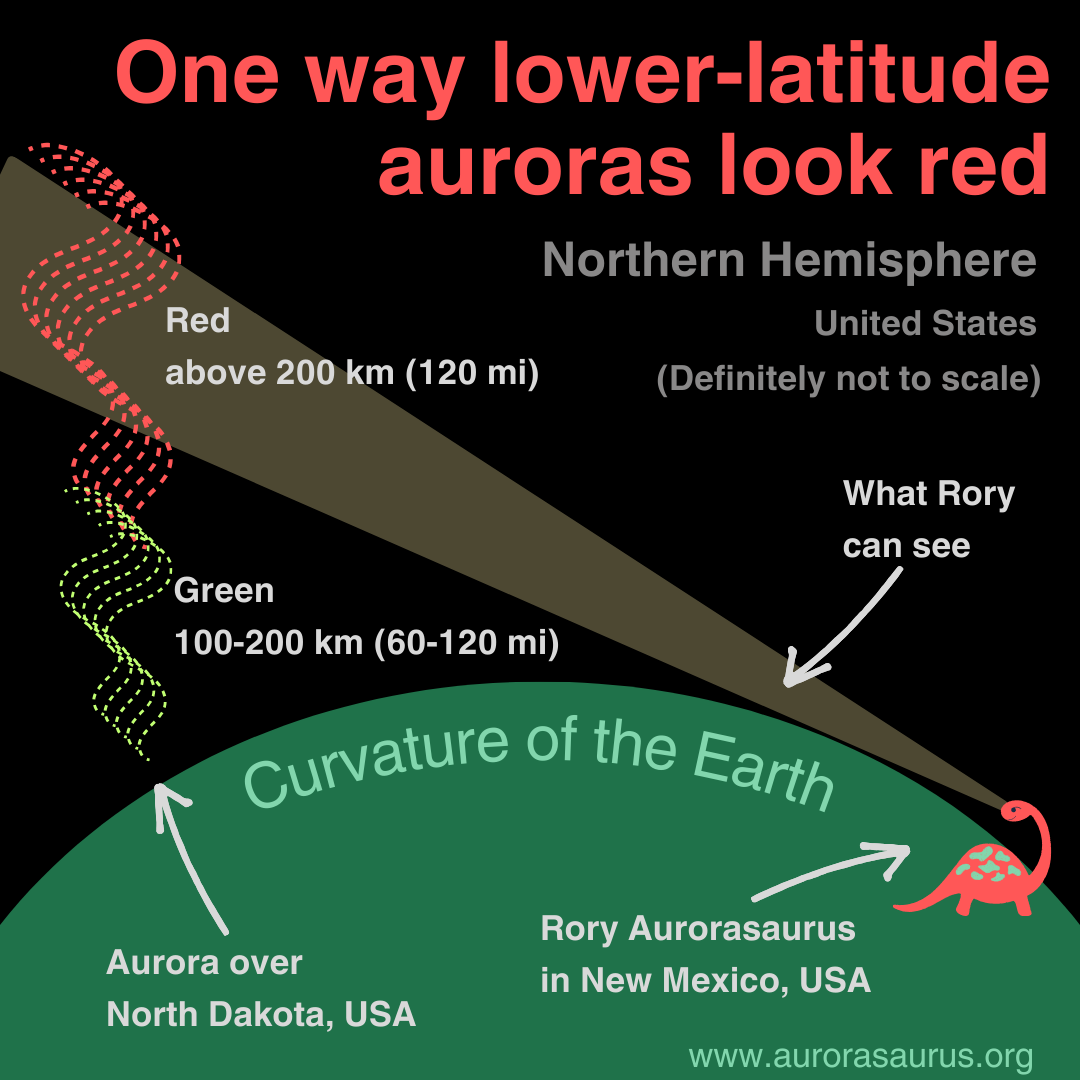
Image Description: Diagram titled “One way lower-latitude auroras look red. Northern Hemisphere. United States. (Definitely not to scale.) A semicircle taking up the lower half of the image represents Earth. Rory Aurorasaurus, a little red brontosaurus, stands in New Mexico, USA, on the right-hand side. She is gazing at an aurora shining over North Dakota, above the lefthand side of the semicircle. The curvature of the Earth between her and the aurora blocks part of her view, so she can’t see the green aurora at 100-200 kilometers (60-120 miles) altitude. She can only see the red aurora higher up, above 100 kilometers (120 miles). The url www.aurorasaurus.org is at the bottom of the image.
Southern Hemisphere
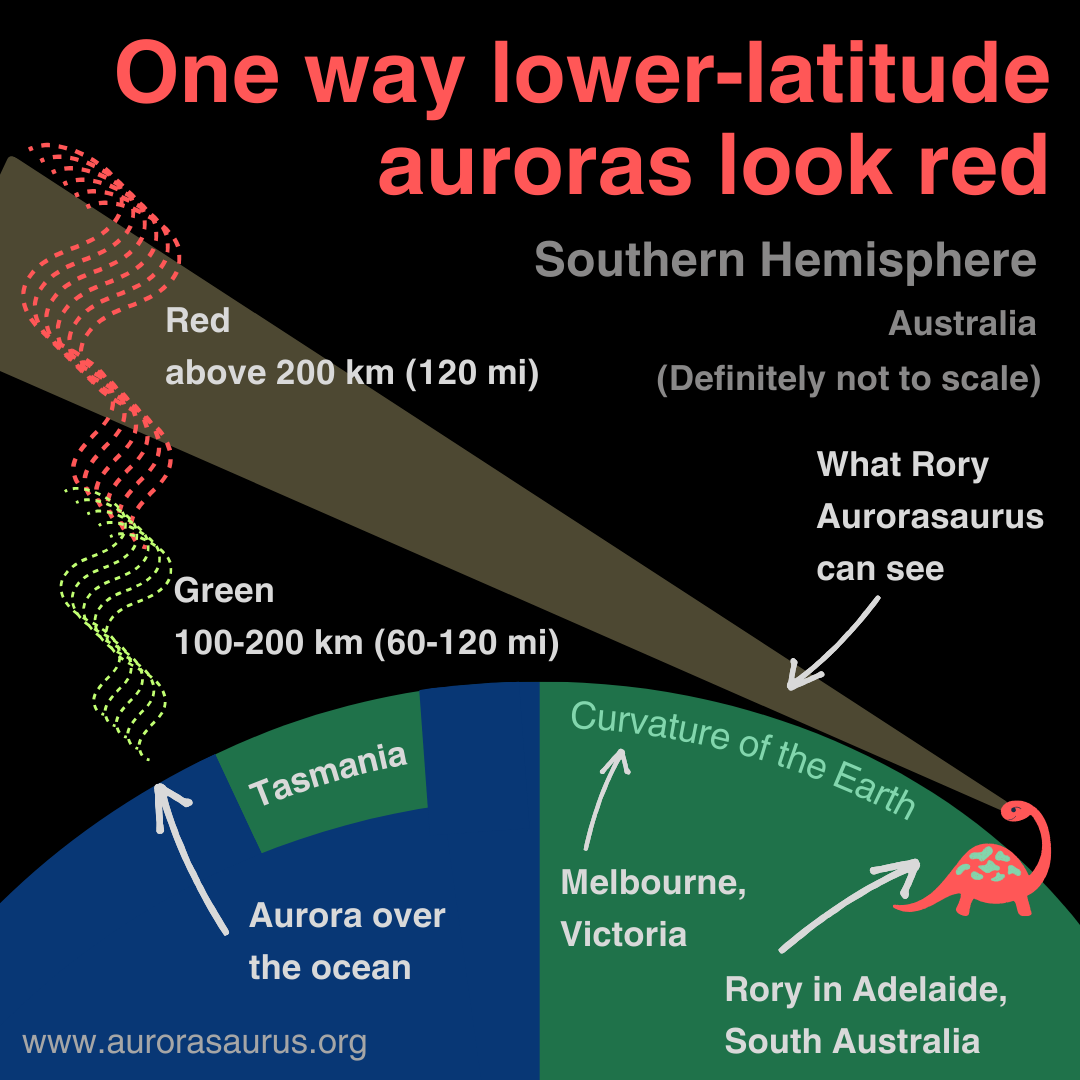
Image Description: Diagram titled “One way lower-latitude auroras look red. Southern Hemisphere. Australia. (Definitely not to scale.)” A semicircle taking up the lower half of the image represents Earth. Rory Aurorasaurus, a little red brontosaurus, stands in Adelaide, South Australia, on the right-hand side. She is gazing at an aurora shining over the ocean beyond Tasmania, above the lefthand side of the semicircle. The curvature of the Earth between her and the aurora blocks part of her view, so she can’t see the green aurora at 100-200 kilometers (60-120 miles) altitude. She can only see the red aurora higher up, above 100 kilometers (120 miles). The image uses geometric shapes to represent mainland Australia and the island of Tasmania. Melbourne, Victoria is also marked, somewhat close to the coast of the mainland, a little to the right of center on the semicircle. The url www.aurorasaurus.org is at the bottom of the image.
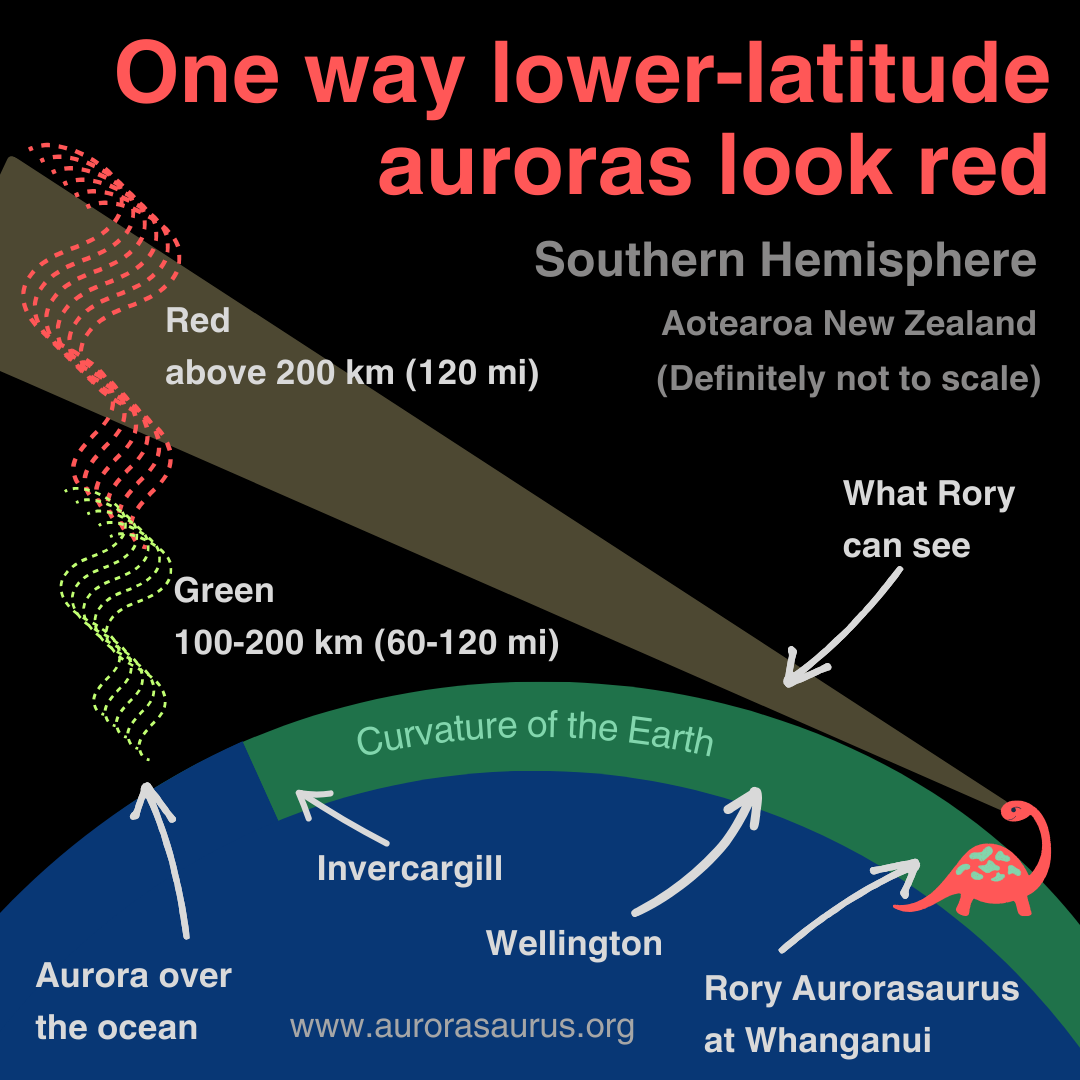
Image Description: Diagram titled “One way lower-latitude auroras look red. Southern Hemisphere. Aotearoa New Zealand. (Definitely not to scale.)” A semicircle taking up the lower half of the image represents Earth. Rory Aurorasaurus, a little red brontosaurus, stands in Whanganui, on the right-hand side. She is gazing at an aurora shining over the ocean beyond the coast, above the lefthand side of the semicircle. The curvature of the Earth between her and the aurora blocks part of her view, so she can’t see the green aurora at 100-200 kilometers (60-120 miles) altitude. She can only see the red aurora higher up above 100 kilometers (120 miles). The image uses a geometric arc to represent New Zealand in green, set against a blue ocean. Invercargill is marked near the coast in the middle of the lefthand side, and Wellington is marked to the right of center of the semicircle. The url www.aurorasaurus.org is at the bottom of the image.
Enjoy!


