Humans have looked to the sky since time immemorial, and noticed a strange purplish arc with stripy green features that runs east to west and appears closer to the equator than regular aurora. In the mid-2010s, aurora chasers began to collectively photograph and speculate about the phenomenon, which did not yet have a formal scientific term. They shared their observations with scientists, including Dr. Liz MacDonald of Aurorasaurus. Chris Ratzlaff, an aurora photographer in the Alberta Aurora Chasers Facebook group, suggested calling it “Steve,” a reference to the animated film Over the Hedge. In the movie, a group of animals, unsure of the nature of a hedge, name it Steve. The name stuck!
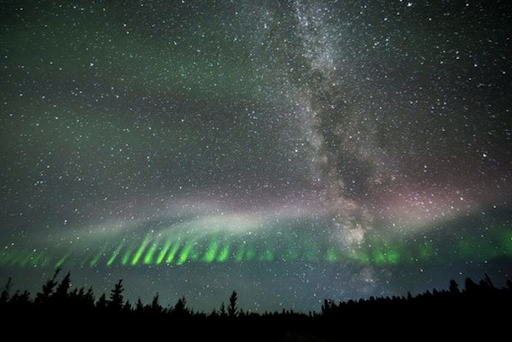
From 2016-2018, volunteers in the Alberta Aurora Chasers group and scientists worked together to publish the first modern paper on Steve: “New science in plain sight: Citizen scientists lead to the discovery of optical structure in the upper atmosphere”. The study, led by Aurorasaurus founder Dr. Elizabeth MacDonald, launched the phenomenon into modern scientific literature. Scientist Dr. Robert Lysak gave it a “backronym”: an acronym made out of the existing word “Steve”, which the paper used. STEVE now stands for “Strong Thermal Emission Velocity Enhancement”. In this post, we’ll break down what that means.
To describe where STEVE’s scientific name comes from, we first have to consider an obscure phenomenon called the “subauroral ion drift,” or SAID. The Earth’s upper atmosphere is a swirling soup of plasma: the fourth state of matter, made of charged particles called ions. Sometimes, the flowing plasma can form brief, fast-moving streams (“ion drifts”) that move east to west and occur equatorward of the aurora (in the “subauroral” region). STEVE is a particularly intense type of SAID: if the ambient aurora was a symphony, STEVE would crash in with an electric guitar riff. In short, its scientific backronym reflects both its citizen science history and the things that make it different from an ordinary SAID.
Strong Thermal Emission
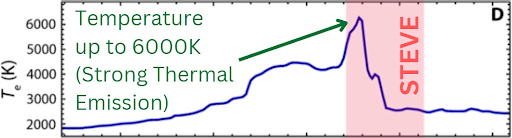
SAIDs can be detected in satellite data, but it had not been realized they could be seen optically from the ground. The “strong flow” of STEVE’s ions is so powerful that it creates light via mechanisms that are still not fully understood. STEVE is also hot! For reference, the temperature of fire is about 1,000-2,000 Kelvins (K). SAIDs don’t usually exceed toasty temperatures of 5,900 K in that region, but STEVE is hotter than that. “Emission” is a general term for energy or matter that has been released. So a “Thermal Emission” is a notably hot flow in the surrounding plasma.
Velocity Enhancement
STEVE moves faster than a regular SAID. Its velocity can be 5 to 10 km/s (about 11,000–22,000 mph) while regular SAIDs usually move a slightly more leisurely 2.9 km/s (about 6,500 mph). For comparison, a jet plane can fly about 500 mph, or 0.22 km/s. When scientists say “enhancement” they tend to mean “more of,” so a velocity enhancement is something with a higher speed than usual.
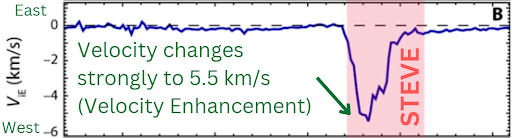
To put it all together, STEVE is different from a regular SAID because it’s 100 K or more hotter (Strong Thermal Emission) and nearly twice as fast (Velocity Enhancement). It’s a rockstar of the sky!
For more technical details about STEVE, check out the original paper by MacDonald et al., New science in plain sight: Citizen scientists lead to the discovery of optical structure in the upper atmosphere.
For more about STEVE’s history, read our blog post, “Celebrating STEVE and You!”
Many people each have their own unique story of meeting STEVE for the first time. What is yours?


