
A question we often get is “does the aurora make sound?” Observers sometimes note a crackling, rustling, whooshing, or similar noise when they watch aurora, but there has not been a lot of conclusive scientific study and anecdotal reports can be met with skepticism in the scientific community. In this blog post, we dive into the historical aspects of the question by summarizing the Notes and Records (Royal Society Journal of the History of Science) open access paper “The disputed sound of the aurora borealis: sensing liminal noise during the First and Second International Polar Years, 1882–3 and 1932–3” by aurora historian (and Aurorasaurus Ambassador) Dr. Fiona Amery of the University of Cambridge.
This paper discusses the late nineteenth and early twentieth century debate as to whether the apparent sound of the aurora, recorded by residents of northern latitudes and a small number of auroral researchers alike, was imagined, illusory, or objective. For decades it was a highly contentious issue, one that divided opinion, provoked lively discussion, and puzzled those who were enthralled by the mystery (Amery 2022, p. 6).
The piece is interesting, not only in how it records the history of studying auroral sound—“liminal” here means noises on the edge of perception—but in how people’s bodies were used as sensors, and how collaborations between professional scientists and participatory scientists have evolved over time. At the end, we’ll discuss modern participatory approaches too.
Setting the Scene

Fifty years apart, two innovative, international scientific efforts called International Polar Years (IPYs) used a Western scientific perspective to learn more about Earth’s remote Arctic and Antarctic polar regions and the meteorology, geomagnetism, atmospheric electricity, ocean currents, and aurora there. They were multidisciplinary efforts that enabled scientific research at the poles on many topics, only one of which was auroral sound, which was “considered peripheral to the primary visual investigation of the phenomenon.” (Amery 2022, p.6)
- The First International Polar Year, from 1882-1883, was a collaboration between 12 countries, with 12 research stations in the Arctic and two in the Antarctic. Researchers mostly gathered auroral data by making sketches and taking notes in logbooks.
- The Second International Polar Year, from 1932-1933, was a collaboration between 44 countries, with 27 Arctic research stations and none in the Antarctic due to the financial restrictions of the Great Depression. Researchers gathered auroral data by taking photos and using spectroscopy in addition to extensive logs.
During both International Polar Years, researchers used similar approaches to gathering data about auroral sound: they listened carefully at their research stations and surveyed people who lived in northern latitudes. This was an example of the scientific community beginning to recognize the human body as a sophisticated sensor—something that we apply today in participatory science. Amery suggests that “the body, and more specifically the western male body, was perceived as an inherently useful instrument, even within the culture of precision technology which pervaded the atmospheric sciences of the late nineteenth and early twentieth centuries” (Amery 2022, p.9). Amery’s “embodied approach” to the history of northern lights research has not before appeared within the IPY literature or within wider histories of polar exploration.
The First International Polar Year (1882-1883)
Scientists were very interested in learning about sound and hearing around the time of the First IPY. In fact, Edison’s early recording device, the phonograph cylinder, was patented just two years before! With wax cylinders and records becoming commercially available in the 1880s, for the first time people were able to hear recordings of sounds made in the past.
Before the First IPY, the relationship between auroras and solar activity was still not established. Most scientists generally did not believe reports of auroral sounds and theorized that the phenomenon might be psychological. They also felt that the unfamiliarity of polar environments made gathering data unreliable. However, they were willing to rely on other trained scientists, who “would sit alone in silence for hours on end within either an auroral observational shelter, most commonly made from earth and corrugated iron, or a more permanent hut among the meteorological and magnetic instruments, watching, listening, and waiting for the aurora” (Amery 2022, p.10).

Danish schoolteacher Sophus Tromholt did take reports of auroral sound seriously; his father had written about hearing a sound like rubbing two pieces of paper together, and had even published a paper, which was unusual for an amateur. Tromholt himself never heard auroral sound, even during his own IPY research station post in Kautokeino, Norway. However, during a time when scientists were trying to move away from human observation toward more “objective” machines, Tromholt conducted what might be considered early participatory science. Two years after the IPY, he sent thousands of letters across Norway to ask whether residents had heard auroral sound. Of the 114 survey responses he received, 92 believed in auroral sounds, 53 said they had heard auroral sounds, 39 quoted someone else who had heard auroral sounds, 21 said they had never heard auroral sounds, and 31 did not express a definite view. Many of the responses described quiet sounds on the edge of hearing: whizzing, crackling, or hissing. Tromholt also worked on early calculations of auroral altitude, which turned out to be so high up that sound would not be able to reach the ground. However, not everyone accepted Tromholt’s results. Even though so many people reported experiential knowledge, professional scientists overall remained skeptical.
Across the world in Canada, Major Henry Dawson was leading a British expedition at Fort Rae, now Behchokǫ̀, on the northern part of Great Slave Lake in Northwest Territories, Canada. While in most of his IPY logbook he noted no instances of auroral sound, he did record hearing it once, describing it as being like the sound of wind in a ship’s rigging. This was considered by Irish astronomer Agnes Mary Clarke to be the first “confirmed” observation of auroral sound. Amery argues that “believability was contingent on a particular body, that of a masculine Victorian explorer, only temporarily inhabiting the high-latitude region, with a rigorous regime of observations” (Amery 2002, p.14). Even with Dawson’s report, however, since no other official IPY researchers heard auroral sound, the scientific debate did not shift.
The Second International Polar Year (1932-1933)
By the Second IPY, auroral height and photography were more well established, but auroral sound was still a hot topic for debate. One of the topics that researchers like Sydney Chapman hoped to learn more about was the connection between what they considered possible unusually low-altitude auroras and auroral sound. This time, they brought more tools: special aurora cameras, an atlas with instructions for how to take scientific aurora photos, and spectroscopy instruments. However, even with advancements in audio technology they did not bring recording equipment; they still planned to record any auroral sounds using their own ears.
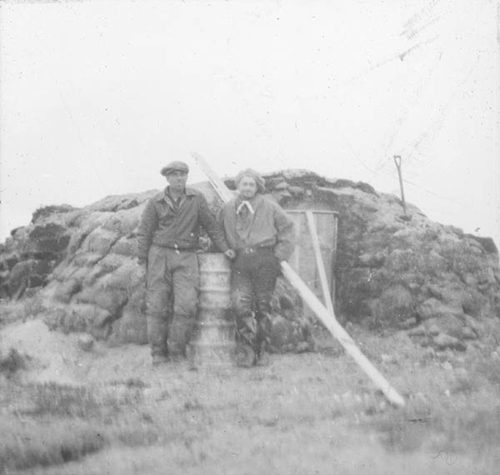
Like Tromholt in Norway during the First IPY, Canadian meteorologist Balfour Currie and a colleague sent an auroral sound survey to the residents of Chesterfield Inlet, also named Igluligaarjuk, in Canada. They separated answers from First Nations and white residents, lending more credence to reports from white people. However, members of every group they surveyed reported hearing auroral sound. The researchers found no correlation between reports of sound and low-altitude auroras, but a very strong correlation between reports of sound and rapidly moving, overhead auroras. A 1933 project from the Dominion Astrophysical Observatory in British Columbia collected 141 similar reports. While Currie himself never heard auroral sound, a younger member of his expedition did report hearing sounds.
In 1933 the editor of The Shetland News in Scotland asked for local and international reports of auroral sound, and published many of the replies. One submission was from Scalloway amateur astronomer Clement J. Williamson, who remembered hearing a continuous, swishing sound one night in October 1926. Despite being an amateur, Williamson corresponded with a number of scientists about auroral sound, including Norwegian aurora scientist Carl Størmer, British geophysicist Sydney Chapman, and British meteorologist George Clark Simpson. Størmer was influential at this time, and participated in the Second IPY. While he did not directly investigate sound, he had published earlier on the topic and influenced Williamson. In his letters, Williamson and others debated some of the major questions for a scientific explanation of auroral sound:
- Could auroral sounds be psychological? Williamson argued that if that were so, they should happen with every aurora, not just the most active displays.
- The aurora is so high in altitude that at the speed of sound, could noises reach the ground fast enough to sync with the display? As explained in Egeland and Burke’s modern book on Størmer, “Sound waves propagate at a speed of about 340 m/s. This means that an audible sound wave would need minimum 400 s to propagate from the aurorae to the ground. The sound would be delayed by more than 6 min when compared to the visible light signal. Sound and visible aurorae cannot vary in phase with each other” (p.106). Williamson’s discussion also turned to whether auroras could reach very low altitudes to begin with.
Overall, at the end of the Second IPY, auroral sound was still unresolved, setting the stage for a conversation that continues to the present day.
What could cause auroral sound?

Even now, despite being widely documented in experiential reports, the puzzle of auroral sound is not entirely explained from a Western heliophysics perspective. There are several theories:
- In his 1923 paper, ‘The Audibility of the Aurora’, Canadian astronomer Clarence Chant proposed that auroral sound might be similar to a brush discharge, also called a corona discharge: “the motion of the lights alters the earth’s magnetic field and induces changes in the electrification of the atmosphere, even at a significant distance. This electrification produces a crackling sound much closer to the earth’s surface, with transduction occurring in the observer’s clothes or spectacles or possibly in surrounding objects including fir trees or the cladding of buildings.…Chant’s theory correlated well with many accounts of auroral sound, and the theory is also supported by occasional reports of the smell of ozone accompanying northern lights displays” (Amery 2022, p.22).
- In 1927, prominent aurora scientist Carl Størmer suggested something similar: that auroral sounds could be electrostatic discharges in the surrounding environment, including trees and antennae.
- In 1973, S. M. Silverman and T. F. Taun published ‘Auroral audibility’, in Advances in Geophysics which looked at previous reports of auroral sound and agreed with Chant that brush/corona discharges were the likely explanation.
- In 2022, Unto Laine of Aalto University in Finland proposed that one possible cause could be discharges like brush/corona discharges electrically induced in a “temperature inversion layer” low in the atmosphere.
The aurora also inspires sound in a different way: through the composition of music. Latvian composer Ēriks Ešenvalds composed a piece called Northern Lights that included late 19th-century journal extracts from American explorer Charles F. Hall and Norwegian explorer Fridtjof Nansen:
In 2020, BBC Radio 3 broadcast ‘Between the ears: songs of the sky’, by biologist Karin Lehmkuhl Bodony, and composer Matthew Burtner, both from Alaska. They translated very low frequency (VLF) radio recordings of the northern lights to sound waves within human hearing, pairing the sounds with personal experiences—including a father-daughter camping trip with radio equipment—as well as tellings by Alaska Native elders, who share knowledge about the Northern Lights.
Looking ahead
Amery concludes by discussing the importance of the human body and individual experience as a sensor in investigating auroral sound. She notes that
The credibility of auroral sound reports hinged on both the perceived trustworthiness of observers and their conformity with the growing literature on the topic. It was the knowledge produced from IPY expedition members, temporary male inhabitants of the land, which was trusted with verifying the accuracy of local testimony. Although sought through surveys and calls for letters to the press, the experiences of local individuals were devalued, even when together they represented a significant and corroborated body of evidence (Amery 2022, p.25).
While participatory science was heavily used to investigate auroral sound, researchers in the early 20th century trusted their own ears as sensors. Even 50 years after the First IPY, Second IPY researchers did not bring new, advanced recording equipment, and seem to have trusted the First IPY methods of using bodies as sensors for auroral sound, hoping to expand their data using this method.
At Aurorasaurus, we primarily practice within Western science tradition, so it’s especially important for us to be aware of and thoughtful about the ways in which our predecessors conducted formal and participatory science. We appreciated reading this paper not only for documentation of the historical scientific approach, but as one way of learning about the past so that we can do better in the future. We are grateful to be part of a newer participatory science movement that works hard to equitably involve multiple ways of knowing, and which seeks deeper understanding by working toward ethical, reciprocal collaboration. Both Eclipse Soundscapes and Heliophysics Audified: Resonances in Plasmas (HARP) have different approaches to collecting and sonifying data in ways that are more accessible than has been typical in the past.
The Fifth International Polar Year is coming up in 2032-2033, and its principles reflect a similar evolution from the First and Second in respecting multiple Ways of Knowing and co-creating plans with Indigenous communities. There may be opportunities to approach this topic in a good way, weaving Western and Indigenous knowledges in a multidisciplinary approach that leads to learning.
Dr Liz says:
I thought it was cool how some of the scientists—Størmer and Tromholt, in particular—seemed to take auroral sounds very seriously, even though they had not personally heard them and the implausibility of producing sound presented major scientific problems. Like Amery, I found it interesting but perhaps not surprising that little progress was made on this topic. However, I think that might have more to do with auroral sound being more of a secondary question without good protocols or instrumentation for collecting data. Even today among scientists, the feeling persists that auroral sound has resisted efforts to study it; it is rare and when scientists do go out on short campaigns with sensitive equipment, they may simply miss it. There are just too many anecdotal reports to be ignored, but a complete theory that strongly correlates with geomagnetic activity is still an open field of research. I feel like in our modern world, quiet places where people could document auroral sound are becoming even more rare, but a participatory science approach that is fully inclusive of people in remote places could be promising, with appropriate effort toward relationship-building.
Have you heard a noise associated with the aurora? Please include these kinds of observations under “Notes” when you make Aurorasaurus reports. It is important to note your exact time and location of course, and in addition, the weather, proximity to power lines, a recording if available, and how many observers in the group reported sound. Ideally multiple events with completely independent observers would document sound at around the same time and region. It would be exciting to be part of solving the mystery of auroral sound!
Reference:
Amery Fiona. 2022 The disputed sound of the aurora borealis: sensing liminal noise during the First and Second International Polar Years, 1882–3 and 1932–3. Notes Rec.765–26. http://doi.org/10.1098/rsnr.2021.0031


