Guest post by Francesca Di Mare
Plane travelers often hope for smooth flights without bumpy turbulence. Turbulence is a kind of chaotic motion in the flow of fluids that is constantly changing in characteristics like speed, energy, temperature, and more. It is full of different-sized swirls that mix things together and dissipate, or spread out, energy. But while it’s less fun to fly through, in aurora science turbulence can be an exciting process; it’s part of the energy that makes auroras dance! In this post, new Aurorasaurus postdoctoral researcher Dr. Francesca Di Mare gives an introduction to the work she is beginning on the relationship between turbulence in the Earth’s upper atmosphere and the quirky subauroral phenomenon STEVE.
Science over coffee
When I think of turbulence, the first thing that comes to mind is something that seems to escape natural laws: at first glance, it appears chaotic, unpredictable, and very complex.
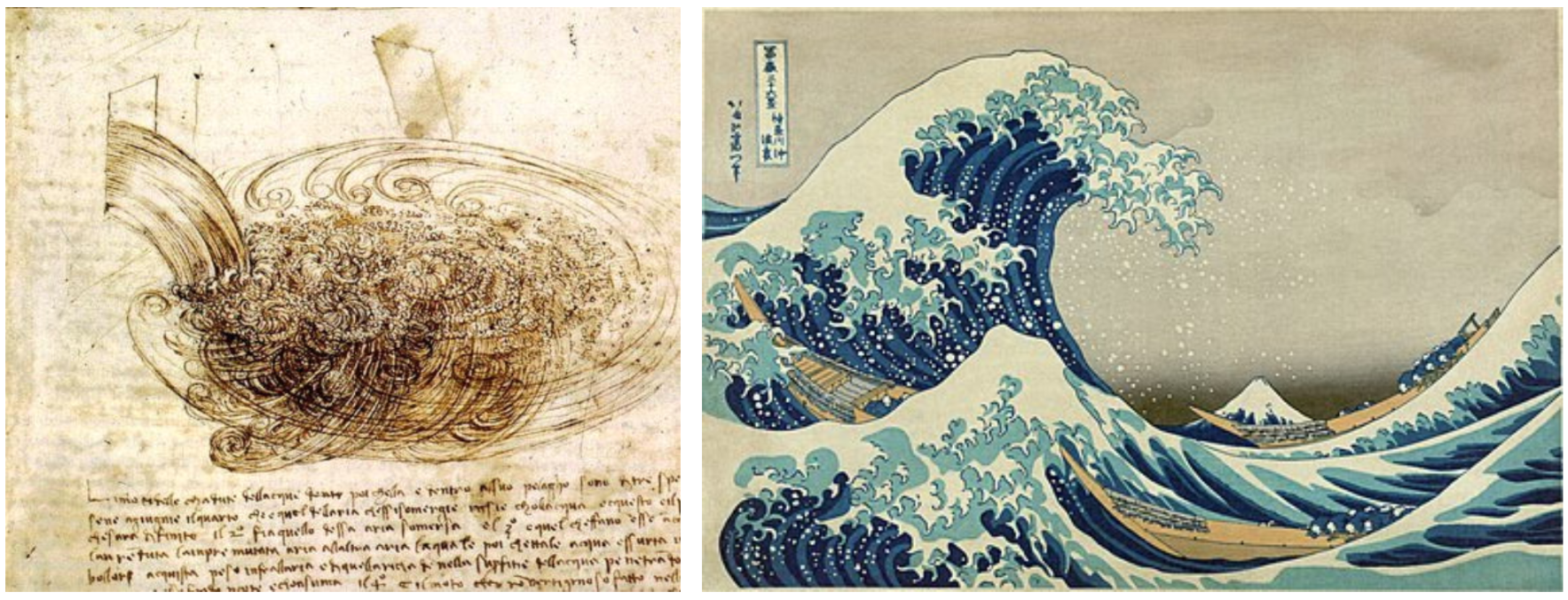
But turbulence is a universal phenomenon that we see every day in water, air, even things like the swirl of mixing milk into coffee or the flow in river rapids. It’s part of nature, from the depths of the oceans to the heights of the atmosphere and beyond! It’s interesting because it’s so irregular, and surprisingly hard to understand because it evolves so rapidly.

One of the most significant characteristics of turbulence is its ability to transport and mix fluid much more effectively than a regular, streamlined flow. This is why when we add milk to coffee, we create turbulence with a spoon to mix it in. As the spoon passes through the liquid, it creates tiny whirlpools called “vortices,” as well as chaotic changes in speed and pressure. As time passes, the vortices become smaller and smaller: absorbing energy, changing conditions in the surrounding liquid, and blending the coffee and milk. Finally, the tiny vortices dissipate their temperature, and the beverage becomes one well-mixed fluid. If you don’t have a hot drink handy, other ways to explore fluid dynamics are with the free Apple or Android app Magic Fluids, and with this video.
A plasma coffee
These ideas about fluids also apply to heliophysics: the study of the Sun and its effects on the solar system. Turbulence happens when different forces crash into one another in the upper atmosphere, in the Earth’s magnetic field, and in the stream of matter and magnetism that flows from the Sun. It’s like a high-energy coffee, although instead of liquid it’s made of plasma, the fourth state of matter. Plasma is made when gas is so superheated that its atoms split into electrons (negatively charged) and ions (positively charged). The charged particles move on their own, dancing to electric and magnetic fields in space. Special, energetic kinds of waves called “Alfvén waves” flow into the plasma-like creamer, transporting energy and allowing the turbulence to spread. Charged particles move at high speeds within their environments, mixing, colliding, and encountering obstacles. The turbulence creates swirling vortices that get smaller and smaller, dissipating the energy from the waves and helping to cause the energy of auroras (and possibly STEVEs).
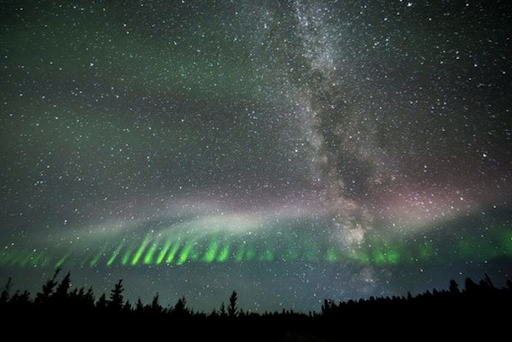
STEVE (Strong Thermal Emission Velocity Enhancement) lights the sky as a grey or mauve arc with green stripey features that runs east to west and appears closer to the equator than regular aurora. While this phenomenon has been observed for centuries by both laypeople and scientists, in 2018 a team of participatory scientists and professional scientists published the first scientific paper on it. Collaborations involving citizen scientists are still discovering new things!
As it glows across the sky, STEVE is constantly, rapidly shifting, not just in terms of its appearance. There are changes in the speed of its particles, the density of particles moving and colliding with one another, and its unusually high temperature. All of these features may reveal its turbulent nature.
Studying turbulence
STEVE continues to amaze us with its complexity and the complicated science that causes it. So far, scientific studies have focused on visual observations, and comparisons with well-known auroral forms. Recent research has suggested that tiny green streaks photographed next to the arc were not actually lines stretching across the sky, but only appeared that way because of how cameras captured them.
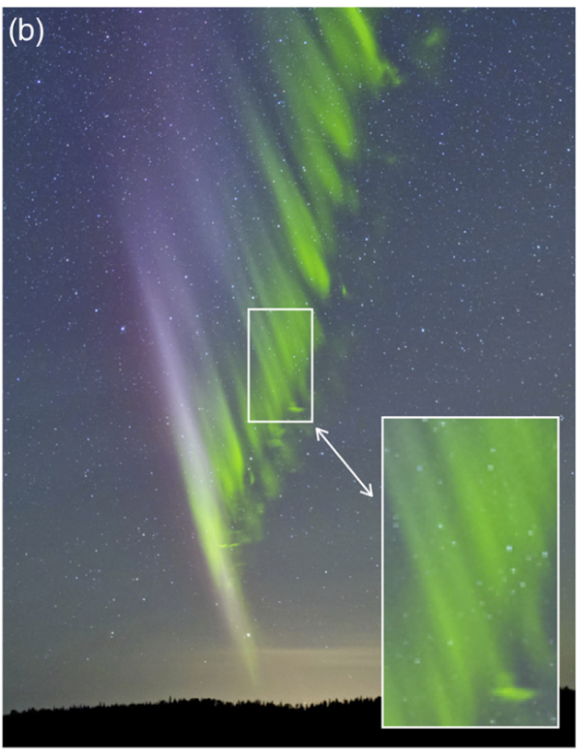
These green spots may result from turbulence in the flowing plasma that creates STEVE’s mauve band. My goal is to look at STEVE data collected by participatory scientists; study the energy released and the differences sizes, or scales, present in these structures; classify it; and measure the level of turbulence present.
You can help!
Understanding the impact of turbulence can help us understand space weather: the science behind and the forecasting of the ever-changing conditions in the solar system. There are growing indications that auroras and the physics that cause them play an important role in the effects of space weather. These may affect technology like satellites, electrical grids, and GPS, so it is crucial to learn more. Knowing which events are particularly turbulent, when they occur, and what causes them means we can study, model and predict them. Doing so will in turn help organizations take preventive measures and build systems that are more resistant to the stresses of turbulence.
This will be most possible with more collaborations, including reports from Aurorasaurus users! If you’ve seen STEVE, I would love to find out more. You can make a report to aurorasaurus.org to share about your STEVE encounters. Then, I can compare them with one another and with scientific measurements. The connection between satellite passages and observations can be extremely crucial to advance this kind of research. I’m excited to work with the Aurorasaurus community to learn more, together.


