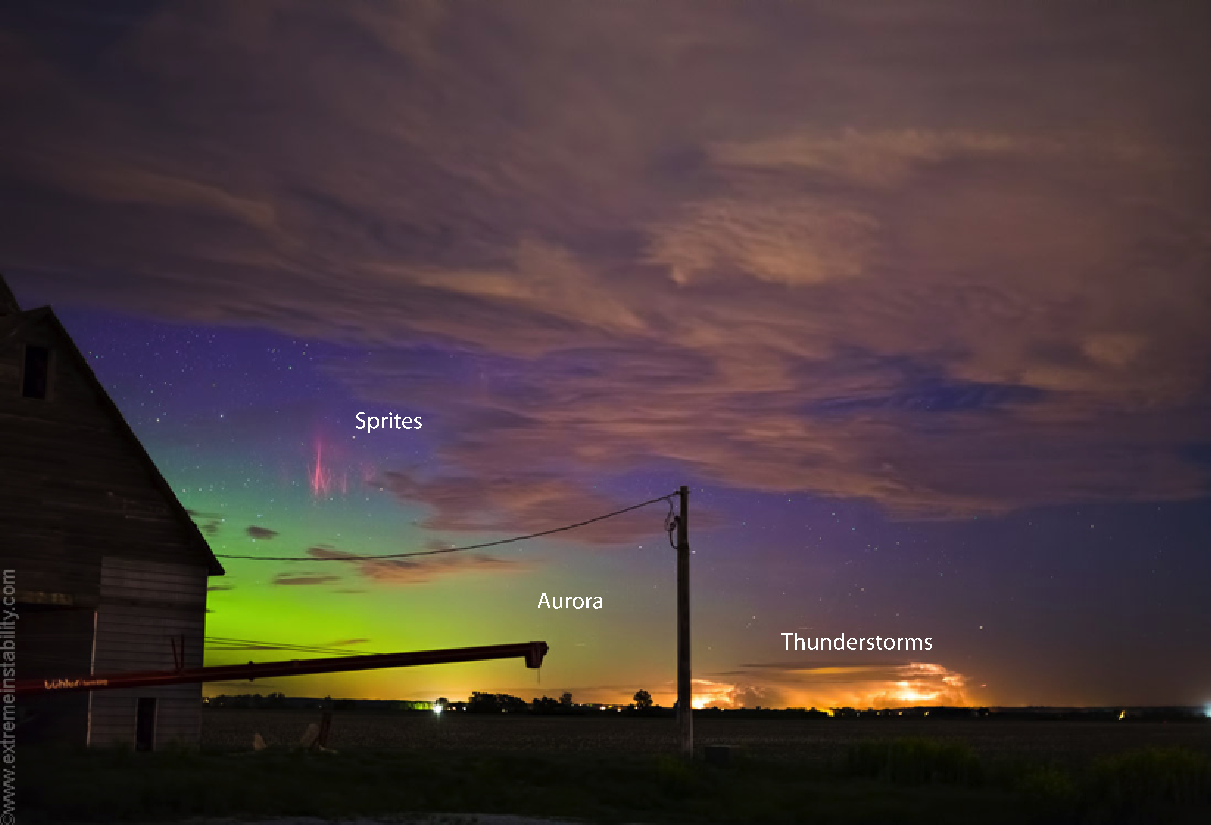
They dance above the clouds but below the aurora, crimson fingers stretching up and down, bursting like fireworks then vanishing in the blink of an eye. Sprites, brief flashes of red and purple light associated with lightning, are some of the least-understood electrical phenomena in the Earth’s upper atmosphere. Even though globally there are 30-100 lightning strikes per second, only a small fraction of lightning flashes are accompanied by sprites, because only very powerful ones are capable of producing them. In the eye of an observer, sprites appear as flickers of light above thunderclouds.

They were even mistaken for unidentified flying objects (UFOs) by airline pilots before they were serendipitously photographed in 1989! Sprites are important to study because they change the electrical properties in our atmosphere and can affect radio communication.
Burcu Kosar, formerly an atmospheric scientist on the Aurorasaurus team, has studied the electrical connection between thunderstorms and the Earth’s upper atmosphere through computer modeling–and is now creating her own citizen science project! Find out more about Spritacular (pronounced “sprite-tacular”) in this NASA feature, enjoy a 2016 Aurorasaurus blog post by Dr. Kosar, watch a short documentary on sprite chasing, follow @Spritacular on Twitter, and check out the project website here.
How do we know about sprites?
People have seen strange flashes of light above thunderstorms for centuries, but it wasn’t until 1989 that the first such event was caught on camera. Researchers from the University of Minnesota were testing a low-light TV camera for an upcoming rocket flight mission. By sheer accident, their camera captured the first photograph of what we now call sprites.
“It wasn’t a very high-resolution or a fast camera, so they just captured these two luminous blobs appearing above the nearby thunderstorm,” Dr. Kosar said. “The whole field was kickstarted just because a camera was pointed in the right direction at the right time.” (Sound familiar, STEVE fans?)

Scientists dubbed these elusive events “sprites,” in reference to creatures from European folklore. As other kinds of optical events above thunderstorms were discovered, the naming convention stuck: today, scientists study ELVES, Halos, Blue Jets, Gigantic Jets, and more. Green GHOSTs are a newer designation that may even occur up in the altitudes of the aurora!
Spritely science
A sprite is one of several phenomena in a category called Transient Luminous Events (TLEs), sometimes called “upper-atmospheric lightning.” Sprites are the most commonly observed form of TLE, occurring at around 50 mi (80 km) altitude, above thunderstorms. The highest sprites just about reach the lowest edge of the aurora, which stretches below 60 mi (97 km). While auroras can dance quickly, sprites move even faster, with speeds up to 50,000,000 meters per second, about one sixth the speed of light! Because of their extremely fast speeds, they are very difficult to capture on camera, much more so than the aurora.
While auroras are generated via magnetic fields, sprites are sparked from electric fields, as large “electrical breakdowns” of air starting at 43-50 mi (70-85 km) in altitude. The electric fields that generate sprites are provided when a cloud-to-ground lightning flash removes charge in the space from the thunderclouds to the ground. This process creates an electric field in the air above the thunderstorm, which stresses the thin upper atmosphere and leads to the heating of electrically charged particles. In the most general sense, if a strong enough electric field is applied, a non-conducting material like air can become a conductor of electricity. This is called “electrical breakdown.” When an electron is accelerated by an electric field, it can smash into atoms and knock loose more electrons that join the fray. When the quantity of frantically-ricocheting electrons reaches a tipping point, they start a chain reaction that creates the plasma from which sprites are born.
That said, there are many questions yet to answer. How often do sprites occur? Why do they take the shapes they do? What conditions in the upper atmosphere trigger sprite initiation? How do sprites affect Earth’s global electric circuit, and what is their contribution to the energy in Earth’s upper atmosphere? How are sprites connected with gravity waves, which send wind-driven ripples of energy through our upper atmosphere?
A Spritacular opportunity
Storm photographers, your mission (should you choose to accept it) is to help Dr. Kosar and the Spritacular team begin building an image database of sprites and other TLEs that will form the basis of countless collaborative scientific studies.
Many commercially available, digital single-lens reflex (DSLR) cameras are suitable for capturing sprites. The hardest part is knowing when and where to look. Spritacular aims to provide all the guidance you need for a successful capture. If you believe you have photographed a sprite or other TLE, you can create an account and submit your photos with time and location information to Spritacular. All submitted photos will be reviewed by scientists. Submitters who collaborate with scientists and whose image leads to a scientific study or discovery will be properly acknowledged or listed as a coauthor on the resulting scientific publication, depending on the level of contribution. Check out this post from NASA’s Sun Spot blog for more info about sprite chasing!
And as we cheer on this sister project, we’re wondering: have you ever seen sprites and aurora dancing together?