Citizen scientists can not only contribute to discoveries, but they can also bring their unique skills to bear to make discoveries of their own and create powerful tools to advance open science. Dr. Michael Hunnekuhl is one such innovator.

Among atmospheric phenomena, STEVE (which stands for “Strong Thermal Emission Velocity Enhancement”) is one of those cool kids the world can’t get enough of. The quirky mauve arc sits atop green stripes and runs east to west, appearing closer to the equator than regular aurora. While it has been observed for centuries by both laypeople and scientists, in 2018 a team of citizen scientists and scientists published the first modern scientific paper on it. This kind of collaboration continues to reveal more and more about STEVE.
But how many people have photographed this elusive character? Aurorasaurus Ambassador Dr. Michael Hunnekuhl aims to find out. By day he is a laser physicist, but for years he has also been interested in scientific and historical auroral and STEVE research. He has authored and coauthored a number of papers on the subject, including the historical analysis “Early Ground-Based Work by Auroral Pioneer Carl Størmer on the High-Altitude Detached Subauroral Arcs Now Known as ‘STEVE’” and coauthored the scientific paper “The Mysterious Green Streaks Below STEVE”. He has been working to link the knowledge gathered by the aurora observer community with that of the scientific community by creating a database of STEVE sightings across the world and through time, and has regularly presented his findings at conferences.
On Friday, January 13, we were lucky to have Michael give a presentation to the Aurorasaurus Ambassadors group, during which he provided a walkthrough of the new update. His goal is to make the collection of more than 1,000 observations available to scientists and citizen scientists alike, giving full access to all the data on the list. All observations in the list are citizen science observations, but in one of the commentary columns, additional observations with professional instruments are mentioned for some observations. Such a large number of data points can now be used for more discoveries and for advancing understanding of the phenomenon. While the first edition was published only as a pdf, this version provides three filetypes for accessing the information.
Michael’s herculean effort is collecting observations and permission from public sources, including citizen science sources and social media like Facebook, which contains many observations that never make it into more official databases. This is a tremendously difficult task, especially alone, and he is now being aided by fellow Aurorasaurus Ambassadors volunteering to help. You can aid this effort by submitting observations directly to a citizen science source like Aurorasaurus or the Finnish site Taivaanvahti (Skywarden Observation Service). Each sighting is then entered into the database and matched up with Kp and other scientific data. When possible, Michael contacts the observer for additional comments and validation, and each entry with a listed name is made with express permission. The list has been a multi-year labor of love, and in this post, we’ll highlight Version 2.2.
Reading the Data
Michael has chosen to host his work on a platform called Open Science Framework (OSF), created by the Center for Open Science. Rather than access to research being limited behind paywalls, OSF provides tools to make sure anyone can engage with data.
What things have you wondered about STEVE? Many people are filled with curiosity about the phenomenon. This dataset is especially exciting because, as Michael points out in his 2022 American Geophysical Union conference poster, it lays a foundation for scientists and citizen scientists alike to investigate big questions like:

Interest piqued? Let’s look at how to access the data. On navigating to the STEVE event list webpage you’ll see a lot of files in a dropdown on the left-hand side of the page. These include previous versions, so it’s especially important to make sure the files you choose to explore are labeled 2.2.
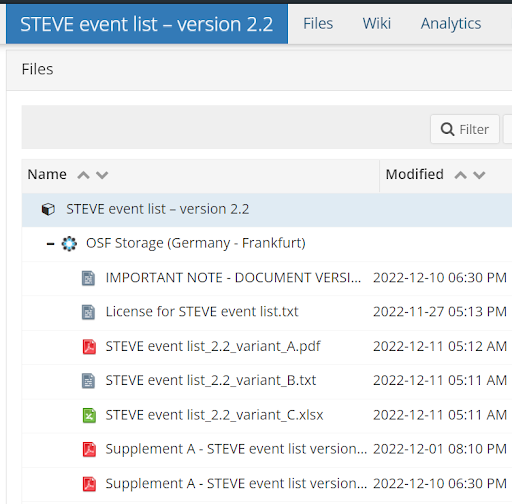
The STEVE event list 2.2 is divided into three filetypes, so you can choose to open or download it as a pdf, a text file, or an Excel spreadsheet. Click on the filename of your favorite type. The window will open a viewer:
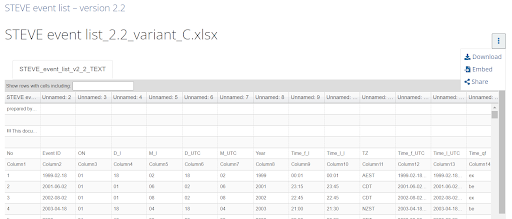
You can use the three vertical dots on the right side of the page to open a dropdown and download the file, making it easier to look through.
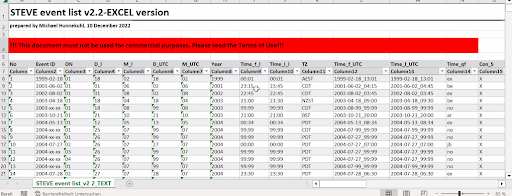
The columns have abbreviated titles, but never fear! Michael has provided a cheat sheet of the column names in Supplement E – Data structure STEVE event list v2.2.pdf. The entries are arranged in rows by date, starting in 1999. Make sure to scroll to the right, however; there are 44 columns! They’re full of data detailing multiple expressions of observation date and time, measures of precision, ratings by expert volunteer reviewers (including fellow Aurorasaurus Ambassadors), scientific data comparisons, location, observer names (with permission), and more. The ratings represent reviews by aurora chasers experienced in recognizing STEVEs, and such meticulous attention to accuracy makes this a gold standard list. The spreadsheet is built so that columns can be sorted and filtered to assist with study, and Michael demonstrates this in his walkthrough for the Ambassadors, available to all on our YouTube page. It’s a rich trove of information with enormous potential to catalyze the study of STEVE, painstakingly constructed and generously offered to the world.
To make such a multifaceted resource easier to use, Michael has also provided a range of supplemental documents:
- What do you need to do to use this data in your research? Check out the Terms of Use in Supplement A. Take particular note of how important it is to respect the permissions of the observers who created each data point.
- What’s the lowdown on geomagnetic storms, and how does the list classify them and their characteristics? That’s in Supplement B.
- What, exactly, is citizen science? Head to Supplement C and read the European Citizen Science Association’s Ten Principles of Citizen Science.
- How does this list classify different aurora-like phenomena? Supplement D has an explanation, and it’s still under development.
- What do all the column headers mean? Supplement E holds the key, using the text file as an example.
- How were data points chosen? There is a list of selection criteria in Supplement F.
- What about accuracy? Michael cares so much about it that he enlisted citizen scientists to contribute to helping review all the social media observations submitted as STEVE. Supplement G summarizes the results of the first review, performed by experienced observers from the aurora chasing community.
- Need an index of the above? Supplement H gets meta with a Plain Language Summary of all the aforementioned supplemental documents.
What will you discover?

Exciting trends are already becoming apparent in the data! The graph above, featured in Michael’s presentation, shows growth in the number of days per year with STEVE observation reports. This a trend that coincides with citizen scientist interest in the phenomenon, and so is not a true increase in absolute frequency. However, there could be solar cycle and pandemic effects visible and we are excited to keep collecting as solar maximum heats up and auroras become more frequent.
Be curious. What patterns might you notice in the data? Dive in and find out! And if you want to help keep the database up to date, Michael can be contacted via email at michael_hunnekuhl@web.de. Finally, a huge thank you to Michael for taking it upon himself to create such an invaluable resource! We can’t wait to see where it leads.
In 2022, Dr. Michael Hunnekuhl received a small grant for the STEVE Event List 2.2 from the Scientific Committee on Solar-Terrestrial Physics (SCOSTEP), an international group dedicated to international collaboration and dissemination of knowledge. It is very unusual for a citizen scientist to receive a grant like this, and speaks to the high quality of his work.
2023 is the Year of Open Science and NASA is offering tools for people to learn more about efforts like these. Find out more here!


