Guest post by Dr. Liz MacDonald
The Heliophysics Big Year will celebrate solar science and its connection with our world; Heliophysics itself is the study of our Sun and how it interacts with everything in our solar system. Inspired by the “Big Year” concept in birding, this will be a personal quest to experience and enhance your relationship with the Sun from October 2023 to December 2024. This time covers two different solar eclipses, as well as “solar maximum,” when the Sun is at its most active! One of the biggest ways to take part will be through participating in citizen science. When I’m not leading Aurorasaurus, I am working on this effort, and I’m excited to bring it to you!
Heralding the Heliophysics Big Year will be two solar eclipses: an annular solar eclipse on Oct. 14, 2023, which will bring viewers in its path a “ring of fire,” and a total solar eclipse on Monday, April 8, 2024, which will fully block the sun along the eclipse path. Most of the following opportunities still apply everywhere with a partial eclipse—in other words, most of the continental US!In this post I’ll highlight ways you can jump-start your involvement now. We are also looking for volunteers and participatory science influencers to help spread the word about #heliobigyear. If you have an interest or question not covered here about how you can get involved, get in touch at hq-heliobigyear@mail.nasa.gov.
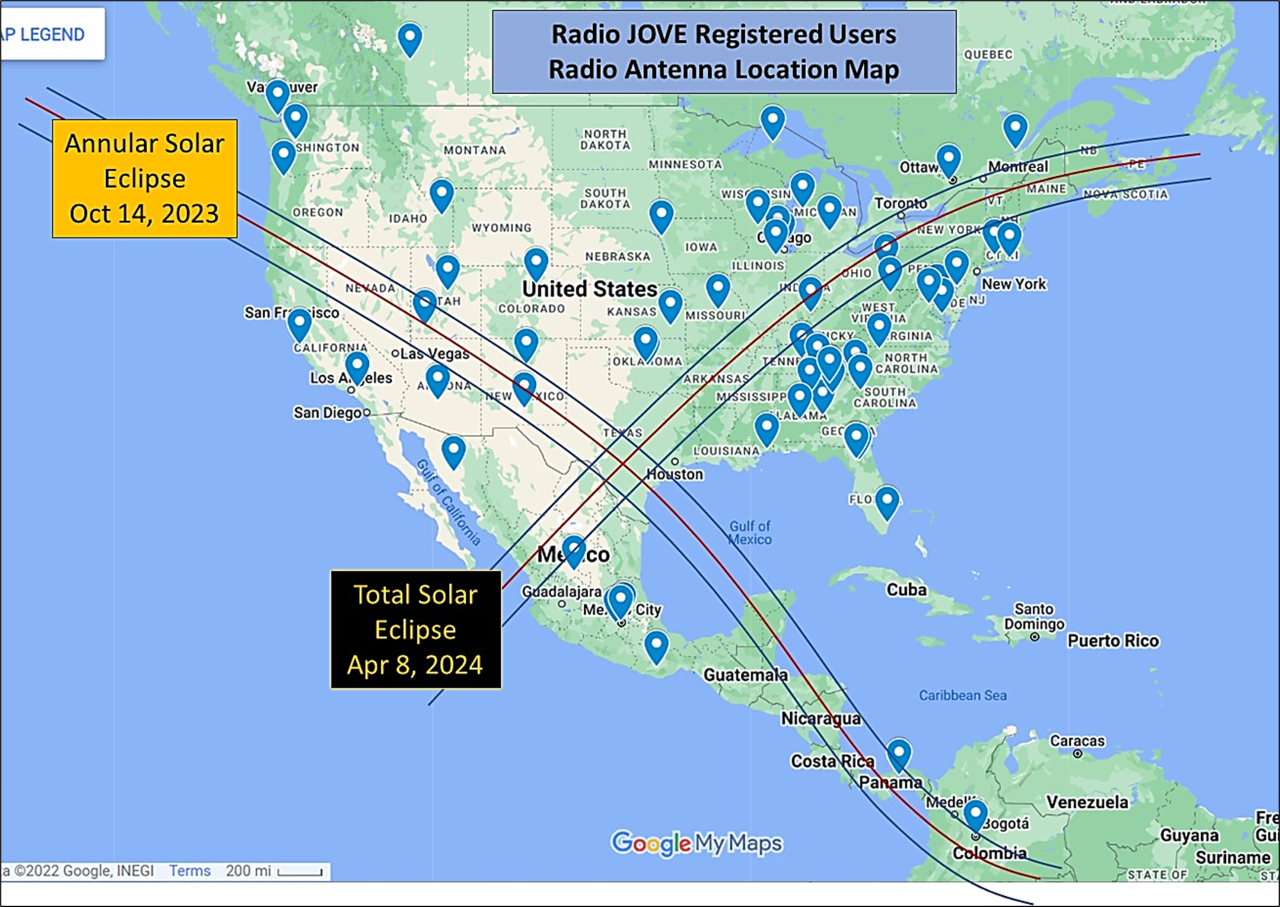
The path of the annular (left) and total (right) solar eclipses over North America. Credits: ©2021 Great American Eclipse, LLC, Used with Permission.
Check out your local library
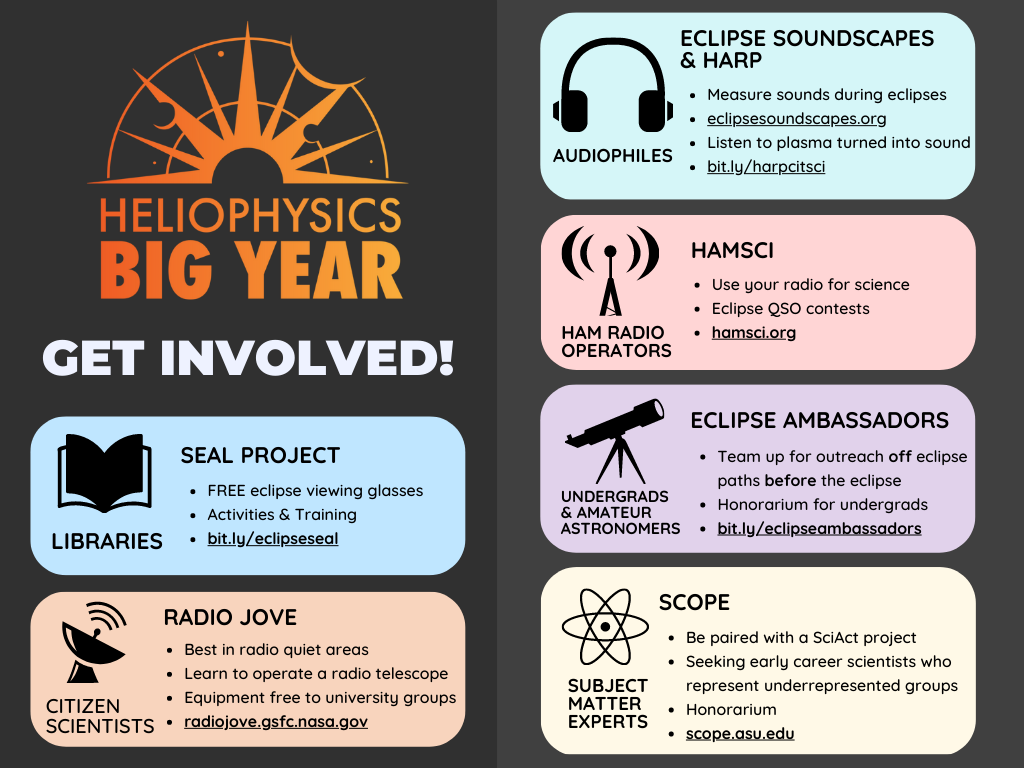
Check out the Solar Eclipse Activities for Libraries (SEAL) Project to help your library get eclipse viewing glasses, activities, and training about the upcoming solar eclipses, all free! The SEAL team plans to deliver free eclipse glasses, educational materials, and online training to 6,000 library systems, provide circulating solar science kits to all 50 State Library Agencies, offer in-person workshops in coordination with all 50 State Library Agencies, and conduct eclipse education activities in non-library community sites.
Turn up the volume
If you’re in an area without a lot of ambient radio signals, you can learn to operate your own radio telescope with Radio JOVE! Small grants are available for students and teachers to bring projects like Radio JOVE to the classroom. During the 2017 All-American Eclipse, Radio JOVE participants listened to the variations in the sounds of the Sun and the Milky Way galaxy background caused by the ionosphere’s response to the solar eclipse. And if you’re an amateur radio operator, you can take part in scientific research with the Ham Radio Science Citizen Investigation (HamSCI). Check out their free virtual conference coming up!
If you like to be still and hear the sounds around you, try Eclipse Soundscapes. This project asks volunteers to take audio recordings of ambient sounds during eclipses. Eclipse Soundscapes also works to enable everyone, including people who are visually impaired, and others who were unable to see the eclipse with their own eyes, to experience the event.
Help spread the word
If you’re an undergraduate student or amateur astronomer, help get the word out about upcoming eclipses by applying to the Eclipse Ambassadors program run by the Astronomical Society of the Pacific. Undergrads and amateur astronomers will pair up and be provided with everything you need to get the word out to your community off the eclipse path, like virtual training, resources including glasses, partnerships and a supportive community of eclipse enthusiasts. As a NASA partner, you will be recognized for your commitment to astronomy public engagement and supplied with educational materials as well as community connections. Note: all engagement is done to prepare your community before the 2024 eclipse – there is no obligation to host eclipse day events. Undergraduate students can also receive a small stipend and the chance for a larger opportunity to experience the aurora in a field school after the Big Year.
Take part in science communication
An opportunity for our Heliophysicist friends, and other Subject Matter Experts: you can apply to the SCOPE project to participate in and support solar science events with the general public, uniting the outreach efforts of NASA’s Science Activation projects with the Heliophysics Big Year. To encourage broader participation in the educational outreach efforts of NASA’s Science Activation teams, funding will be provided to support your time and effort.They are especially seeking early career participants from communities underrepresented in STEM. See the listing for full eligibility requirements.
Going Global
Last but not least, Canadians can check out eclipse information from the Canadian Space Agency. There is also a French-language Éclipse Québec initiative, which aims to include a mobile app, eclipse glasses, events, teacher resources, and an Ambassador Program for university students. According to N. Nguyen-Quoc Ouellette, who gave a recent presentation on Canadian eclipse opportunities, there will also be task forces by Ontario, Prince Edward Island, and the Royal Astronomical Society of Canada. Other global participation can happen via the amateur radio community, as eclipses affect the Earth’s atmosphere in a way radios can measure, and by getting creative with NASA Space Apps Challenges. Stay tuned for more information!
The Countdown Begins
I’m excited to kick off the Heliophysics Big Year. As someone who is both a space physicist and an avid citizen scientist, I think the Big Year represents a great chance to spread out the huge peak of interest in eclipses into participation and increased awareness of our science, with joy, curiosity, and equity. I hope you will join us through one or more of these opportunities and stay tuned for more ways to participate that are coming soon. Be thinking of how you want to celebrate a #heliobigyear and which projects you may try.
Resources
- Heliophysics Big Year website
- A whole deck of slides about Eclipse opportunities from a session at this year’s American Astronomical Society conference
- Another deck about the Big Year that includes slides about all of the involved community science projects
- NASA Eclipses website
- NASA Science Activation teams, including many of the projects mentioned in this post


