By Vincent Ledvina, Andy Witteman, and Laura Brandt
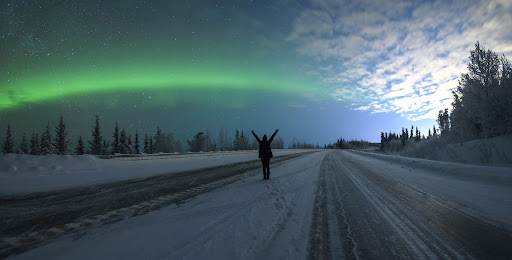
Watching the aurora is a breathtaking experience, but unless they are very strong, the Northern Lights don’t look to the naked eye like their colorful photos. It’s not a trick of the light—just a difference in the ways eyes and camera lenses work.
In Your Eyes
The human eye evolved to help navigate the world in a range of light levels, and contains special cells called rods and cones in the retina, the back of the eye. The way that input from the retina interacts with the brain is complex, and different from a camera sensor.
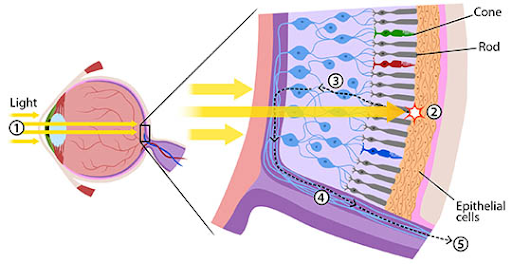
Rods respond well in dim light and to movement, but not to color. They are more than 1,000 times more sensitive to light than cones and comprise most of the receptors in the eye: about 100 million. Rods are concentrated off-center on the retina, which is why astronomers often use “averted vision” to view dim stars. Looking just to the right or left of a dim structure turns more rods toward it. Another quirk of rods is that they are not sensitive to red light, which is why people who need to maintain “night vision” use red lights.
Cones respond well in bright light and process color. The eye has about 6-7 million cones, concentrated in a divot in the center of the retina called the “favea” that helps with seeing details. There are three types of cones, each of which responds to a different wavelength range: blue, green, and red. The way the brain combines signals from each type allows for sight in different colors. Different people with typical color vision can have different proportions of cone types, which means it is normal for different people to see different amounts of color in the aurora.
In bright light, cones take over, rods are less active, and color vision strengthens. In very low light, cones enter a standby mode and the eyes see in grayscale using rods. Cones activate in moments, while rods can take up to 40 minutes to fully activate. At about twilight light levels, they work together, and it is possible to see dim colors.
So what does that mean?
Seeing color in an aurora has to do with the ways your eyes are activated. If an aurora is strong and gives off enough light to activate your cones, you will see colors. If it is weaker, it may be visible with both rods and cones and appear greyish-green, or with rods only and appear grey. Another way cones can be activated is through the artificial light of light pollution. Dim aurora is often “washed out” by light from towns and cities, but according to aurora chasers, during a rare intense storm or when viewed from a location in the far north, the color can appear easier to see when combined with light pollution. The overall amount of aurora you can see is much lower in bright locations, but the color may appear more vibrant—a strange testament to the way our eyes function! One aurora guide pro tip is to shine a flashlight underneath your eyes (point it at your mouth) for a few seconds, activating the cones and allowing you to briefly view the colors of aurora better. Note that you should never shine a flashlight directly into your eyes, and that this technique will reset the up to 40 minutes that your rods need to fully activate.
Aurora guides are often asked: does aurora viewability change with age?
As humans age, we slowly lose both rods and cones, but far more rods than cones. The light-sensitive pigment in rods also regenerates more slowly in older eyes. Combined with other changes like the pupils letting in less light, slower movements of the iris muscles, and thickening of the lenses, this can create challenges with eyesight, especially at night.
Into the Lens
How A Camera Works
Let’s do a quick recap of how images are created in cameras. For simplicity, this explanation will cover digital cameras.
Light from the aurora enters through the camera lens. The light first passes through an aperture in the lens. The lens’ aperture controls how much light passes through the lens and determines how much light the camera sensor receives. After the aperture, the light passes through a number of concave and convex glass lenses. The purpose of these lenses is to focus the light onto the image sensor. It just so happens that when the light beams are reflected, the image actually ends up being upside down. The camera rotates the image right side up.
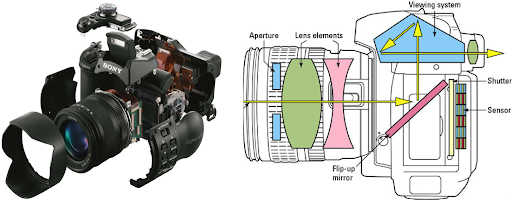
A camera has three main settings the user can control: aperture, shutter speed, and ISO (related to the International Organization for Standardization).
- Aperture is the size of the hole inside the lens through which light can enter and illuminate the camera sensor. Larger apertures let in more light while smaller apertures let in less light. The “f-number” of a lens indicates how large this opening is. Lower f-numbers correspond to larger openings, and an f-number below 2.8 is ideal for low light photography, including auroras. When taking photos of the aurora, use your lens’s widest aperture setting (lowest f-number).
- Shutter speed is the duration that a camera sensor is exposed to light. A longer shutter speed means the sensor is collecting more light, while shorter shutter speeds mean the camera receives less light. For aurora photography, shutter speeds around 5-20 seconds work well. The exact number will depend on how bright and active the aurora is. Brighter and faster-moving auroras will require less exposure time, so a shutter speed of 5 seconds may work well to make the resulting image bright enough. Very faint aurora may require a shutter speed as long as 20 seconds.
- ISO is complicated, but for our purposes we can call it an amplification setting which brightens the light after it has been collected by the camera. For aurora photography, after you have adjusted aperture and shutter speed, set your ISO to a value that makes the image look bright enough.
Cameras and Eyes are the Same, but… Different
Cameras and eyes have a few similarities. The rods and cones in our eyes are like tiny camera sensors; they receive light and send signals to our brain that it uses to construct an image. Our eyes also have an aperture: the pupil. At night our pupils dilate, or get bigger, to let in more light—just like a photographer uses large apertures in low light to maximize the amount of light gathered by the camera. That’s largely where the similarities stop. While cameras have a shutter speed, our eyes do not. Cameras are able to shoot an image with an exposure of 10, 20, or 30 seconds, which lets in an incredible amount of light and allows more photons of light to be recorded. Eyes take in a certain number of images per second that can be processed by our brain—akin to a video “framerate.” These range anywhere from 50-90Hz, meaning that we can process 50-90 images per second. Cameras have a setting called ISO that allows them to amplify very low amounts of light. Camera settings are something we can adjust while our eyes are controlled subconsciously, and most people can’t control how wide their pupils are or how “fast” they capture images. Camera settings allow for more flexibility in how an image is produced and how it looks.
Do cameras or eyes see aurora better?
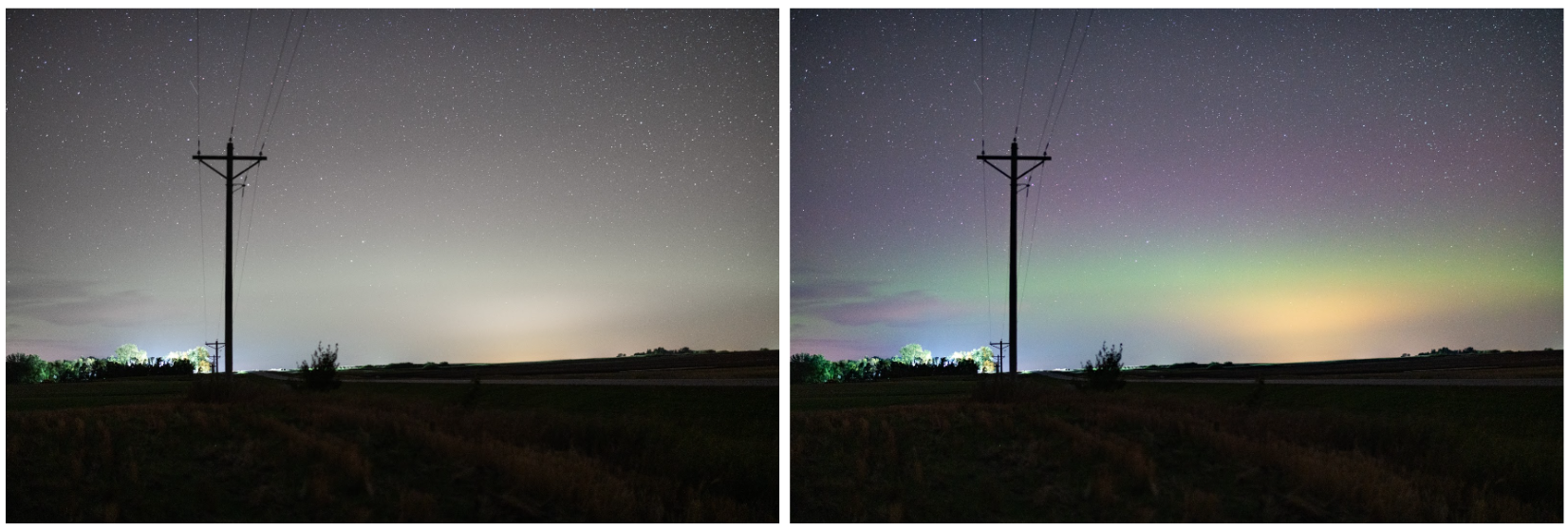
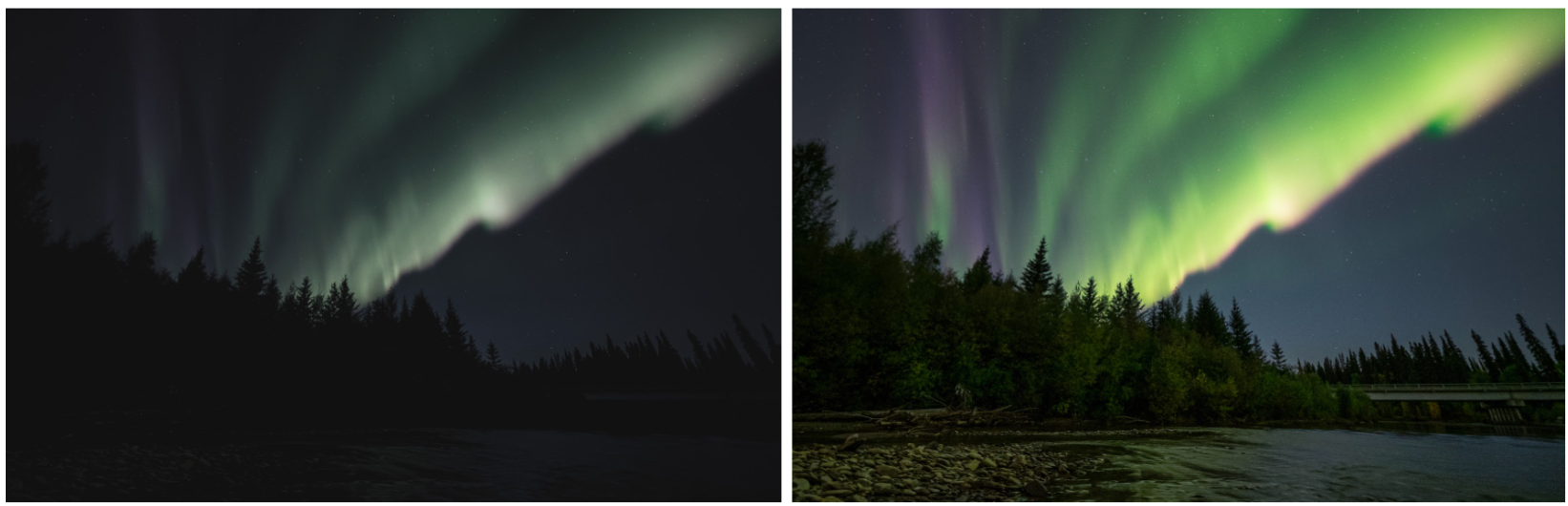
In general, auroras captured by cameras are typically more vibrant and colorful. Cameras can collect many more photons than our eyes, and the more signal is captured by any recording device the more color fidelity, structure, sharpness, and detail can be extracted. Cameras also don’t experience the loss of color at night that eyes do as rod cells dominate; the camera’s sensor can record photons, even very tiny amounts, meaning that the faintest of colors can be perceived by cameras. They are able to capture more of the aurora and more colors of the aurora, even sometimes seeing reds and pinks that are invisible to us.
Because of this, it is helpful to keep expectations in check. While auroras seen by the unaided eye may not have the same vibrant colors and detailed structures as photos, seeing them in person can provide a much different experience. Depending on the location and intensity of the show, many auroras have an eerie color palette which cameras can’t quite capture. There can also be fast-moving structures that longer photo exposures tend to miss. Seeing the motion of auroras with the naked eye is often exciting for new aurora chasers, who are used to viewing static images.
While changing settings on a camera can compensate for some differences, aurora photography is still at its core a predictive art. In other words, the biggest disadvantage to using a camera is that after the shutter is pressed or video is started, it only captures the aurora according to the settings the photographer chose. Especially during intense periods of a display the aurora can change rapidly. While photos may capture more light or vibrant colors, they are still based on settings the photographer selects, predicting what the next moment may bring. By contrast, our eyes have the ability to endlessly and seamlessly adjust from one moment to the next, providing a very different experience when it comes to the overall progression of aurora structure, brightness, intensity, and even color. Auroras are amazingly beautiful, and cameras can’t fully capture the overall experience; the overwhelming emotion, feeling, and atmosphere of witnessing one of nature’s most ethereal phenomena.


