By Vincent Ledvina and Laura Edson
With many thanks to aurora photographer Marybeth Kiczenski for reviewing the post
As artificial intelligence (AI) becomes more popular, many are using it to create content, including about auroras. While it can be useful, in a social media world that values speed, clicks, and engagement it can be hard to discern AI photo art from real photos. AI may also use a photographer’s or artist’s work without permission. Not only may that present copyright issues, but it can remove meaningful work from its original context—for example, with regard to issues of cultural sovereignty or an artist’s tributes to loved ones who have passed on. AI also raises concerns about accurate scientific data and data ethics, so the best participatory science images are in RAW format, and unedited. In this post, we share some tips for telling the difference between real and AI-generated aurora pictures. This is by no means comprehensive, but we hope it provides a starting point.

Color
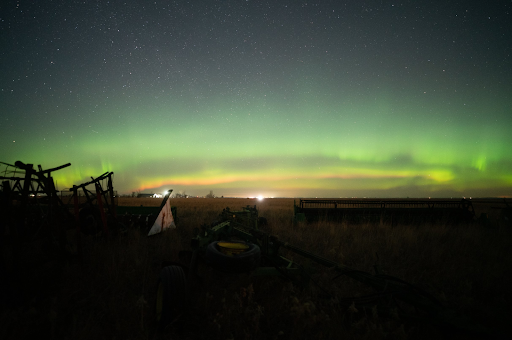
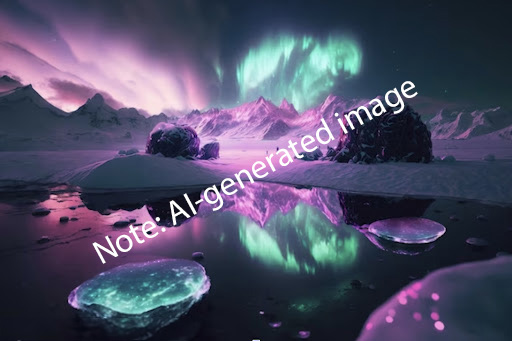
While auroras are sometimes poetically likened to rainbows, their colors are different. Aurora colors layer by altitude like a cake and are so consistent that they can be used to tell the elements and altitudes of different parts of the aurora (see diagram below.) Any deviation from these patterns—for example, a “rainbow” aurora where the colors change along the horizontal plane—may be a sign the picture is AI-generated.
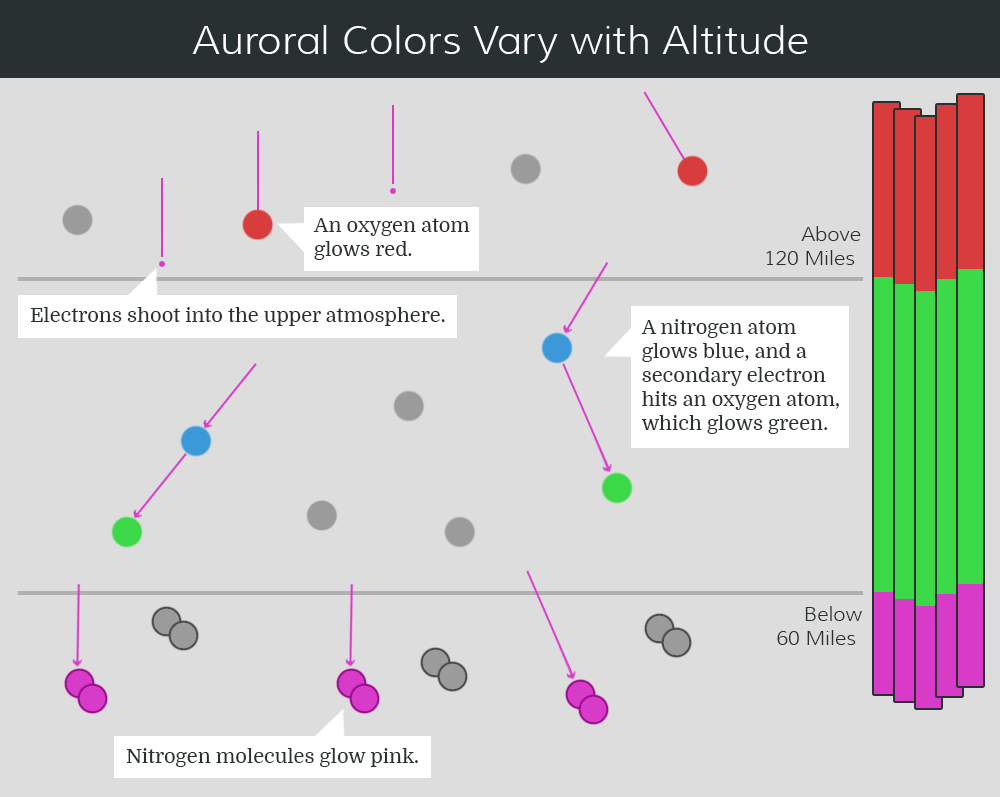
Occasionally there might appear to be other colors in an aurora because of rare atmospheric conditions or the way that our eyes interpret colors of light mixing. Because of this, people sometimes see colors like yellow or cyan in aurora. Special “astromodified” cameras can also make red tones look brighter. However, aurora colors will never appear in the same order as a rainbow.
|
|
|

Shape
While aurora displays can evolve in many different ways, they often take on very distinctive shapes. Aurorasaurus places auroral shapes into three main categories for reporting: discrete, diffuse, and pulsating. You can find out more about each type here, but for this post we will focus on the brightest, most sharply defined, and most photographed: the curving, ribbonlike discrete aurora.
Aurora chasers and scientists identify shapes within discrete auroras, like curtains, arcs, curls, spirals, or rays. For example, one type is the auroral spiral, affectionately called “cinnamon rolls” by some aurora chasers.
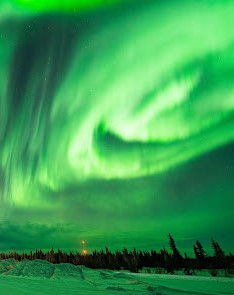
However, there are shapes auroras don’t typically make, like right angles or polygons. In addition, while real-life discrete auroras occur in multiple ribbonlike sheets, the forms are separated from one another like the layers of a flaky pastry. In other words, real auroral forms should have gaps between them and never directly touch or cross one another.
|
|
|

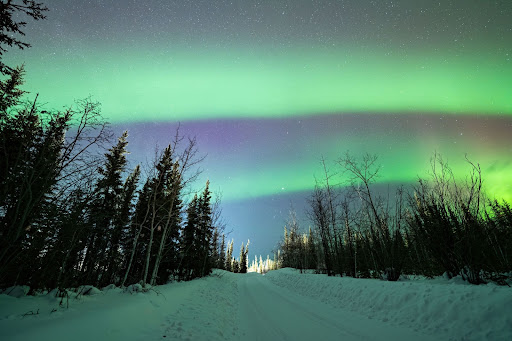
Location
Auroras occur in an oval around the magnetic north and south poles. If the aurora is particularly strong, the oval can expand to lower latitudes, but it is highly unlikely to be close to the equator. If an image includes a popular landmark or landscape that usually doesn’t see aurora, it’s unlikely to be real unless there was a particularly strong event.
For example, a photo of the aurora above the Galapagos Islands (about 1° South latitude) would require extremely improbable conditions. A photo over the Grand Canyon (about 36° North latitude) would be more possible, but only if archives show strong auroras that night. To find out, you could look up the date on Aurorasaurus and see if there were other reports from that location. More reports from that area will give the image more credibility. If there wasn’t activity on the night the photo was taken, then it is an artistic rendering, possibly AI.
Star patterns
One of the best ways to tell between an aurora and a cloud is that stars are visible through an aurora, while clouds are opaque. Therefore, in a real photo you should be able to zoom in and see stars through the aurora. If you can’t, the photo may be AI-generated.
In addition, at the time of writing AI is unable to depict accurate star locations. This is most obvious in AI-generated images of the Milky Way, which often misplace certain nebulas. With an image of the night sky in general, it can be harder to tell if the placement of the stars is realistic. Some sites like astrometry.net have tools that can tell you what stars you are seeing in a photo, so running an image through such a tool would tell you if star placement is accurate. AI photos would likely not pass this test since the “stars” are randomly generated.
|
|
|
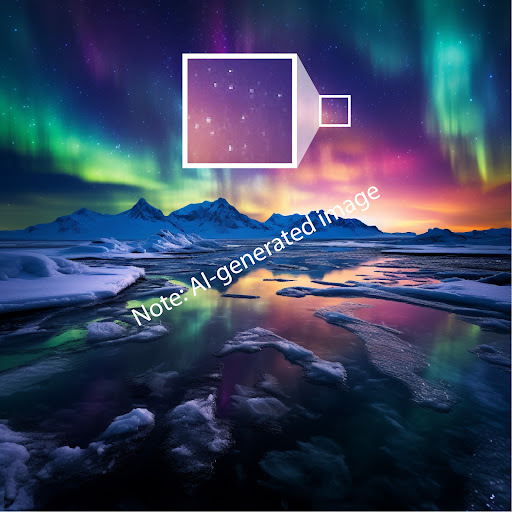
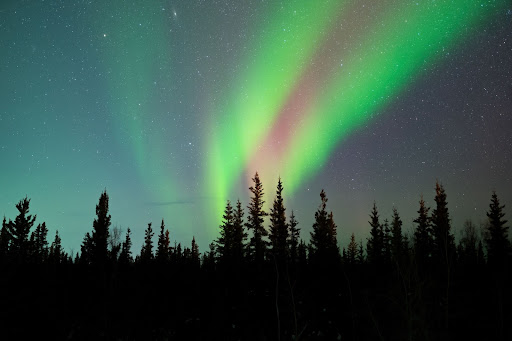
Smoothness
At the time of writing, AI-generated photos usually have a telltale aesthetic that can be easy to spot with practice. The sky and landscapes may look smooth—almost painted—and lack detail. The aurora may also look airbrushed in and have perfectly smooth gradients between colors. There may be uneven sharpness or inconsistent details throughout the image. For example, one giveaway is if some portions of the sky have stars and some do not. Some sections of the photo might also show stars “in focus” while other sections show blurry stars. An aurora image with perfectly lit and focused animals in the foreground would be nearly impossible to take with a camera and is a giveaway that the image is artistic—either AI or edited with special techniques.

The net upshot
AI will inevitably grow in usage and become more sophisticated, so it’s a good reminder to think critically about images shared online. In addition, if a photo is real, the photographer will easily be able to tell you how they took and processed it. That also means that if they choose to share it with Aurorasaurus for science, we can ask questions and learn more about what they saw. AI-generated images, on the other hand, do not contain useful aurora science information. Unedited RAW shots are preferred for scientific analysis. So while aurora art may see a renaissance, for projects like Aurorasaurus it’s important to keep it real.


