On October 10-11, 2024, the aurora danced through skies across the globe. The storm was driven by a large, fast coronal mass ejection that had launched directly at the Earth about 38 hours before, and was heralded by a long-duration, very strong X1.8 class solar flare. During both the October and May 10-12 storms, the aurora was seen much further toward the equator than usual, with May the largest storm of the solar cycle thus far and October the second largest. Now the question on many minds is: how did these two storms measure up in terms of aurora? In order to compare and contrast them from a scientific perspective, we need lots of data. And while the excitement and enthusiasm about the October storm didn’t quite break the Internet, it did temporarily overwhelm the Aurorasaurus site. We are back up and more solid than ever, but the best way you can help is to report your sightings (or attempted sightings) for October 10-11 to www.aurorasaurus.org.
In this post, we walk you through the aurora’s world tour on October 10-11, with firsthand accounts from around the globe. We will use EDT (Eastern Daylight Time) throughout in order to match the following screenshots of the Aurorasaurus website. Please note that sightings on the Aurorasaurus website (as shown on the screenshots) constitute a preliminary dataset and are further verified for scientific use.
Oceania and Asia
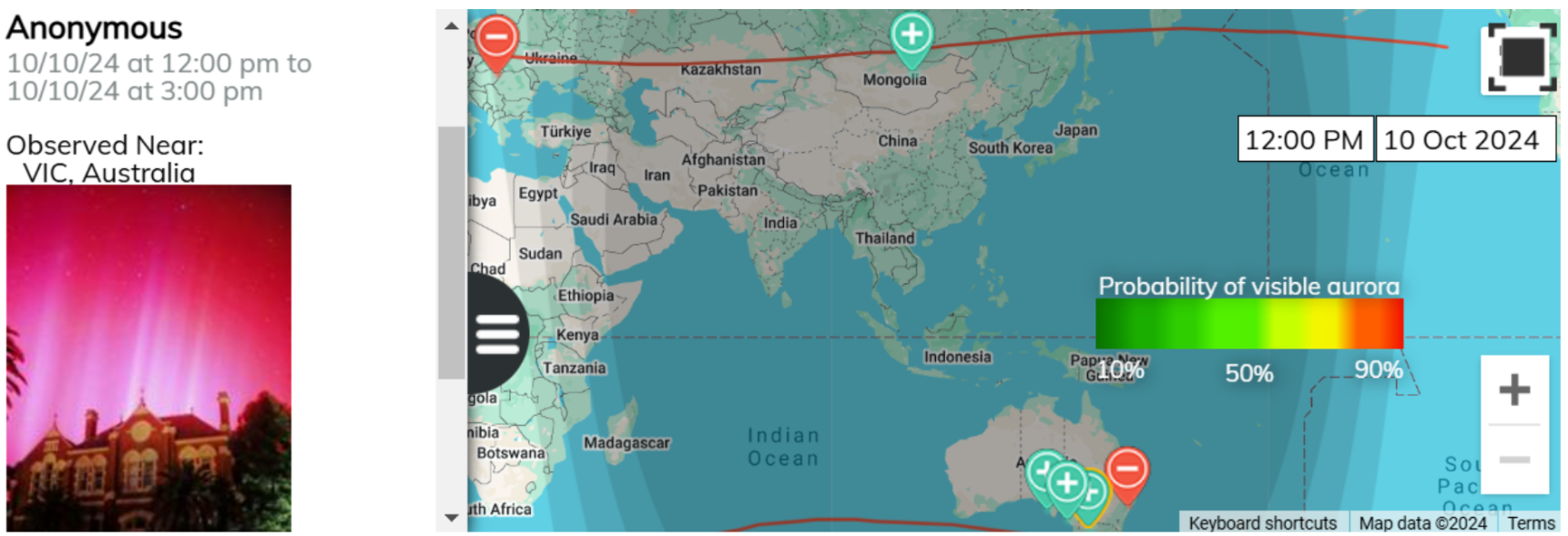
Tasmania, Australia — Aurora Chaser Gill Dayton
Observed the aurora on Oct 10 at 12:30 pm EDT,
which is Oct 11 at 3:30 am local time and Oct 10 at 16:30 UTC
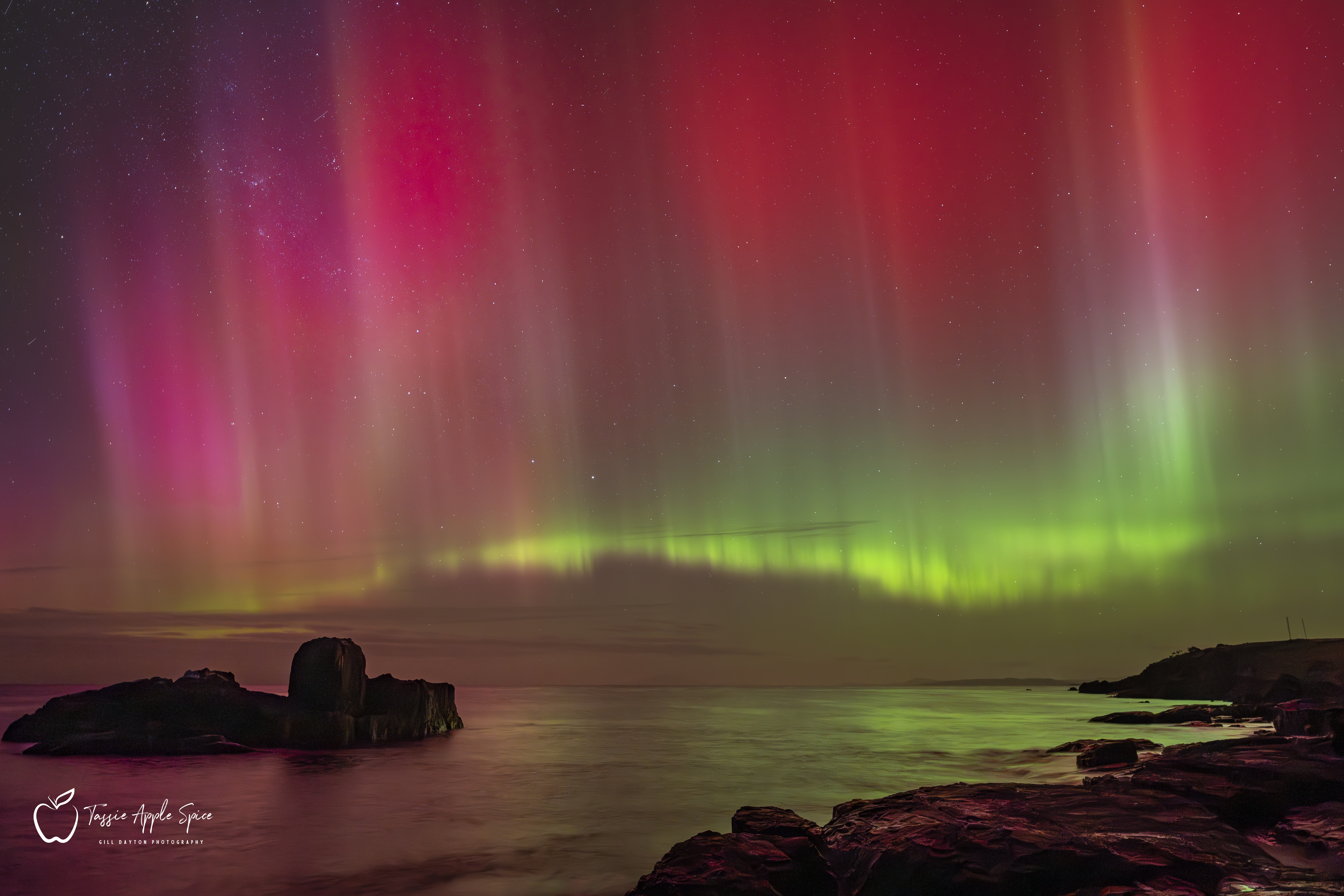
I’d set myself up for a night of camping on a secluded little piece of coastline on the East Coast of Tasmania. There had been so much excited hype about the upcoming aurora, and she did not disappoint. She turned up just after 0330hrs (12:30 pm on the 10th in EDT)—not quietly, but with an explosion of amazing, bright colours. The back of the camera looked like a packet of crayons had combusted across the screen. Stunning in intensity, the aurora was still going strong as dawn broke, eventually fading away with daylight. Read on for what happened that evening!
Europe and Africa
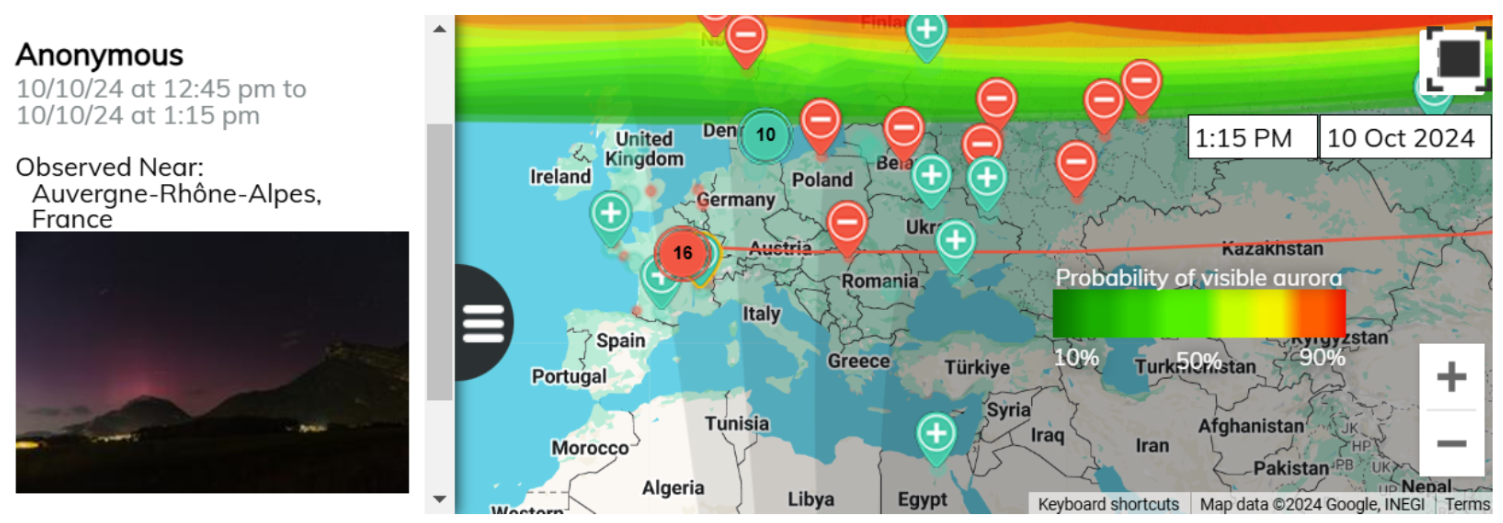
England, UK — Aurorasaurus Ambassador Hannahbella Nel
Observed the aurora on Oct 10 at 5:30 pm EDT,
which is 10:30 pm local time and 21:30 UTC
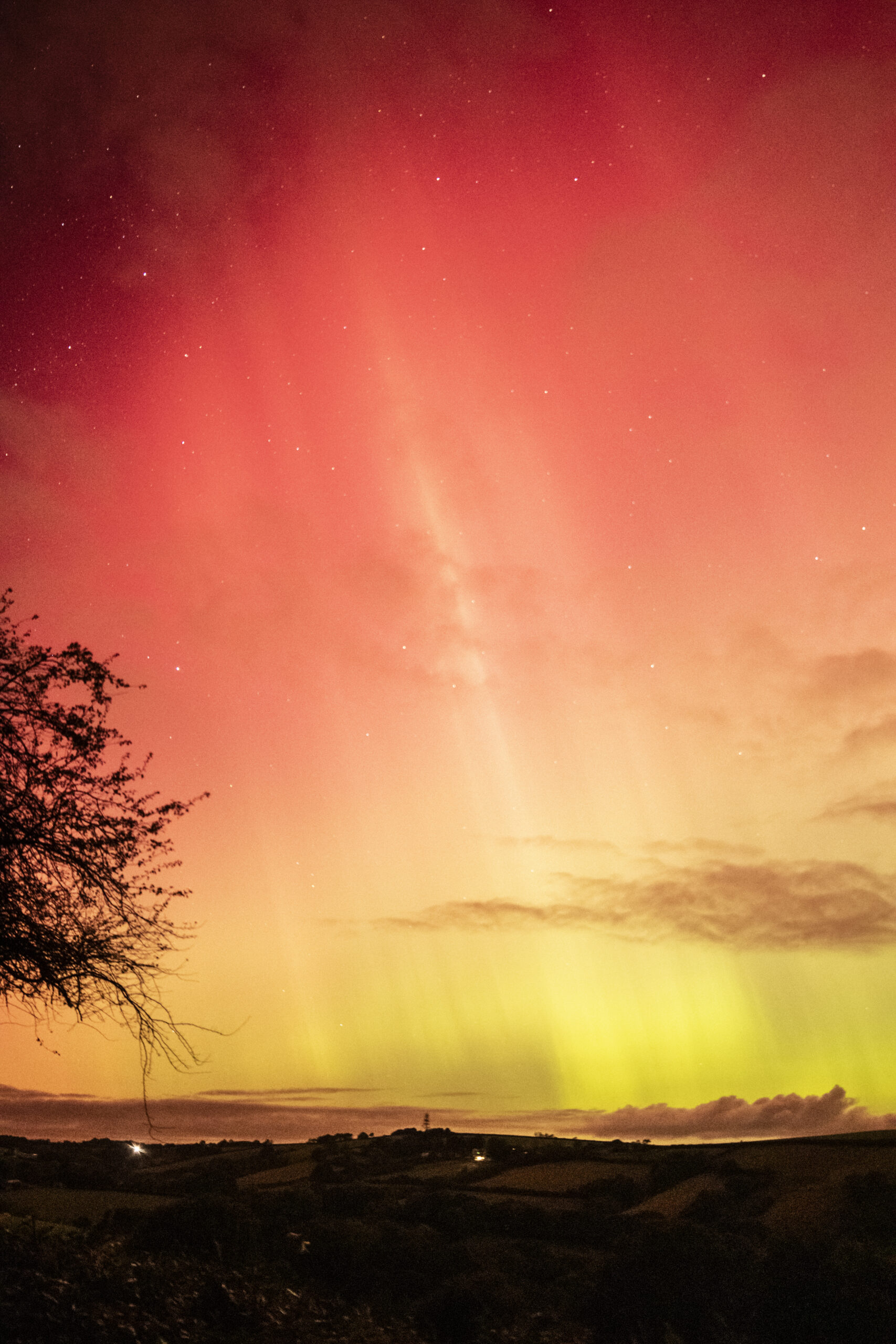
I watched the display from a friend’s north-facing garden. The weather was against us until around 22:30 BST (5:30 pm EDT). I had been keeping an eye on the data and saw a substorm was about to grace our skies. Between broken clouds, the sky had turned almost completely red! As the clouds cleared quickly, we found ourselves standing beneath huge pillars which were almost white: something I hadn’t experienced as far south as Exeter.
For many years and across many countries I have both worked as an aurora guide and been an aurora chaser, but this was without a doubt the reddest display I have ever seen. The October 10 storm was mainly red and green, and had huge, wide, tall pillars, pulsating aurora, blob aurora, a SAR arc which lasted hours, a corona, and alllll the red! We didn’t see it reach the southern horizon while we were watching it from 22:30-02:00 BST, but it was magnificent!
North America
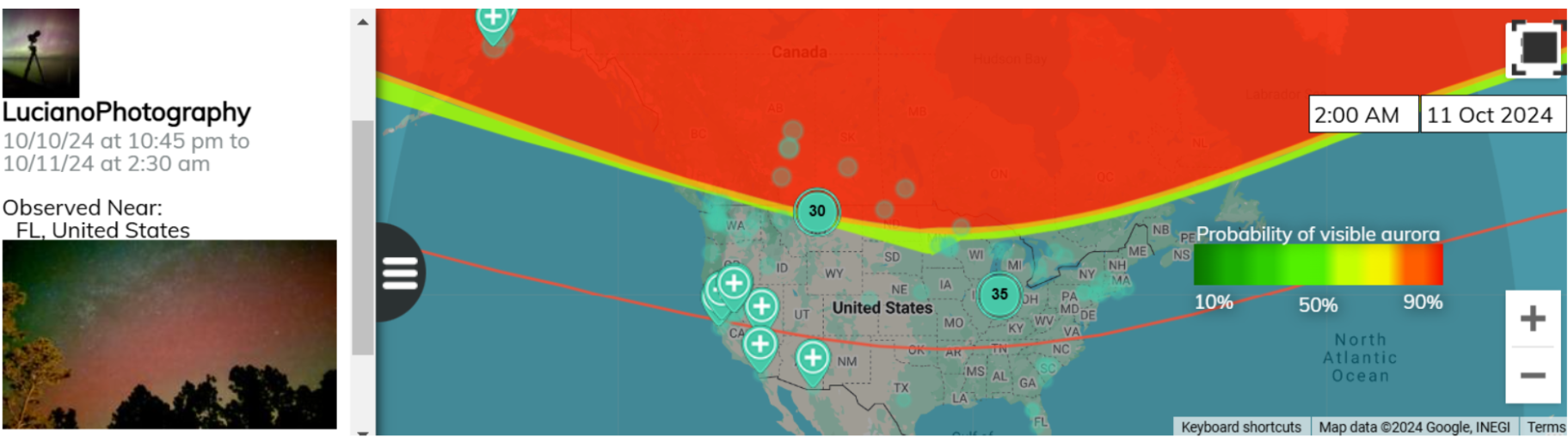
Washington, DC, USA — Aurorasaurus Project Manager Laura Edson
Observed the aurora on Oct 10 at 7:30 pm EDT,
which is 7:30 pm local time and 23:30 UTC
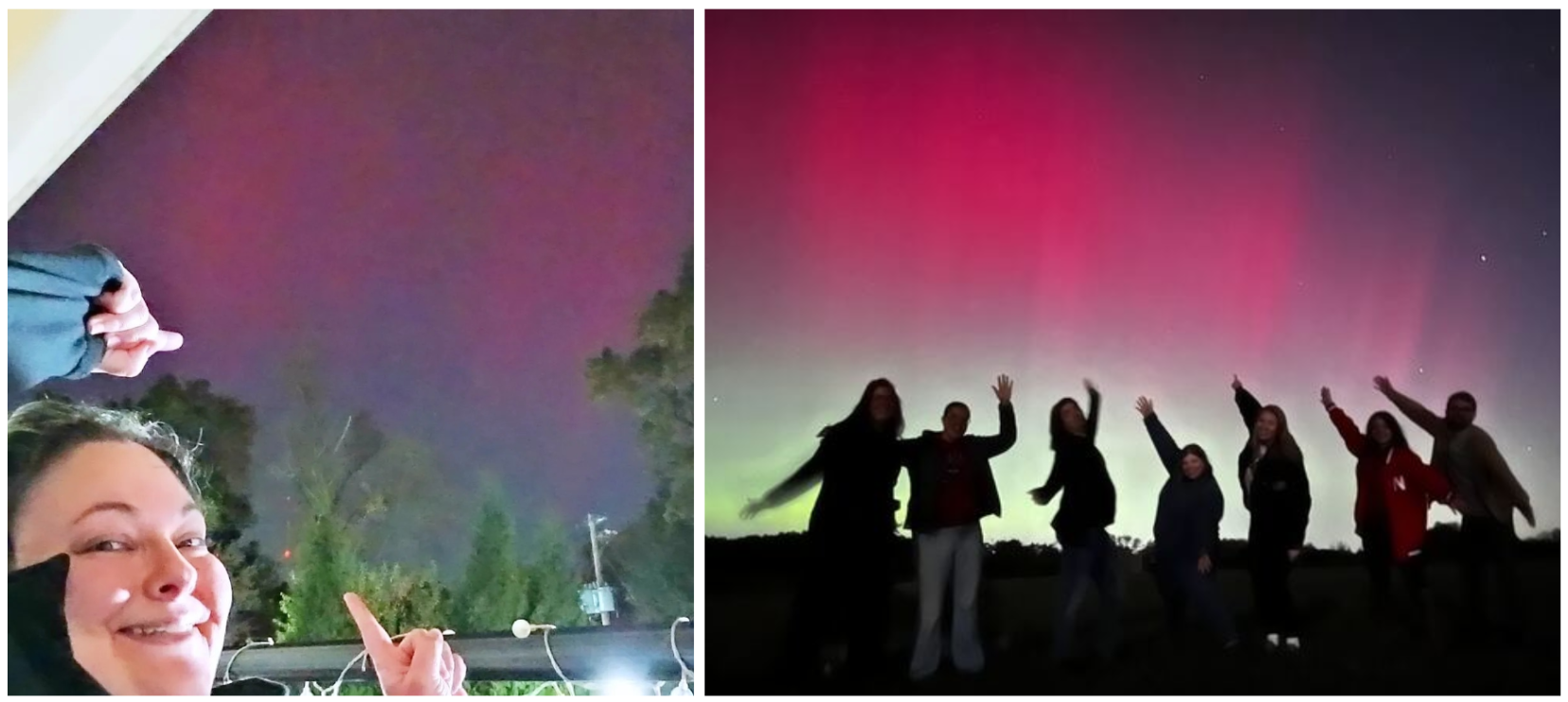
On the US East Coast just north of Washington, DC, and south of the light bubble of Baltimore, Maryland, I was cautiously hopeful to see aurora. I ran outside as soon as it became deep twilight. My eyes couldn’t see anything beyond the painfully bright street lights, but with my phone camera on night mode I found a reddish-pink glow to the north. Over the next half hour, the glow brightened to where I could see pink with the unaided eye even through the direct beam of an LED street lamp. An arc crossed overhead to the southern sky and back again. I frantically texted friends and family, and called out to passersby to look up with their cameras. Later, Aurorasaurus Ambassador Tanya helped me see a second display around 10pm.
Meanwhile, my colleagues at NASA Goddard Space Flight Center went on their own successful aurora chase! There’s an inside joke in the heliophysics community that the people who study auroras often haven’t gotten to see them in person, but I hope that it’s no longer true for our location. I never dreamed we’d get to aurora chase without traveling, and I can’t wait for the ongoing solar maximum to bring the northern lights back to dance with us again!
Manitoba, Canada — Aurorasaurus Ambassador Justin Anderson
Observed the aurora on Oct 10 at 10:00 pm EDT,
which is 9:00 pm local time and Oct 11 at 2:00 UTC
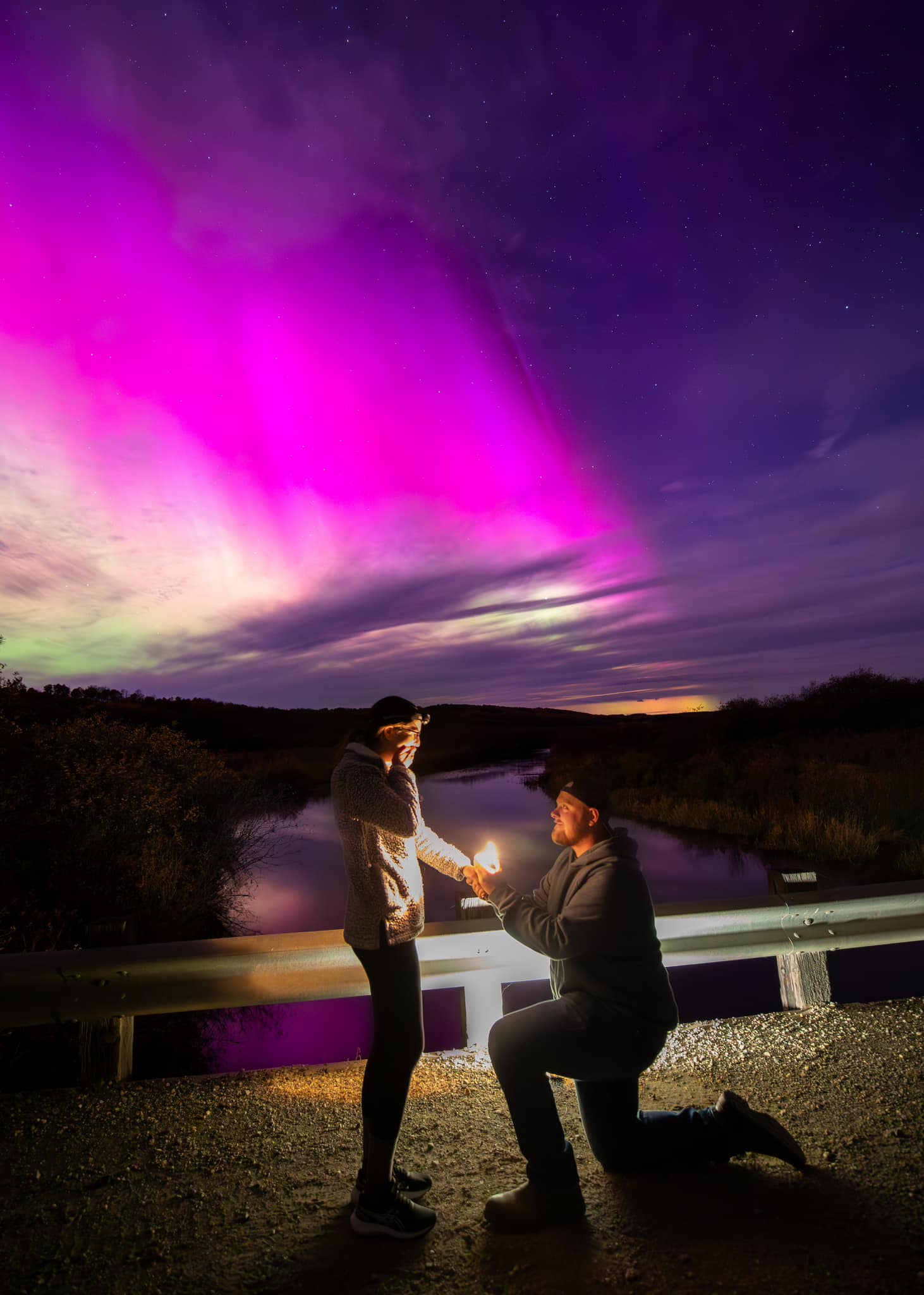
I asked my girlfriend Jenn to marry me! Three years ago to the day, I commented on her TikTok saying, “if you ever want to see the Northern Lights, you’ve got yourself a guide!” The aurora is our entire lives. Anybody who knows us knows: we’re Northern Lights people! I knew that the best way to propose was going to be under the aurora. Every time we’d get a selfie underneath the Northern Lights, I’d have friends go “where’s the ring?” I kept telling them that no, we need the strongest show you can get! I knew that when the aurora was going to dance, that was the moment I would ask her. I custom-designed the ring: underneath the diamond, there are gems that are colorful like the Northern Lights. Jenn adds that that’s what makes the ring super special: the Northern Lights are there, close to her. TikTok and the aurora are what started it all for us, and I’m so excited for what the future holds!
Manitoba, Canada — Aurorasaurus Ambassador Donna Lach
Observed the aurora on Oct 11 at 1:49 am EDT,
which is 12:49 am local time and 5:49 UTC
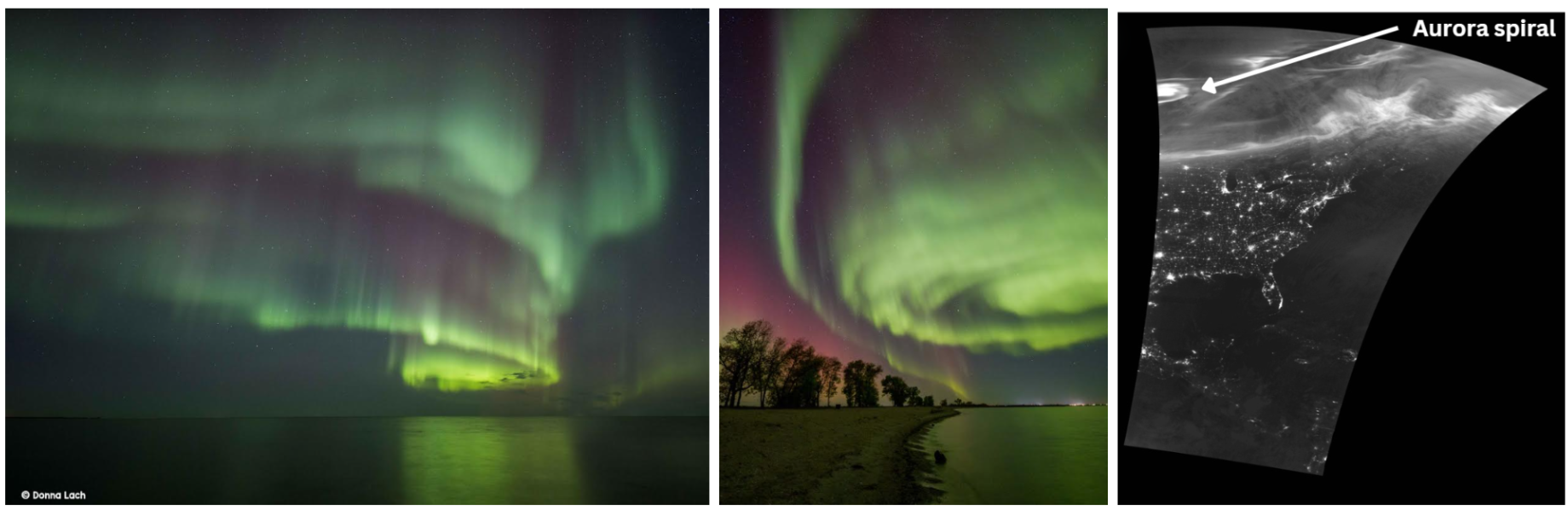
If I were to compare the May storm to the October storm, the defining difference for me was that we saw so many auroral spirals in October, and less structure in May. It could have just been the timing of the substorms, but when I went to the CIMSS VIIRS Imagery viewer online, I saw some amazing things through the satellite photos that showed what was going on at a larger scale.
The photo taken by the Suomi NPP satellite showed a massive spiral near me, and I found a photo that I had taken of that same spiral as it developed. The photo over the water was taken at the same time as the satellite photo. The photo over the beach was about ten minutes later. I was just west of the satellite photo, but I had the camera aimed northeast over Lake Manitoba. There are so many fascinating things in these photos including their massive size, a succession of vortices, and interesting things happening on the equatorward edge of the oval with a bright edge and omega bands forming after midnight.
Encore: Oceania and Asia
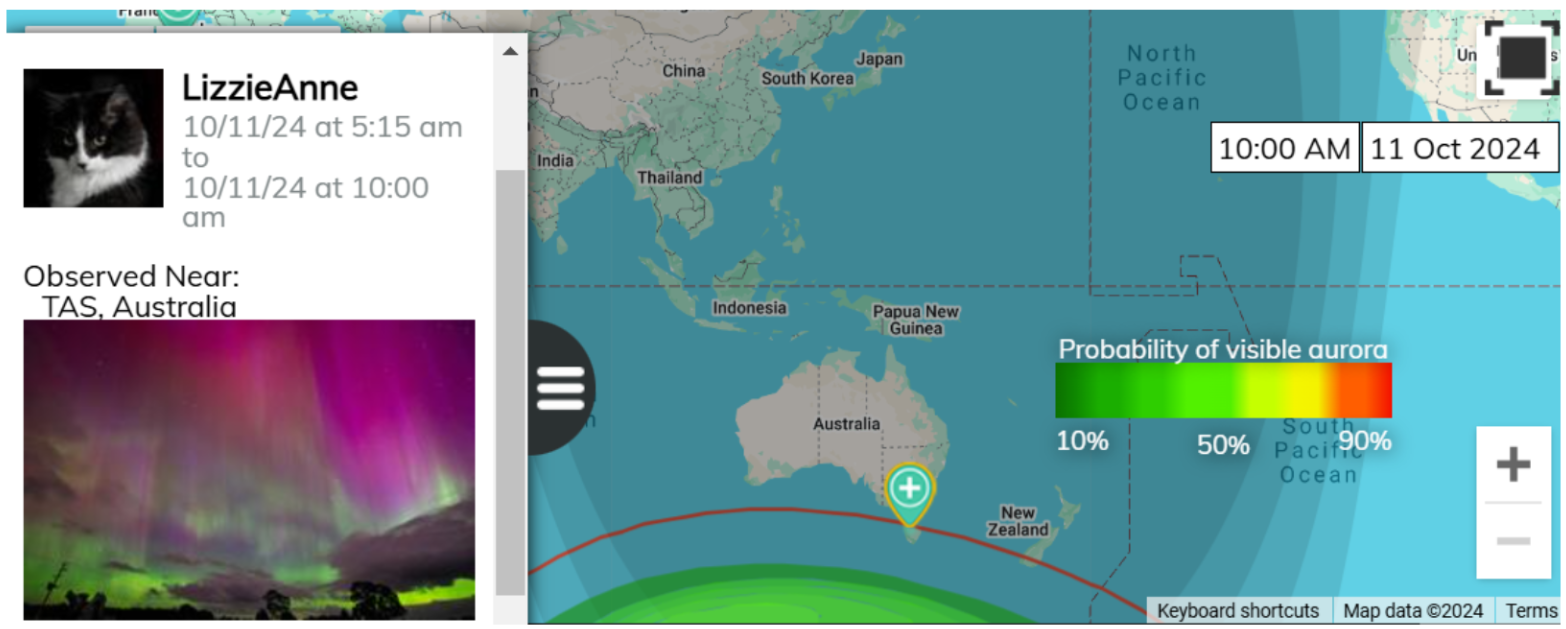
Tasmania, Australia — Aurora Chaser Gill Dayton
Observed the aurora on Oct 11 at 7:14 am EDT,
which is 9:14 pm local time and 11:00 UTC

Reports throughout the day of the aurora continuing in the Northern Hemisphere had all of us ready for another night of activity. As soon as the sky darkened a little it was possible to see naked-eye beams and pulsations dancing away. The Aurora had changed from the earlier intense crayon colours to massive, storming beams and waves of activity: a constant shifting, fluid movement of dynamic ripples and pulsations. It was like being at your very own rock concert, with the sound of the waves crashing on the shoreline and the lights dancing across the sky. Nature really spoiled us with back-to-back nights of incredible auroral activity: nights you don’t ever forget.
Behind the Scenes
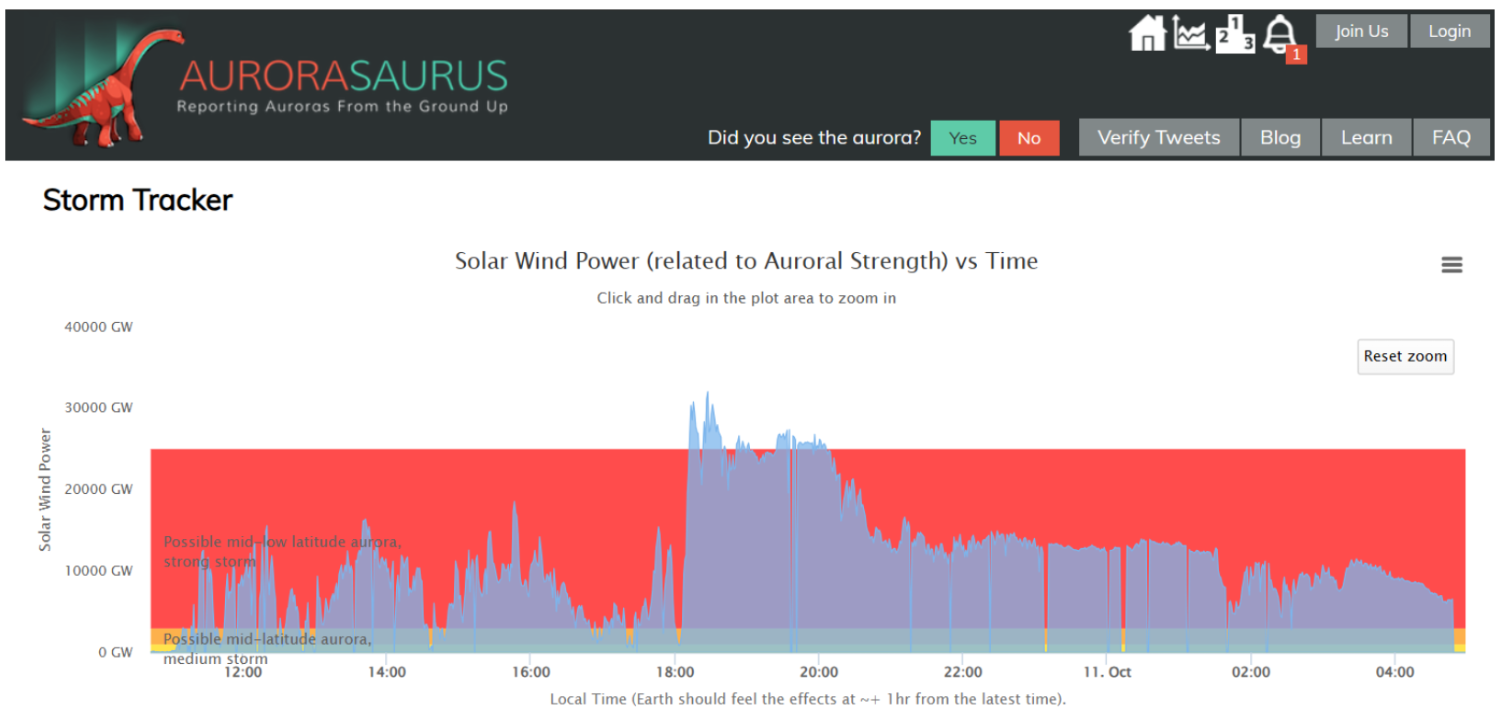
Storm Tracker Solar Wind Power chart from Aurorasaurus, in EDT. The higher the graph goes on the y axis, the more likely aurora is in about 1 hour at your location. Around 18:00 pm EDT (22:00 UTC) on the 10th is when the core of the CME hit.
With many thanks to Dr. Katariina Nykyri
Coronal mass ejections (CMEs) are giant explosions of plasma and magnetic fields from the Sun which can produce beautiful auroras, but can also affect large technology networks. The strength of the storm depends on the conditions of the Earth’s magnetic shield (magnetosphere); the strength and direction of the CME’s magnetic field; the CME’s size and speed, which drive its duration; and other properties. In a recent paper published October 12th, 2024, NASA GSFC scientist Dr. Katariina Nykyri analyzed CME observations and their effects during the May 10-12 aurora superstorm. During the CME encounter, the magnetic field periodically alternated directions, along with changes in the density of the surrounding plasma, or ionized gas. This allowed the Earth’s magnetosphere to fill up with plasma (occuring mainly during times when the solar magnetic fields faced north) and helping it to accelerate particles toward the North and South poles to drive aurora (occurring mostly during times when the solar magnetic fields faced south). It was shown that these variations were produced by “Kelvin-Helmholtz” waves—with giant wavelengths 238,000-1.1 million miles (383,000-1.7 million km) long — so that the entire Earth’s magnetosphere was surfing the crests and troughs of these waves while absorbing the kinetic and magnetic energy from the solar wind. This resulted in the largest storm in 20 years.
By contrast, the October storm did not have these strong variations with the CME that arrived, so Dr. Nykyri suspects even though the incoming solar wind power was strong for many hours (as shown in the graph above), the storm may have run out of fresh plasma to drive a bigger storm, due to the lack of northward-facing magnetic fields, which are required to bring large quantities of dense solar wind plasma. Scientists will be studying and comparing these two large events for years. Your observations can help and backdated reports are still valuable!


