With contributions from Dr. Andréa Hughes

The short answer is yes, but they are different from those on Earth. When we think about the aurora, we often imagine beautiful green and red lights that ring the night skies around the north and south poles, with the most dramatic displays in the hours around midnight. This kind of aurora requires a robust dipole magnetic field: one that has two poles, like the Earth’s. Mars lost the ability to create aurora like ours more than four billion years ago, when it lost most of its internal magnetic field. (Earth was just a baby planet at the time.) Therefore, Mars doesn’t have aurora in the same way that Earth does. That said, there are many kinds of aurora, and Mars has numerous other types, some of which are more similar, but not identical, to Earth’s. In this blog post, we’ll cover the fascinating, invisible Martian proton aurora.
A Mars MAVEN
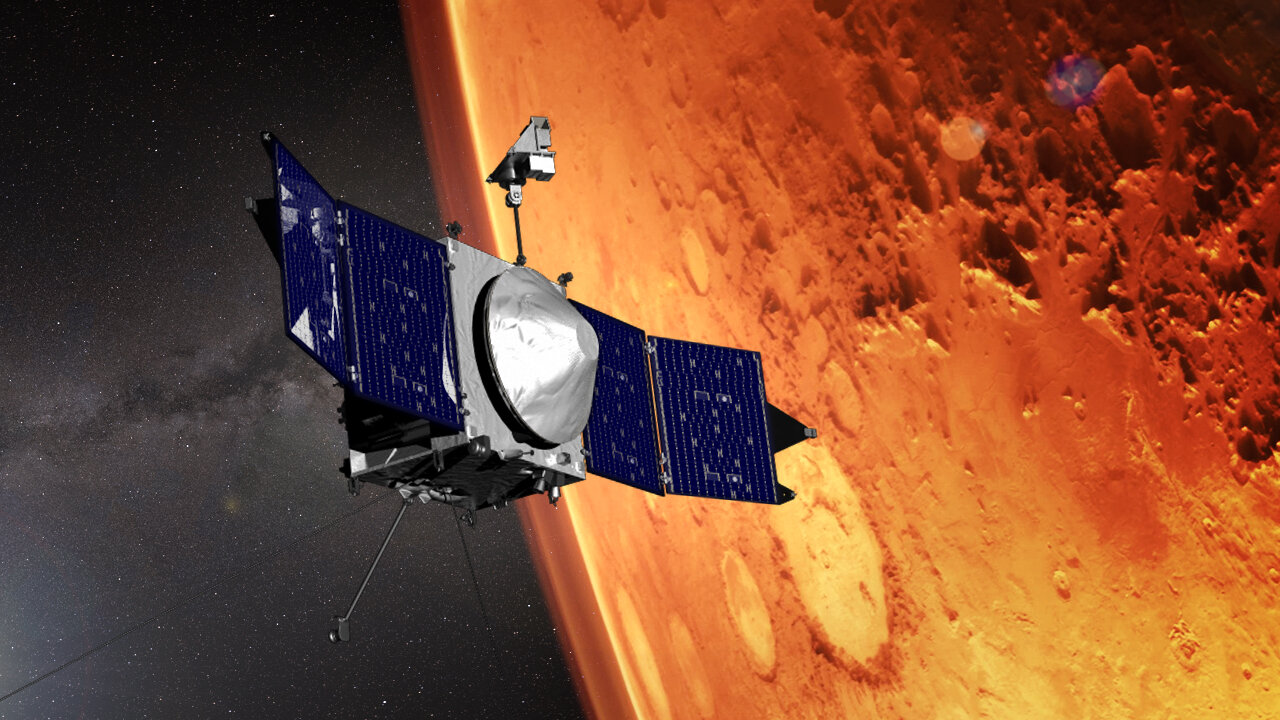
Since September 2014 the Mars Atmosphere and Volatile EvolutioN (MAVEN) orbiting spacecraft has been learning a lot about the Red Planet’s past through its upper atmosphere. MAVEN’s mission is to investigate how Mars lost much of its atmosphere and water, transforming its climate from one that might have supported life to one that is cold, dry, and inhospitable. The spacecraft surveys the planet with a number of instruments, including its Imaging UltraViolet Spectrograph (IUVS), which can see ultraviolet light invisible to human eyes. Proton auroras on Mars happens during the day and give off ultraviolet light, so scientists can study it using instruments like MAVEN’s IUVS.
MAVEN recently celebrated 10 years in orbit: an amazing milestone!
You can follow its continuing journey on its website and X/Twitter.
What is Martian proton aurora?
The solar wind, made up of particles carrying magnetic fields from the Sun, constantly streams through the solar system. Some of the particles are protons: hydrogen atoms stripped of their lone electrons by intense heat. Mars lacks a dipole magnetic field (like Earth’s), but it does have a weaker, induced magnetic field. This field deflects charged particles (like protons, ions, and electrons) around the planet along a shield shape called a “bow shock”.
However, there is also the Martian hydrogen corona: a huge, extended “cloud” of hydrogen surrounding the planet. Some sneaky solar wind protons can steal an electron from hydrogen atoms, becoming neutral through a “charge exchange”. They are no longer affected by the induced magnetic field, bypassing the bow shock and going straight into the atmosphere. When these high-speed, incoming neutral atoms hit the atmosphere, some of their energy is emitted as ultraviolet light when they de-excite. Because this process takes place on the side of the planet facing towards the Sun, proton auroras occur almost entirely on the dayside of Mars.
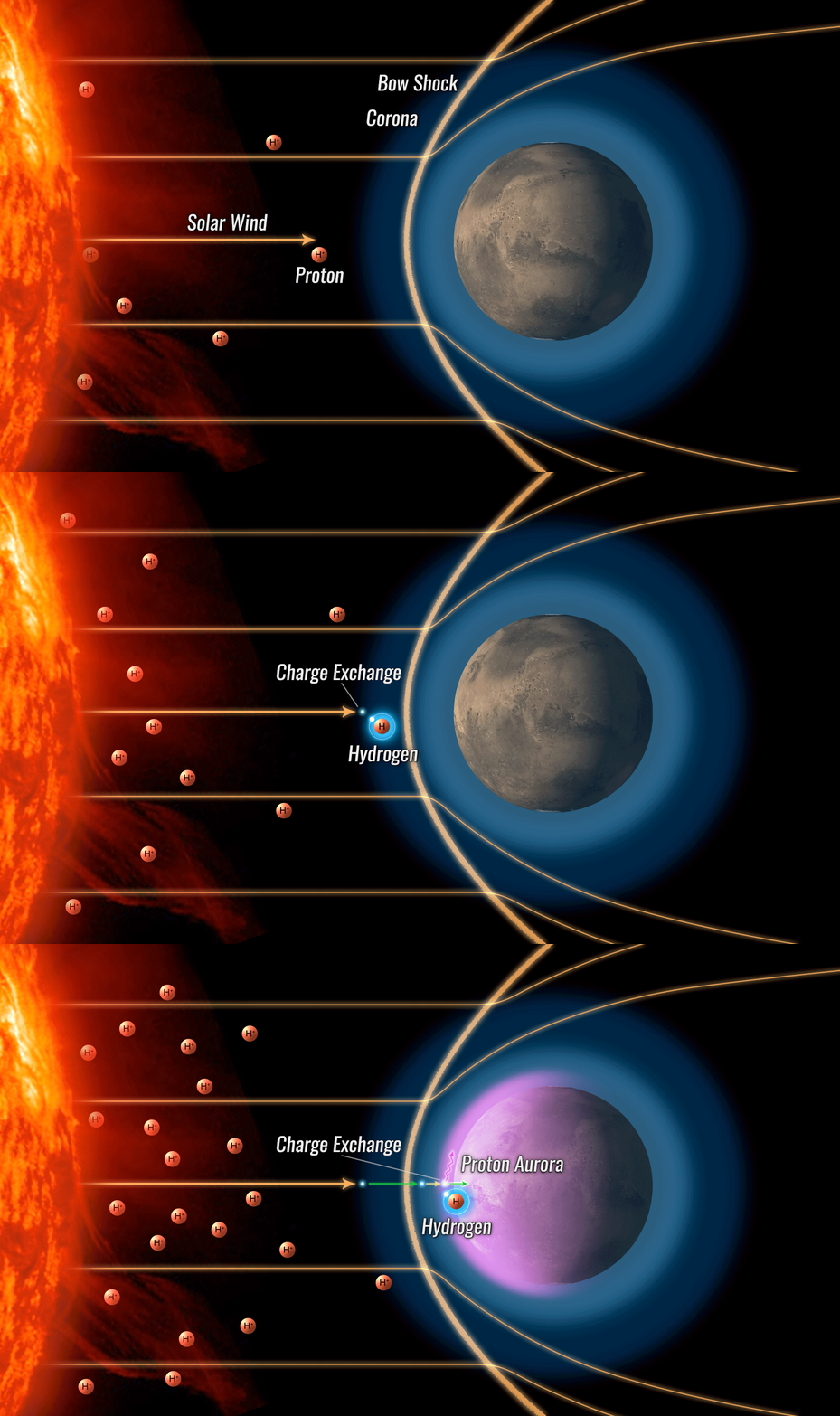
Imagine summer in the southern hemisphere of Mars. Due to Mars’ highly elliptical orbit, the planet is also near the part of its orbit closest to the Sun, and it can become relatively hot. While higher temperatures might sound fantastic for a beach day on Earth, southern summer on the dry planet of Mars coincides with periods of huge dust storms. These high temperatures and atmospheric dust can force water vapor higher into the atmosphere, where extreme ultraviolet light from the Sun breaks the water molecules into hydrogen and oxygen. The hydrogen is weakly bound by Mars’ gravity, and the hydrogen corona surrounding Mars puffs up during this time, increasing the amount of hydrogen that escapes into space. More hydrogen beyond the Martian bow shock allows interactions with solar wind protons to be more common, which in turn make Martian proton aurora brighter and more frequent during this time of year.
How do Martian proton auroras reveal how Mars has changed?
Dr. Andréa Hughes works in the Laboratory for Ionosphere, Thermosphere, Mesosphere Physics within the Heliophysics division of NASA’s Goddard Space Flight Center (GSFC) and jointly at George Mason University. She studies proton aurora on Mars, for which she received the 2024 L’Oréal For Women in Science (FWIS) award. Her work provides a novel and unprecedented understanding of Martian proton aurora, which contributes to our understanding of why the Red Planet has evolved into the cold and dry climate that it is today. Learn more about Dr. Hughes’ journey and research here.
“All the conditions necessary to create Martian proton aurora (e.g., solar wind protons, an extended hydrogen atmosphere, and the absence of a global dipole magnetic field) are readily available at Mars and contribute to creating this unique type of aurora,” says Dr. Hughes. “What’s even more exciting is that the connection between MAVEN’s observations of increased hydrogen escape and increased proton aurora frequency and intensity means that proton aurora can actually be used as a proxy for evaluating what’s happening in the hydrogen corona surrounding Mars, and therefore, a proxy for evaluating atmospheric escape and water loss at Mars.”
Proton aurora on Mars act as an indicator of some of the important processes that led to major changes in the Martian climate. It is also relevant to any planetary body that lacks a dipole magnetic field, like Venus, comets, or even exoplanets! Understanding present-day auroral processes on Mars can provide a window into how conditions changed in the past (Deighan et al., 2018; Ritter et al., 2018; Hughes et al., 2019), which is critically important to understanding the evolution of our solar system through time. Learn more about how the solar wind relates to atmosphere loss here.


