Journey Toward the Lights
Guest post: Laura Brandt joins the Aurorasaurus team as Project Manager and reflects on her first experience viewing the aurora in Iceland.
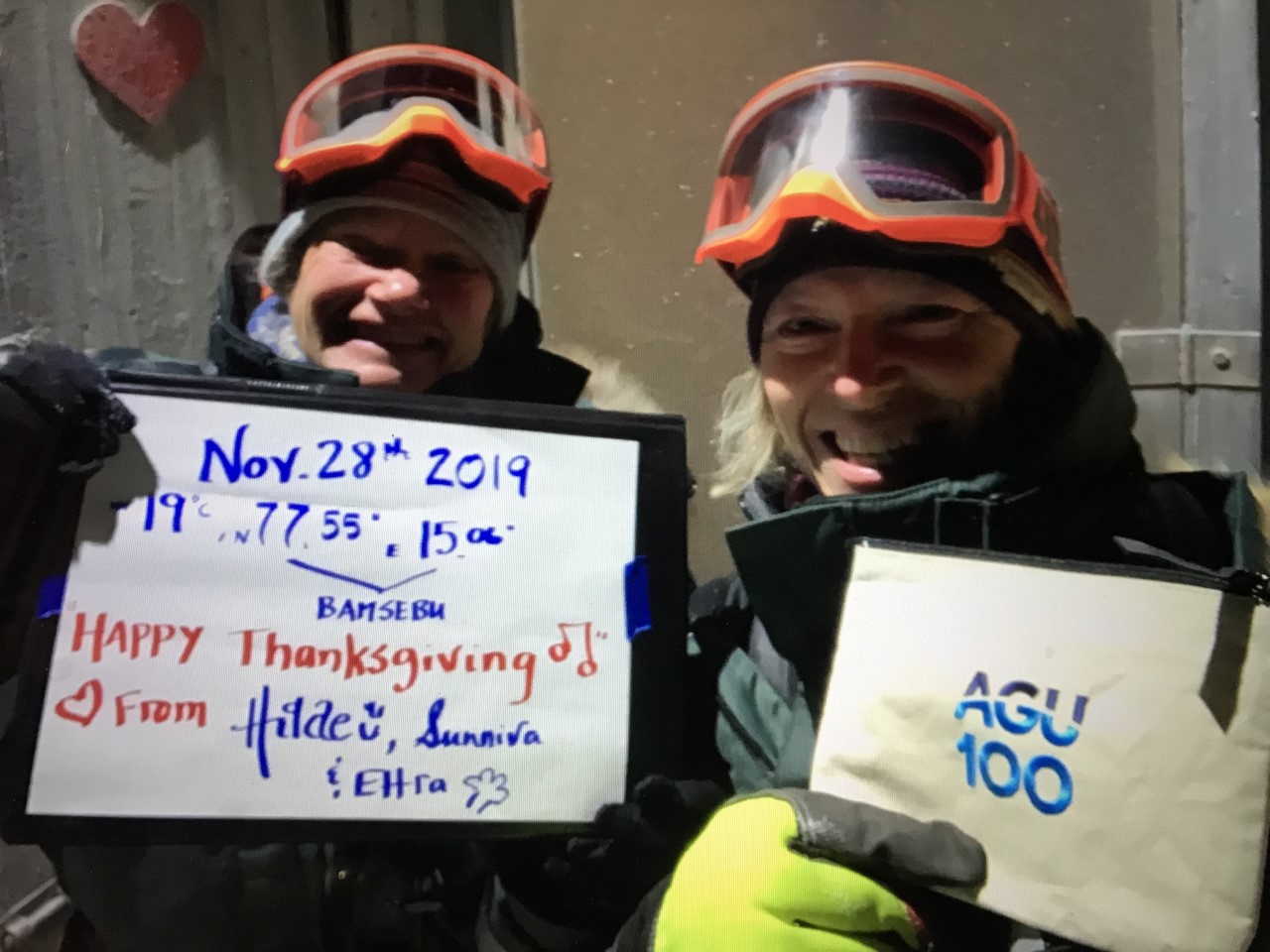
If you turn on the news for very long, you’re likely to hear about some of the changes our planet is going through. Temperatures are on the rise, glaciers are receding, precipitation patterns are changing — and many of these developments are most obvious in the polar regions. A formidable two-woman team is heading to… Read More »Hearts in the Ice: Citizen Science in the Arctic
Jordan, an 8th grade student from Calgary, recently won the Rideau Park Science Fair with her poster on the new STEVE phenomena. Jordan tells Aurorasaurus more about her project and interest in aurora in this Q&A article. Read through to the end for some questions she asked Dr. Liz MacDonald, Aurorasaurus founder, also!
Andøya Space Center, Andenes, Norway January 22, 2018 In January of 2018, I traveled to Andøya Space Center in Andenes, Norway, to attend a four day rocket field school. My name is Hannah Gulick, and I am a sophomore at the University of Iowa studying astronomy, physics, and creative writing. I went as one of… Read More »The Ultimate Undergraduate Field School Researching Auroras and Rockets in Norway
Liz got to meet up with the Alberta Aurora Chasers, see aurora on her first two nights in Canada (including her first sighting of STEVE!), and have daytime fun too. Read all about it!
For the first time, scientists had ground and satellite views of Steve. Scientists have now learned, despite its ordinary name, that Steve may be an extraordinary puzzle piece in painting a better picture of how Earth’s magnetic fields function and interact with charged particles in space. The findings are published in a study released today in Science Advances.
By Michelle Tebolt, summer intern 2017 Above our heads, the aurora provides one of the biggest and best light shows on Earth. The light moves about, flashes across the sky, similar to some of the types of man-made lights we are familiar with. However, this light show isn’t to set the mood for a party. It… Read More »Lava Lamp or the aurora?
What’s wrong with this infographic? A common misconception about the aurora is that it’s formed by particles streaming straight from the sun. But that’s not the whole story. By only considering the solar wind, we leave some key questions unanswered like why do we see the aurora at night (when we’re facing away from the sun)? The answer lies in magnetic reconnection in the magnetotail.
By Dr. Liz MacDonald Learn more at our Twitter #citscichat with Dr. Caren Cooper (@CoopSciScoop) on Aug 17 at 4 pm ET. Participants from most of the projects highlighted here will participate. Over a century ago, American astronomer W.W. Campbell set up a 40 foot ‘Schaeberle camera’ in Jeur, India to take pictures and study… Read More »Science Experiments for the Public during the Solar Eclipse
Fidget spinners are the latest fad toy and new student favorite, but did you know they can explain a total solar eclipse? Aurorasaurus founder Liz MacDonald explains how fidget spinners can be used to talk about physics concepts and orbital mechanics for kinesthetic learners.