Guest post by Dr. Liz MacDonald, Sarah Kirn, and Laura Edson
As it rises, sets, dances the seasons with the Earth, and sends space weather our way, the Sun is an integral part of our daily lives. Science is one of many ways to get to know our Sun better, and the upcoming year will bring especially exciting opportunities. In this post, we’ll introduce collaborative science projects that use different senses, like sight and sound, as well as sensors like radios to learn about the Sun’s influence on life on Earth and on our Solar System. We’ll also explain how these projects connect with the Sun, upcoming eclipses, and one another in the broad field of Heliophysics, the study of our Sun and how it interacts with our solar system.
From October 2023–December 2024, NASA will be celebrating a Heliophysics Big Year (HBY) that will celebrate solar science and its connection with our world. Heliophysics provides a huge breadth of activities to try out and phenomena to observe. Like a “Big Year” in birding, the HBY is a personal quest to experience and enhance your relationship with the Sun, especially through citizen and community science. If you’re as excited as we are, there are ways to get involved early and help prepare.
Not only are we ramping up to the Sun’s most active “solar maximum” phase, but an annular eclipse will occur on October 14, 2023, over North, Central, and South America, and a total eclipse will happen on April 8, 2024, over North America. Solar eclipses occur when the Moon passes between the Sun and Earth, casting a shadow on our planet.
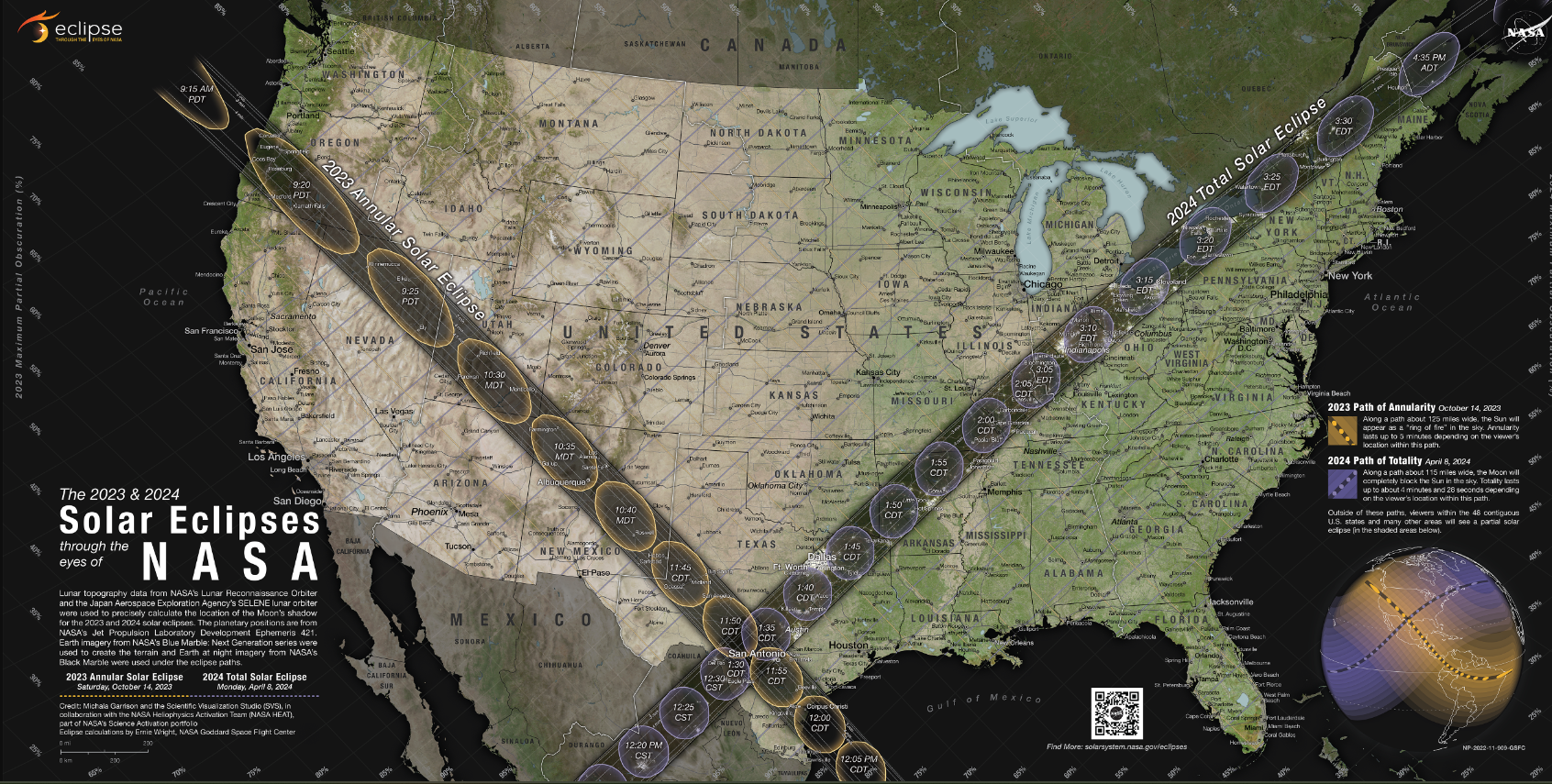
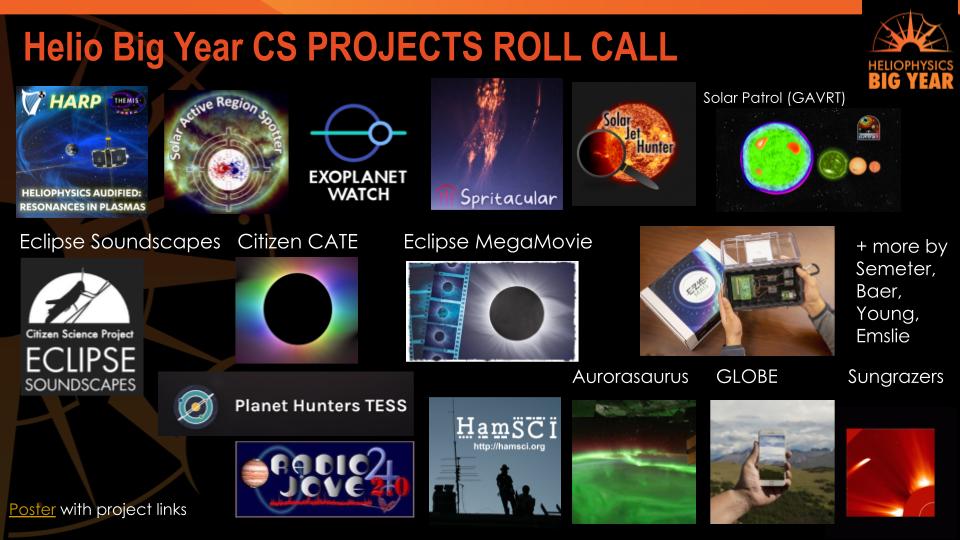
Collaborative science projects take individual approaches to learning about the Sun, but like a family they relate to one another. In other words, read on to find out more about some of the cool things you can try out during the Heliophysics Big Year!
Keeping a (safe!) eye on the Sun
During the total eclipse in April 2024, for a few minutes in the path of totality people will be able to see something amazing (find out about eclipse safety best practices here). Because the Moon blocks so much light, during total eclipses we can see detailed features of the outermost part of the Sun’s atmosphere, called the corona. The corona is home to one of the biggest mysteries in Heliophysics: it’s much hotter than we think it should be. Why?

Volunteers for several projects will have special solar telescopes trained on the Sun to record the changing corona, too! (Never point a regular telescope or camera at the Sun, even during an eclipse.) And we need to look with different filters and at different spots to see different things, and do as much science as we can during this incredible observing opportunity. We don’t know what rare events might be captured, like the evolution of a flare, the passage of a comet, or something else entirely! A dynamic duo of projects, Citizen CATE 2024 (CATE stands for Continental America Telescope Eclipse) and the Dynamic Eclipse Broadcast Initiative (DEBI), will engage teams of volunteers on the path of totality to make recordings during the eclipse. The resulting hour-long movies about the Sun’s corona will allow scientists to study its movement and features. While both projects descend from the Citizen CATE 2017 project, they have different goals. Citizen CATE 2024 will be working with upgraded equipment to study a certain kind of light, while DEBI will use more accessible equipment on and off the path of totality. The Eclipse Megamovie 2024: Characterizing Transient Plasma Flows and Jets in the Solar Corona will combine volunteer photos along the path of totality, expanding on a project they did in 2017. Suffice it to say, these eclipses will be well documented and you can help!
Can we see eclipses elsewhere in the galaxy? When we see a star get suddenly dimmer in scientific data, something might have passed in front of it—like a planet! In other words, objects can pass in front of stars and that, in short, is how exoplanets are found. You can help by searching for these patterns with Planet Hunters Tess, or finding them yourself with a small telescope with Exoplanet Watch.
A lot of citizen science revolves around people finding tricky things that machines simply aren’t able to notice. Some use satellites to safely watch the Sun. For example, Solar Jet Hunter is a Zooniverse project in which participants identify small, narrow ejections of solar material. Solar jets are important to the origin of the solar wind, a gusty stream of material that flows from the Sun in all directions, all the time, carrying the Sun’s magnetic field out into space. The Sungrazer Project gives participants the opportunity to discover new comets by looking at images of the Sun.
Listening to the Earth
When scientists think about a planet, they think about the things it is wrapped in, too, like magnetic fields and atmosphere. In addition to the Sun itself, Heliophysics studies how the giant magnetic field that surrounds the Earth responds to what is happening on the Sun. It’s complicated, so spacecraft flying through the Earth’s magnetic field itself collect data on special kinds of particles and waves. A brand-new project called Heliophysics Audified: Resonances in Plasmas (HARP) changes some of the collected data into sound and asks volunteers to listen for unusual noises. Check it out, and check out this recent Q&A with the Aurorasaurus Ambassadors!
If a sudden explosion of energy called a solar flare happens, the Sun could also emit radio waves. Radio waves can also be generated in unusual ways during the rapid sunset-like effect of an eclipse on the upper atmosphere. With the right equipment, people can observe these radio wave signals and their variations! Two projects capture different frequencies. The Ham Radio Science Citizen Investigation (HamSCI) is a way for ham radio operators to take part in scientific research on the effects of solar flares on man-made, high-frequency radio signals, and it has an annual free virtual conference and special QSO (eclipse contact) contest. Radio JOVE participants build their own radio telescopes and listen in to natural radio emissions from the Sun. Small grants are available for students and teachers to bring projects like it to the classroom. Radio JOVE is also super cool because in the high-frequency range of radio waves it covers, participants can also capture dynamic emissions from Jupiter for study.
What about life on Earth? How do living things on or near the path of an eclipse respond? Eclipse Soundscapes asks volunteers to submit their eclipse observations, and/or collect audio recordings of ambient sounds during eclipse week using a special device. In this way, volunteers will work alongside scientists to document changes in animal behavior and sounds during the eclipse. Eclipse Soundscapes also focuses on accessibility and works to enable everyone to participate in multisensory eclipse research.
Sensing the world around us
The Earth responds to a solar eclipse in myriad ways, the breadth of which scientists want to understand better. With the Earth beneath a massive sunshade, what happens to air temperature and clouds? GLOBE Observer Eclipse asks volunteers to use their smartphones to record changes in temperature and clouds around them. The measurements will help scientists learn more about how the Earth’s atmosphere is affected by solar eclipses. Eclipses are great natural experiments!
Other phenomena sparkle in the sky. Aurorasaurus tracks the Northern and Southern Lights around the world via reports on its website to a real-time, global map of the aurora. Each report serves as a valuable data point for scientists to analyze and incorporate into scientific models. Spritacular collects observations of lights that occur above thunderstorms, collectively known as Transient Luminous Events (TLEs). One type, sprites, lends its name to the project. The database generated from these observations will lay the groundwork for first-ever event catalog of TLEs that will greatly contribute to advancement of scientific studies.
Feeling closer to the Sun
During the Heliophysics Big Year, you can use senses and sensors in a variety of ways to help us all get to know the Sun, our nearest star, a little better. We are super proud of these projects and the people involved. We hope that you will follow your own curiosity and joy, and get to know the Sun a little better with us. Stay tuned for more as the HBY draws closer!
Resources
- Heliophysics Big Year website
- A deck of slides about Eclipse opportunities from a session at this year’s American Astronomical Society conference
- Another slide deck about the Big Year that includes slides about all of the involved community science projects
- NASA Eclipses website
- NASA Science Activation teams, including many of the projects mentioned in this post
- Poster by Heliophysics Presidential Innovation Fellow Ha-Hoa Hamano describing the HBY with links to all the projects you can participate in
- Slide deck describing the HBY


