Note: this post contains discussion and imagery of solar eclipses.
Few things are as awe-inspiring as the aurora or a solar eclipse. In just a few weeks, a total solar eclipse will cross North America, and provide a rare opportunity to connect with the natural world. In this post, we consider awe and hope to inspire you to take part in participatory science during the upcoming April 8, 2024 eclipse. We’ll highlight the Eclipse Soundscapes project, which uses multiple senses to not only gather data, but enhance the eclipse experience.
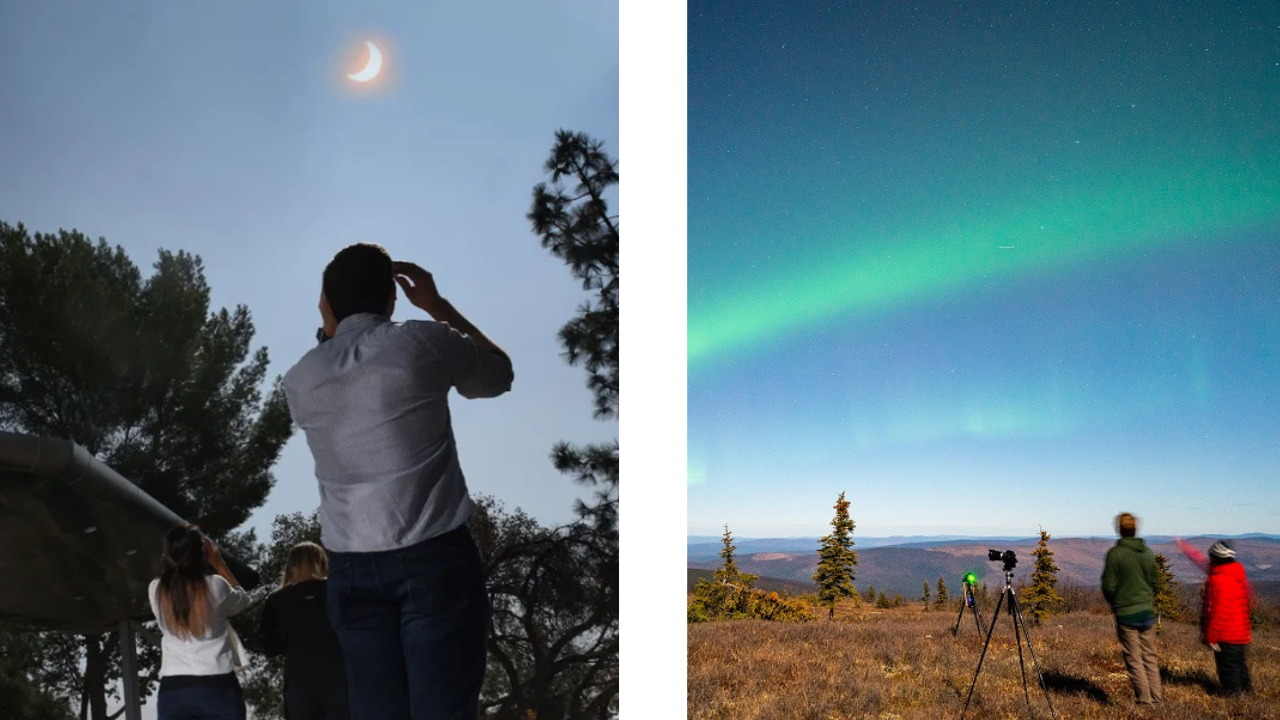
Awe-inspiring aurora
We often hear of people’s feelings of comfort in observing something beautiful like aurora and the night sky. Aurora chasers know awe well, often calling on poetic metaphors to illustrate their experiences. For example, Aurorasaurus Ambassador Notanee Bourassa beautifully described the Northern Lights as “the visual representation of cosmic music being played on electromagnetic field lines.” This blending of senses applies not only to auroras, but other cosmic phenomena.
“According to awe researcher Dacher Keltner, mind-bending experiences can create a feeling of profound connection between people and the world around us. Awe can also open up new neural pathways—creating a small window to potentially rewire your thought patterns or reframe your priorities. Scientists who have studied this experience believe that getting your mind blown by the northern lights, an eclipse, or other natural phenomena could provide a burst of clarity. That can be useful in making big life decisions or even just in grounding yourself in gratitude for what you already have” (Outside Online).
It may well be part of what draws aurora lovers to the chase: as aurora chaser and student Vincent Ledvina once pointed out, “Everyone says, ‘but you’ve seen the aurora already, why do you want to see it again?’ And my response is, no two displays are the same—you discover something different each time.” The same could be said of eclipse chasing.
Listening to a solar eclipse
Whie aurora chasing is a game of chance, eclipse chasing is more predictable. Like the aurora, however, there’s nothing quite like experiencing a total solar eclipse in person, with all available senses. Evaluators who studied awe during the 2023 annular eclipse at an event in New Mexico found that “eclipse viewers rated the annular solar eclipse as a 7.43/10 of their most awe-inspiring experiences…. Many people named the 2017 total solar eclipse as the most awe-inspiring event they have ever seen” (Fischer et al., 2023).
One way that eclipses can be awe-inspiring has to do with the ways a viewer can feel and hear changes in the environment, as well as seeing them. There is also a lot of science to this kind of multisensory observation. A century ago, a study by William M. Wheeler and a team of collaborators invited the general public to help study how the August 31, 1932 solar eclipse affected animal and insect behavior. The study compiled 498 personal observations from game wardens, naturalists, and members of the general public. The evidence noted changes in animal behavior and soundscapes during the eclipse.

Now, participatory science project Eclipse Soundscapes seeks to build on the historic Wheeler study by asking members of the public to observe and analyze data collected during the October 14, 2023 annular eclipse and April 8, 2024 total solar eclipse. There are many ways to get involved! Sensory observations will be different for everyone and they welcome that variety of sight, sound, and feeling! One user noted that participating “has opened my mind up to the many senses we can use to understand our surroundings more.”
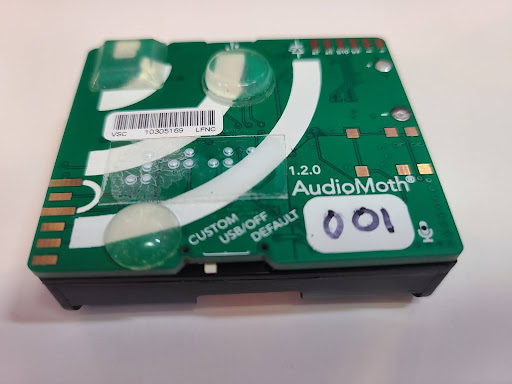
Eclipse Soundscapes has also strived to increase inclusion and the accessibility of their project, including the data collection process and tools. Different role options allow participants to choose the role that best fits their needs – from one that requires equipment and training (Data Collector Role), to one that requires no equipment and takes place outdoors on eclipse day (Observer Role), to one that requires no equipment and can be done anytime (Apprentice Role). After the eclipse, the general public will be invited to help with the analysis of the audio data collected as Data Analysts! Each role offers participants a certificate of completion.
For educators and students, we especially recommend checking out the quick-start Observer role for a cool record of eclipse observations or Apprentice role, which includes free lessons about eclipses. There is a lot to dig into on their website!
MaryKay Severino, Education Director at ARISA Lab and the co-lead on Eclipse Soundscapes, says: “Experiencing a natural phenomenon—like eclipses or auroras—with all of the senses available to you grounds you in the moment and connects you to the universe. During natural events, this feeling can be profound and inspiring, igniting joy and curiosity in everyone.”
The ways in which the Earth, wildlife, and people react to eclipses can make the experience unique and moving. One 2023 Eclipse Soundscapes observer wrote of their experience with the annular eclipse, “I never knew how satisfying it could be to simply watch and listen to the natural world so completely.”
Relationship with the sky
We’ll conclude this post with some words from the new book Spirits Dancing: The Night Sky, Indigenous Knowledge, & Living Connections in the Universe by Travis Novitsky and Annette Lee:
“Few experiences bring us such feelings of joy, curiosity, and excitement as gazing upward on a dark night sky. Instinctively, we seem to know what the same sky has shown down on us, on all humanity, for all time. The sky defines our humanness and connects us through the millennia to people past, present, and future. We truly share one sky.”
Whether you visit the path of totality or watch online, we hope awe inspires you to take part in one of the many ways of participating in the April 8 total solar eclipse! We also invite you to continue your Heliophysics Big Year experience by making participatory science observations with other initiatives, like Aurorasaurus. In the words of an Eclipse Soundscapes user, “I think that science is the best type of curiosity and a great way to explore.”


