Guest post by Aurorasaurus Ambassador Dr. Becca Robinson
It may not seem ideal to spend the winter months experiencing the bitter cold polar night, but for me, the light far outweighs the darkness.
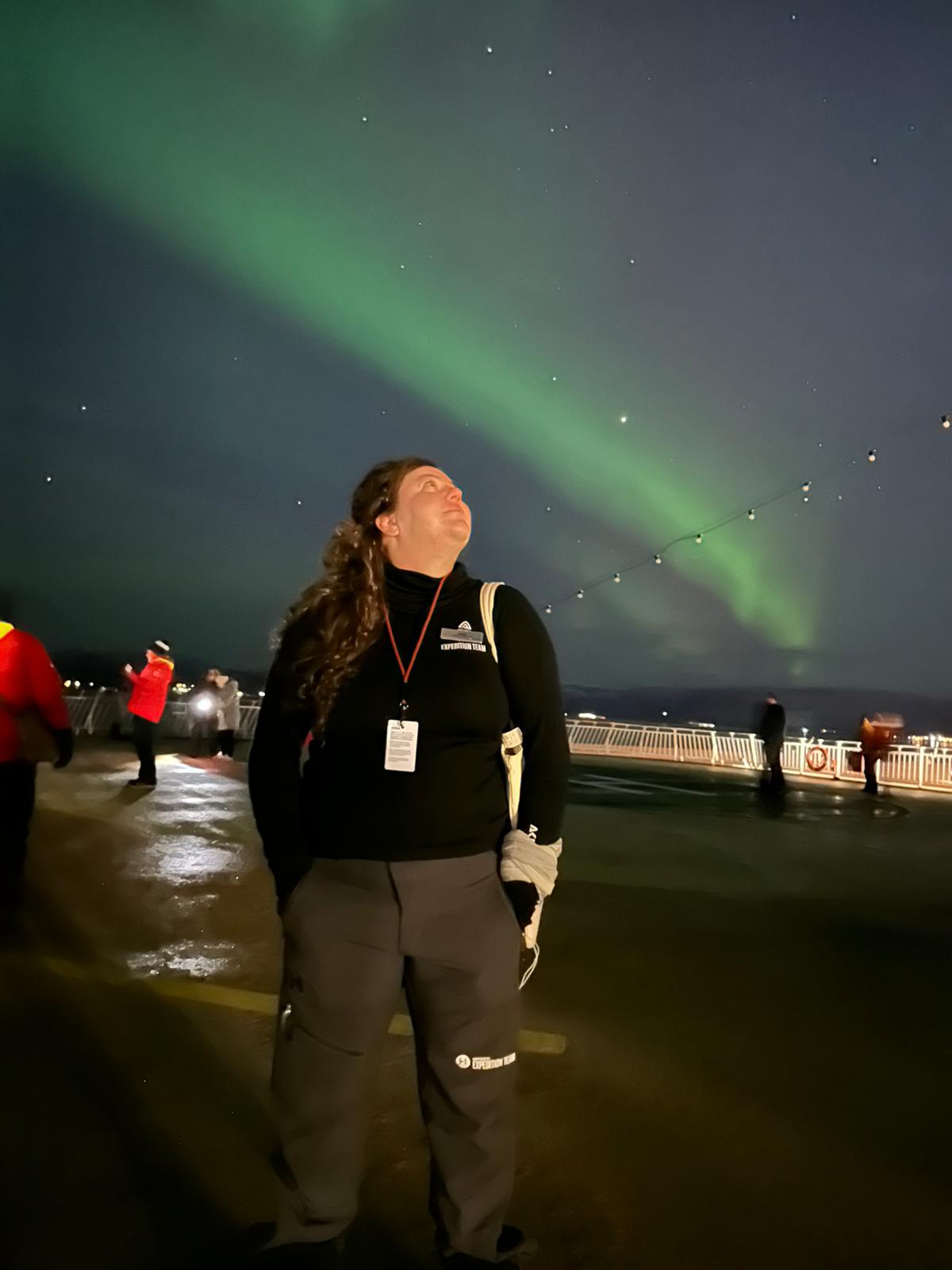
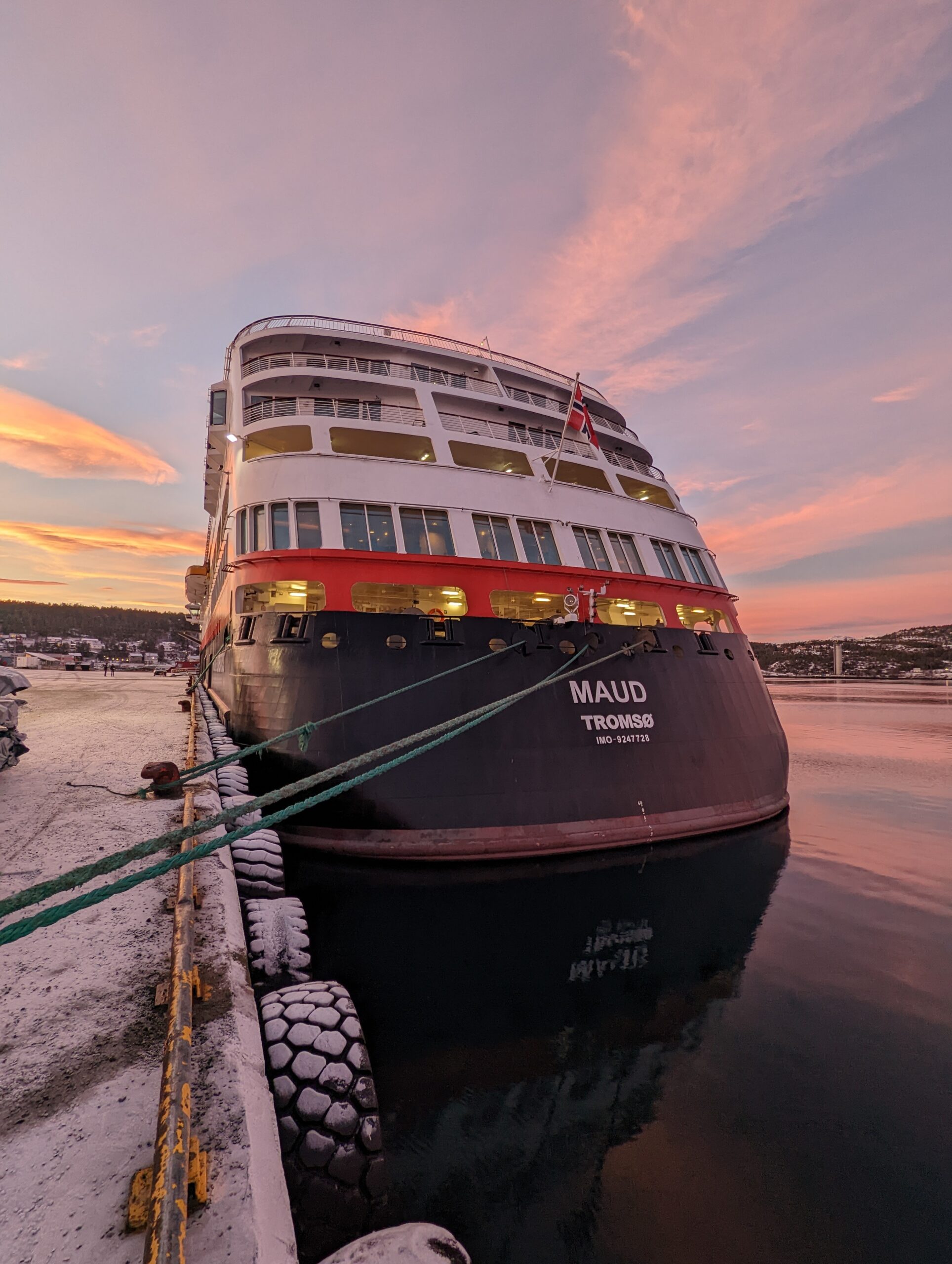
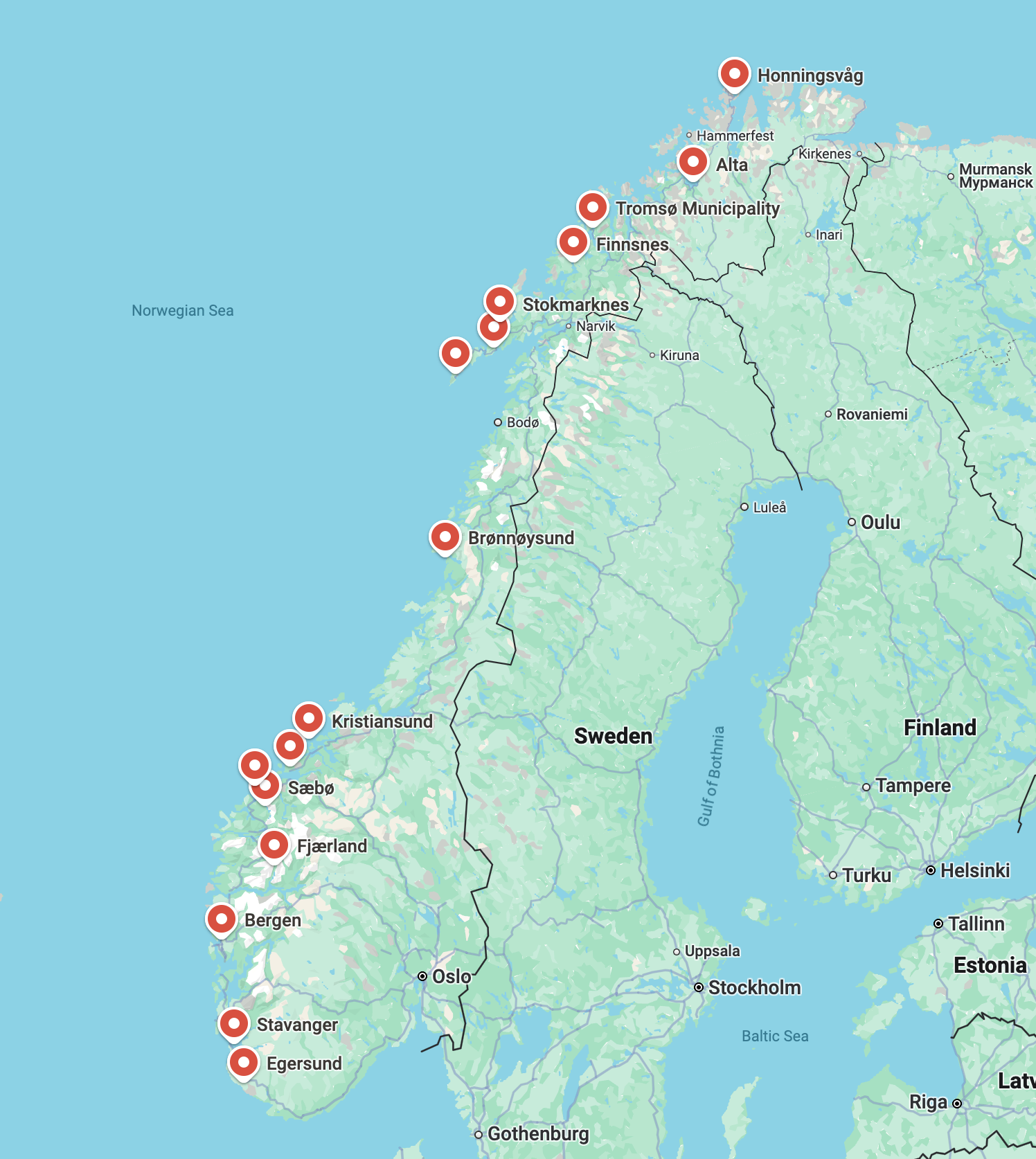
My name is Dr. Rebecca Robinson (you can call me Becca) and over the course of winter seasons 2021 and 2022, I spent 15 weeks sailing with cruise company Hurtigruten Expeditions (HX) along Norway’s rugged coast. I traveled on two ships: the MS Otto Sverdrup between Hamburg, Germany, and Norway, and the MS Maud between Dover, England, and Norway. The partnership I curated with HX was one part necessity and three parts adventure; participating in an outreach activity was a special requirement during my PhD at the University of Oslo at the time, but I was totally free to determine the scope and subject of that activity. I used this freedom to offer my services to HX as a subject matter expert when it came to solar and aurora physics, with a strong emphasis on demonstrating how the two are intimately, endlessly, necessarily intertwined.
Come along on a virtual tour as I take you with me between barren skerries (small rock islands), lonely lighthouses, icy blue fjords and crashing waves. As we venture farther and farther north, through whiteout blizzards and blustery gales we are rewarded on the other side with the stillness of snow capped peaks and smooth seas – then perhaps, if we’re lucky, an explosion of colorful auroras as we sail on.
First, some orientation and a safety briefing: HX Expedition ships tend to be on the smaller side when compared to other larger cruise lines, and since I sailed during the COVID-19 pandemic, our passenger population was even smaller than usual. Despite the extra labor of making sure our passengers and crew remained healthy and safe with frequent testing, I enjoyed having a smaller number of passengers so that I could learn more about them, care for their specific needs and interests, and calibrate my content to their curiosities.
Even though I was the onboard heliophysicist—a scientist who studies the Sun and all it influences—I was far from the only scientist onboard! I found myself surrounded by biologists, zoologists, ecologists, geologists, historians, ornithologists, and folks who work on all sorts of professional and citizen science. It was our job to provide an onboard lecture series pertaining to our own expertise, and to facilitate hands-on activities, measurements, and observations that followed the lecture content. By doing this, we could connect them to the expedition environment as well as citizen science projects like iNaturalist, Happy Whale, eBird, NASA GLOBE and Aurorasaurus!
For my content, I facilitated daytime solar viewing with a special solar telescope that lets us safely see the surface and lower atmosphere of the Sun. This is challenging (read: impossible) to do at sea because of the constant movement, so I always had to wait until we were safely docked to pull out the solar telescope!
Additionally, I held multiple lectures in the onboard auditorium. My lectures focused on my research in solar physics, which featured simulations of the Sun’s magnetic field. I shared updates on my doctoral research, but first I gave passengers a thorough rundown of the Sun’s many layers, how the Sun processes and transports energy through its different regions, and why we care to study the Sun at all.
In short, nuclear reactions in the core of the Sun release tons of energy that travels through the interior of the Sun via radiation for a while, and then finally reaches the surface via circular currents. These rotating currents generate the Sun’s magnetic field, which eventually shapes the Sun’s atmosphere and provides energy to solar flares and magnetic explosions. At the end of my solar physics lecture, I would always promise to connect what they just learned with the northern lights. This isn’t necessarily intuitive; many folks don’t realize that the processes that eventually lead to auroras on Earth begin deep inside the Sun!
My next two lectures focused primarily on the aurora: how and why they form, and how research is helping us better predict them. Following my background, I always emphasize the Sun’s role in this: magnetism on the Sun can lead to sneezes of matter and magnetism called coronal mass ejections (CMEs), which if angled toward Earth lead to the processes that create the aurora. Besides communicating the fundamental physics, it’s important to adjust passenger expectations on aurora-chasing expeditions like this! Our eyes work very differently from cameras, so it’s important to understand those realities of aurora observing before heading out.
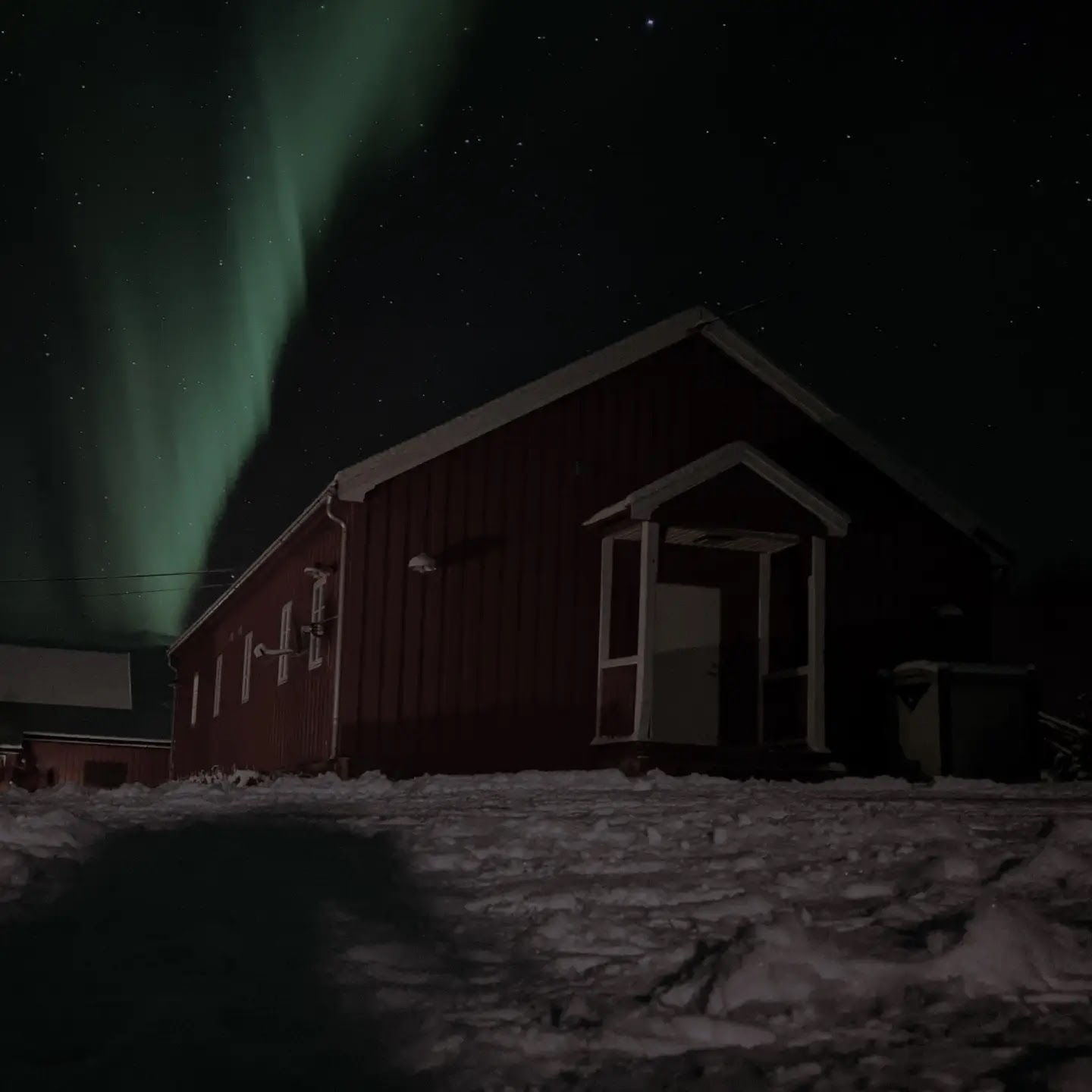

Theoretically, I could give these lectures anywhere; but the real excitement comes with the expedition environment. After all, it’s not nearly as fun listening to lectures about northern lights if you can’t see them for yourself! So we sailed on, crossing the Arctic Circle and up to approximately 71 degrees north latitude: perfectly situated underneath the auroral oval. Because of this ideal location, we were treated to dazzling auroral displays almost every single clear night! I’d like to take you with me back to one of those nights, sailing peacefully past the town of Alta on the evening of November 30th, 2022.
By November, the high Arctic is already well into what Norwegians call mørketida, or “the dark time.” Many folks at lower latitudes experience some degree of darkness during their winter seasons, but darkness at the poles is truly different. I grew up in Michigan and thought I would be prepared for such a degree of darkness, but I’ll readily admit that I was wrong! Michigan lies at around 45 degrees north latitude. It gets noticeably dark during the winter, but we still get to see a bit of sunshine.

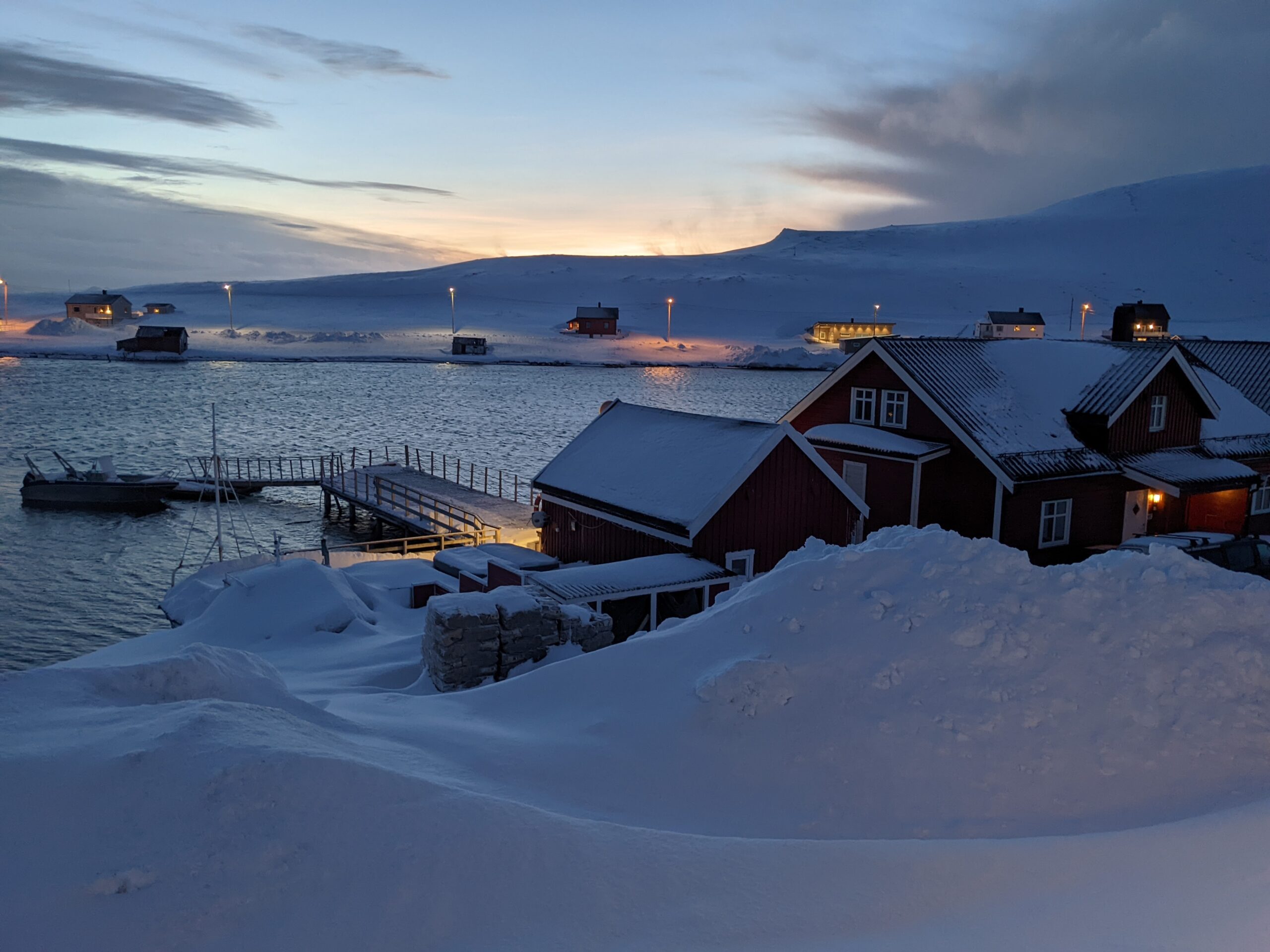
In the high Arctic, however, there is little to no trace of the Sun. Instead, clear days consist of a few hours of low pink and gold hues before fading again into lavender and periwinkle; eventually succumbing to the early twilight and then inky midnight blue. This midnight is where we sit for the rest of the day and night until a lonely strip of deep orange returns to the southeastern horizon, eventually heralding the colorful few hours of “day”time.
That’s it, that’s all we get.
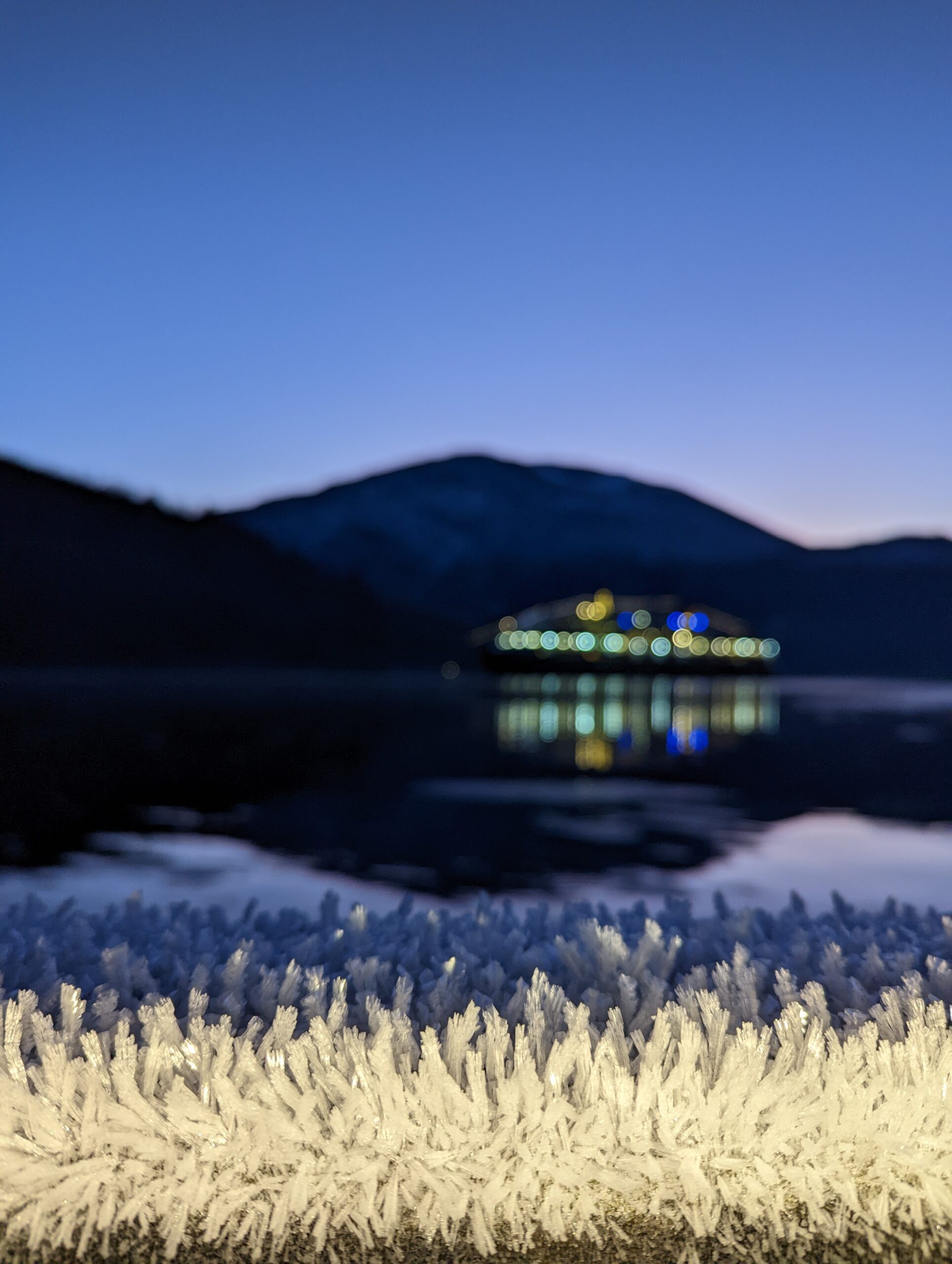
For many folks, the seasonal darkness comes with a seasonal depression, to which a lot of us find it difficult to adapt. I find, though, that these feelings of sadness and loneliness do not necessarily come from the darkness itself, but they can often come from a conflict between expectation and reality; between how things are, and our expectation of how they should be. During the dark time, our work doesn’t necessarily stop even as the darkness invites us to slow down. We’re not allowed to sink inward and hibernate as our bodies and minds want to do; we don’t have any fewer deliverables or responsibilities. On the ship, I still have to wake up and give a lecture on solar physics to paying guests. Where is the hibernation in that? Where is the invitation to rest? At what point are we able to succumb to the nature of darkness, solstice, and winter?
I have found that this moment arrives the moment the aurora arrive.
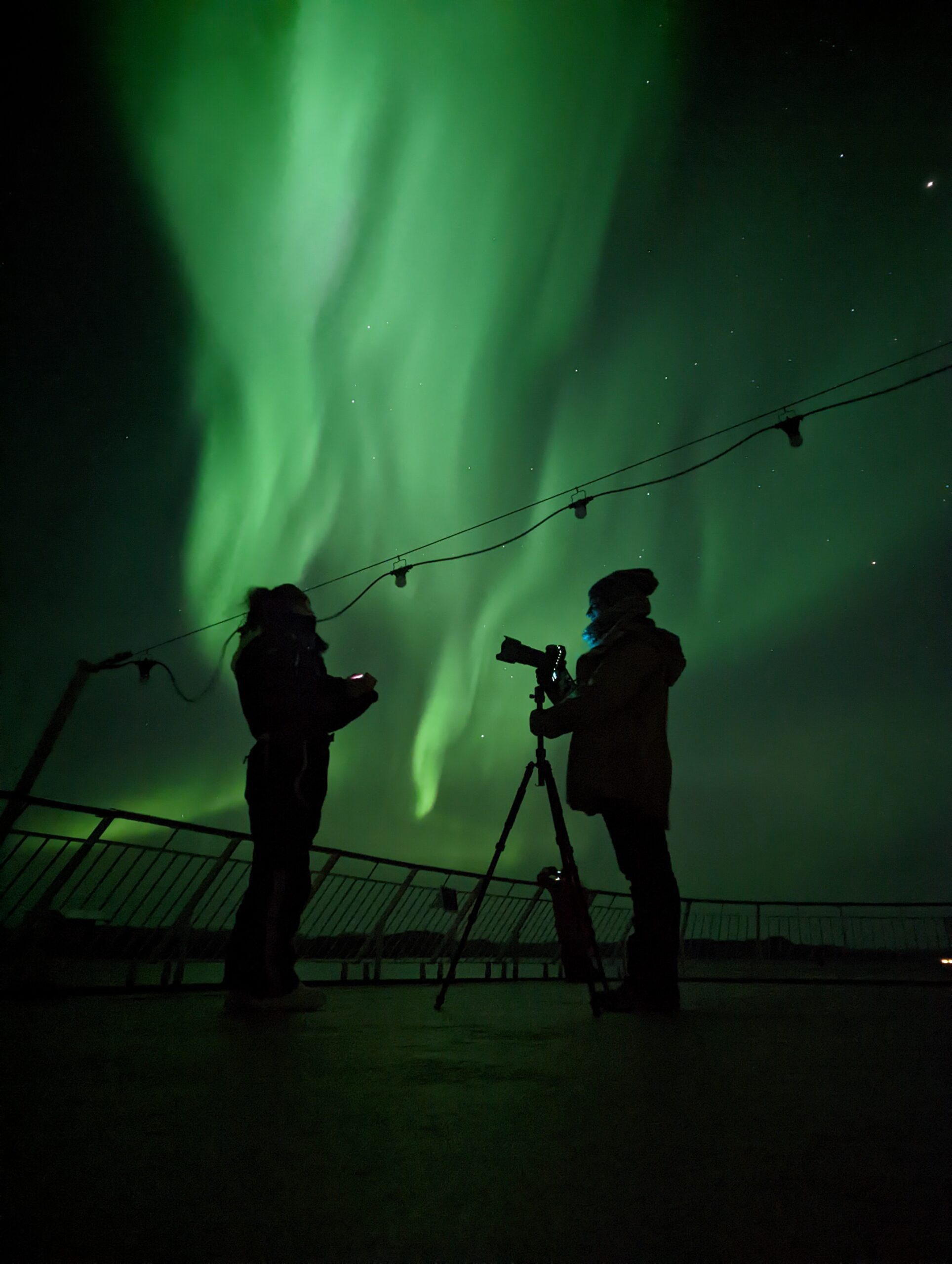
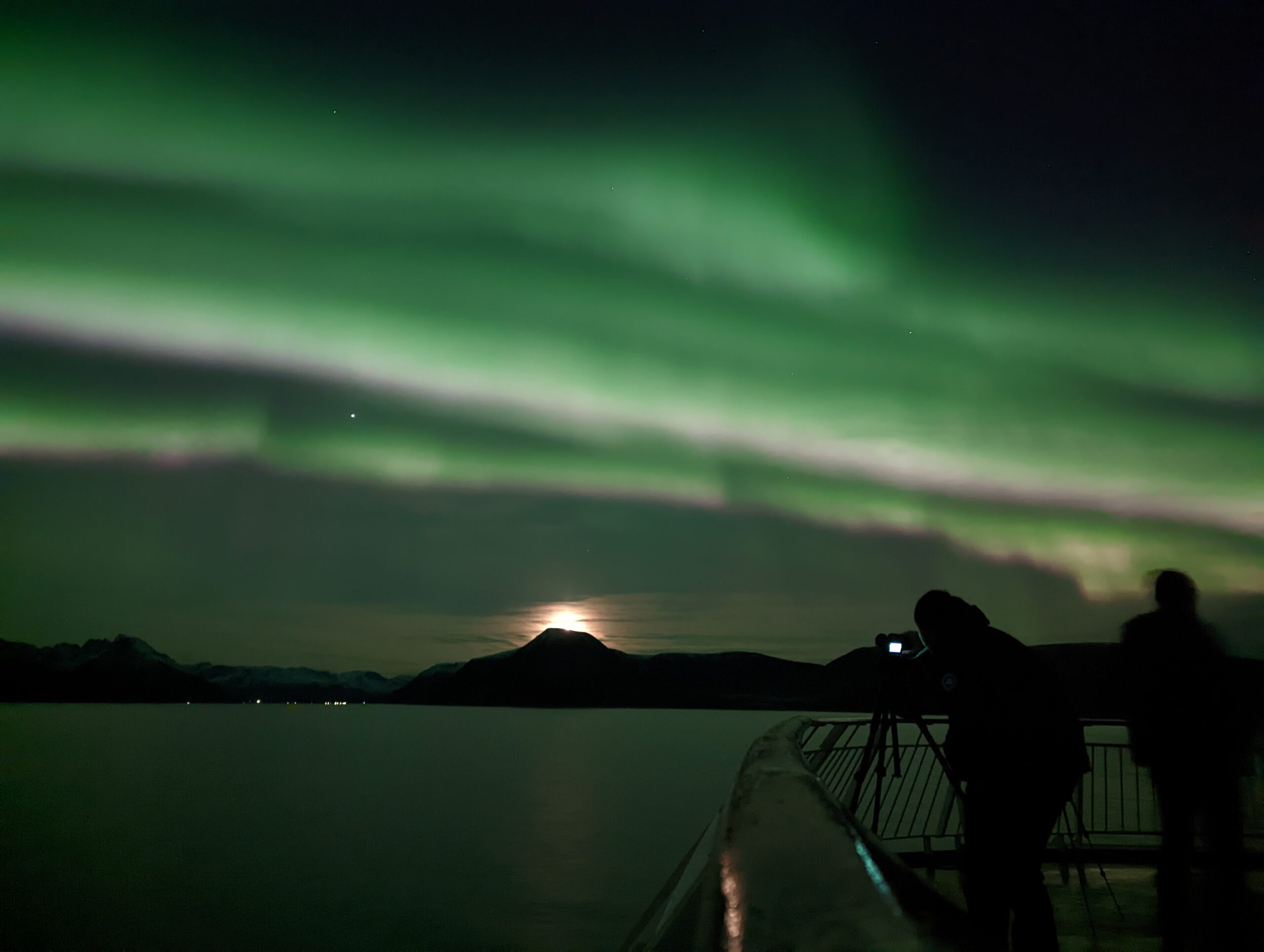
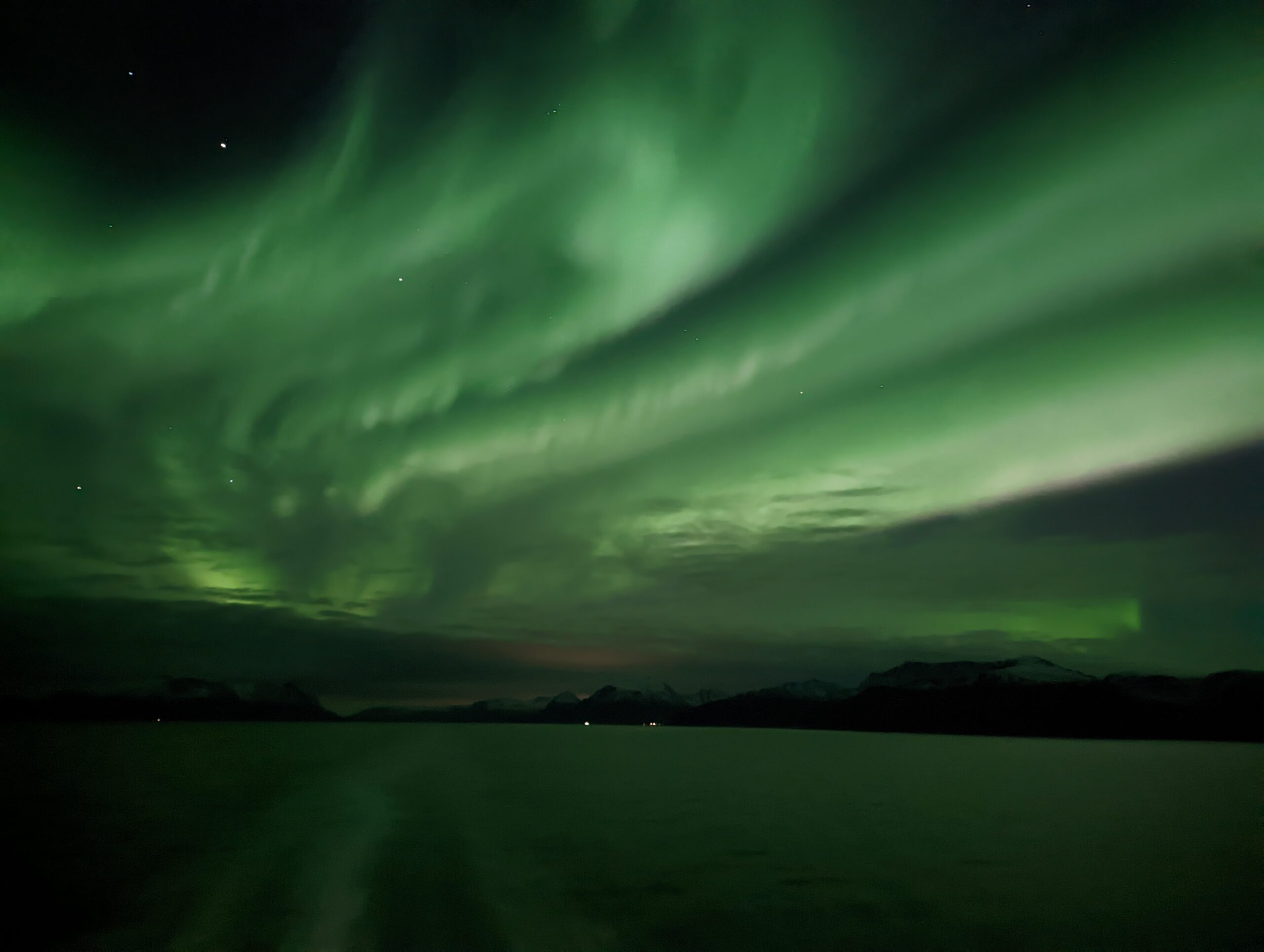
When they arrived on November 30th, 2022 between the frantic pulling-on of our woolens and the rushing outside, between the setting up of tripods and the gathering of passengers to the upper deck, there was stillness. A stillness, and a magnificence, and an awe. The auroral substorm that hit us around 7:30 PM was a strong one, replete with color and structure, full of dancing and vibrance. In fact, it nearly outshone the full moon on the horizon.
Out of the countless times I had seen the aurora before, I had never seen such deep and saturated pinks. The pink color comes from molecular nitrogen in the lower part of the Earth’s upper atmosphere, meaning the particles from the Sun had to barrel through the rest of the upper ionosphere before depositing their energy there. It was a powerful electrical punch that created the most delicious candy stripe in the sky; enough for all of us to enjoy.
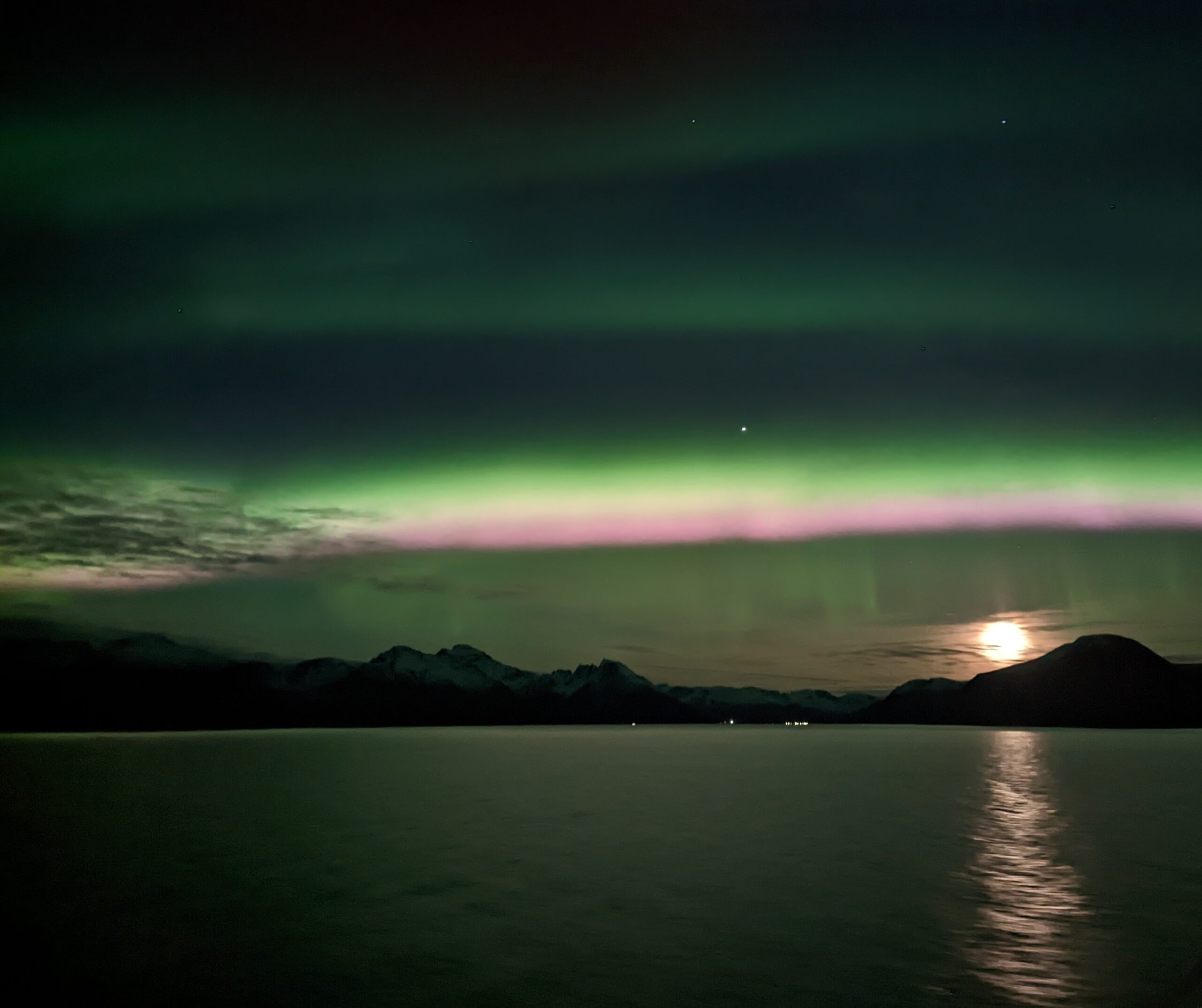
So, I suppose it was a little ironic that something with such intense amounts of energy in the upper atmosphere would create such a stillness on the ground. Whenever there is such an amazing auroral substorm with such motion and color, I usually advise the passengers to take a few moments to just look at it. I tell them not to waste time messing too much with their cameras and phones (that’s the photographer’s job) and to just absorb what’s happening in real time. This is an invitation to get lost in what the darkness provides us, an invitation to see – really see – what they came to the Arctic to experience.
There is a Christmas song in Norway called Nordnorsk julesalme (Northern-Norwegian Christmas Hymn) that I think is particularly poignant and relevant here. It’s a lovely song to listen to during the dark months because it’s fundamentally a meditative blessing; a deep yearning for peace, and a nod toward brighter times ahead.
Du ser oss i mørketidslandet, du signe med evige ord
Husan og fjellet og vannet og folket som lever her Nord.(You see us in the land of darkness, you bless with eternal words
the houses, the mountains, the sea, and the people who live here in the North.)
These two lines are a humble request to be seen even during the darkest period; for everyone and everything in the far North to be seen, known, and cared for during the polar night. And for me, listening to this song is a deep comfort in the dark; knowing that sometimes, the blessing lies in the invitation to be quiet and let nature do its thing. It’s a wonderful thing to surrender to nature and its structure and power; to be still and bear witness to it, and to have the privilege to see it only because of the darkness. In this way, the darkness is a blessing in and of itself.
This auroral display had a significant impact on me and our passengers, some of whom had never seen the Northern Lights before then. Of course, this storm had sizable scientific and physical impacts as well! As we sailed back southward along the coast after November 30th, I had the chance to gather observations to submit to Aurorasaurus, and to look at data collected by various instruments around Norway. While the data are available and usable in real time, poor WiFi connectivity often made it difficult to check data sources and submit observations to Aurorasaurus in real time. Sometimes, we’d have to wait until we sailed back into a more stable and connected region to understand how all the data comes together.
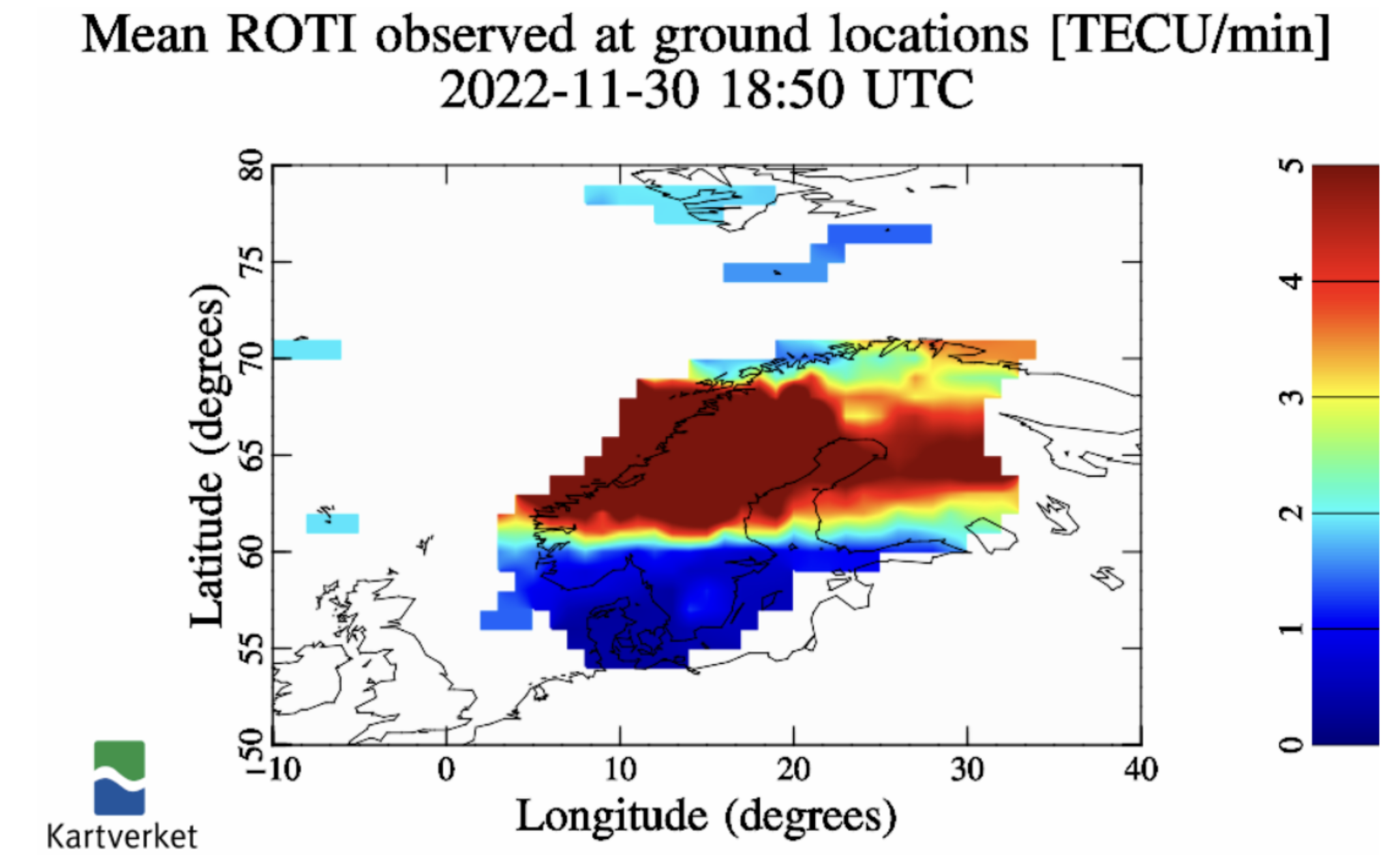
Norway is well-equipped with scientific instruments that collect information on the upper atmosphere, which includes both changes in the particles as well as changes in Earth’s magnetic field. With the help of Kartverket (the Norwegian Mapping Authority) we can see changes in the total number of electrons in the upper atmosphere every five minutes, which tells us when huge amounts of electrons get dumped into the ionosphere, driving the aurora. If you look at Chart 1 below, you’ll see a map of Scandinavia and Finland with lots of colors superimposed over the countries. These colors correspond to the change in particles in the atmosphere over time – specifically, red regions means that there has been a large increase in atmospheric electrons that came from the Sun. These electrons interact with particles in our upper atmosphere, and those interactions result in the colorful lights that we see as aurora. So, the deeper the red over Norway, the more I expect to see auroras in those regions!
Particles aren’t the only things changing in the Earth system, though; the Earth’s magnetic field experiences changes during the aurora, too! The Tromsø Geophysical Observatory provides live data from a system of magnetometers along the Norwegian coast, tracking disturbances in the Earth’s magnetic field that diagram particular shapes or “signatures” during an aurora display. Looking at Chart 2 below, we can see three different colors of squiggly lines. These squiggly lines all indicate disturbances in Earth’s magnetic field, and each color corresponds to a different direction of the magnetic field (up and down, side to side, and tilt.) The more disturbed the magnetic field, the deeper the squiggles are – and the more I expect to see northern lights. If you’re in a place with good connectivity, this real time data is useful for anyone waiting to brave the cold until the magnetometers really start picking up some auroral action!
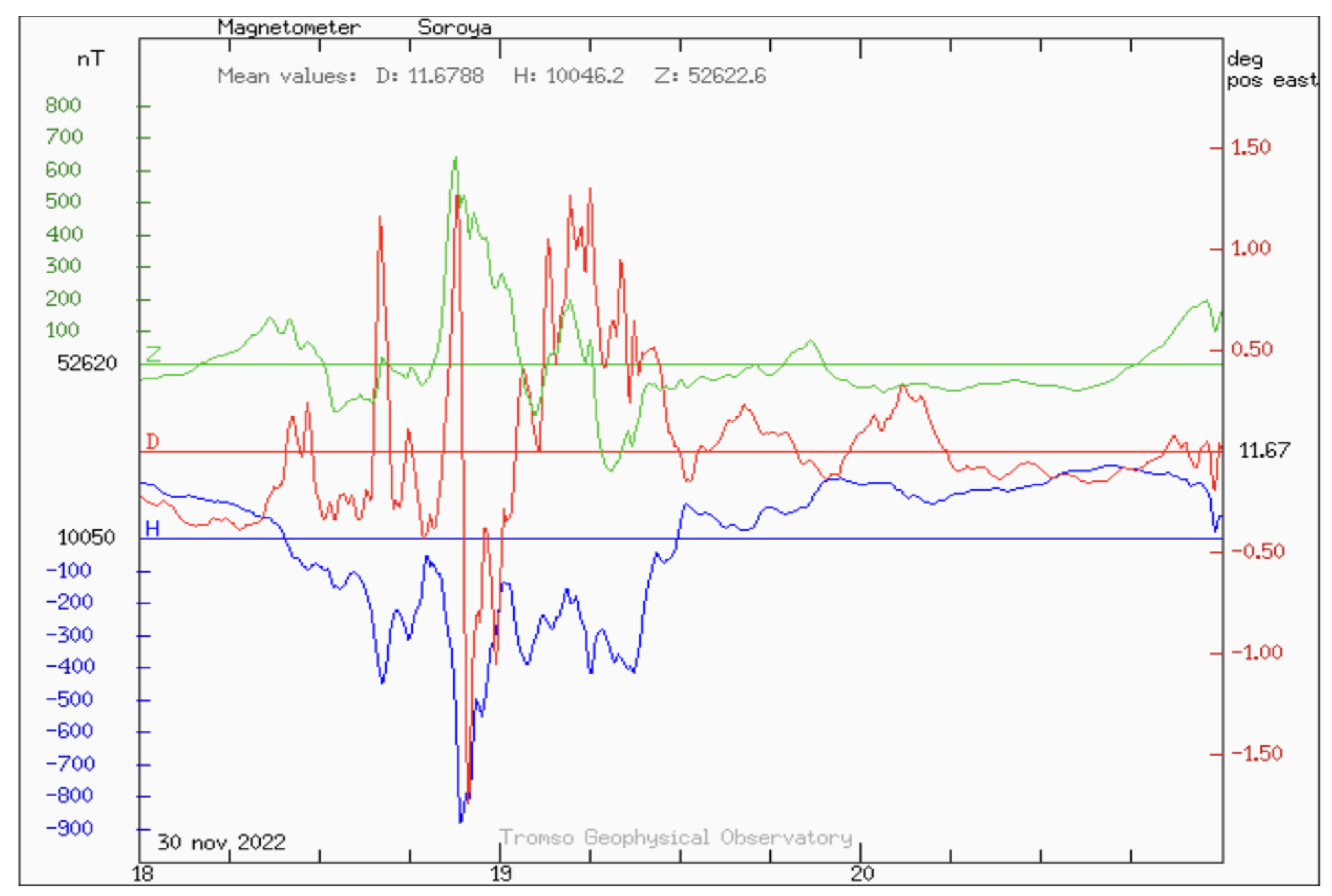
Together, all these streams of data paint a delicate, specific story. The disturbances in the Earth’s magnetic field (squiggly lines in Chart 2) happen around the same time as the increase in electrons (red regions in Chart 1), which also correspond to the time we saw the aurora from the ground. Using this data, I was able to present the full story of the aurora quite nicely: from our learning about the Sun and how the aurora form, to observing them from the ship, to understanding what kinds of measurements we can take as those storms are happening, to the citizen science we can do as a result. It’s wonderful to have the time to tell the whole story, and be able to pull that thread from solar origin to aurora generation to observation and measurement over just a few days.
The Arctic is often portrayed as a desolate, barren wasteland that is prohibitively dark and cold in the winter, but I find it to be one of the places where I feel most alive, safe, and in touch with nature. It is a perfect blend of quiet and excitement, adventure and stillness, science and art: where the auroras both dance and nudge our magnetometers, where they roar across the skies to remind us to embrace stillness. As folks in Norway place candles in their window sills during the dark time, the Arctic skies illuminate with their own version: the northern lights that bring us bursts of light in the darkness.