How can I take part?
There are lots of ways to take part in aurora citizen science and be part of this global community of aurora lovers.
How do I participate in Aurorasaurus?
- Register for a free account to receive email notifications when the aurora is observed near your location
- Be a participatory scientist and earn points when you report aurora sightings. Click here for a quick-start video on how to make reports, and here for a lecture at the UAF Geophysical Institute that talks about the science behind auroras and participatory science.
- ALL reports are useful! Both positive reports (that you have seen aurora) and negative reports (that you have not seen aurora) are important.
- Website reports can be made in real time, or backdated.
- For quality control, and to prevent spam, the system is limited to 100 reports per person per day.
- Each report should not exceed a 3-hour timeframe.
- Examine the map to see locations of real sightings and the predicted auroral oval showing where conditions might be right for auroral viewing.
- Learn more about the aurora with our blog, and keep an eye on space weather with our Storm Tracker.
How does Aurorasaurus make a difference?
- Reports help scientists analyze how far away the aurora was visible and improve aurora models.
- Negative reports clarify whether factors like light pollution or clouds made the aurora hard to see.
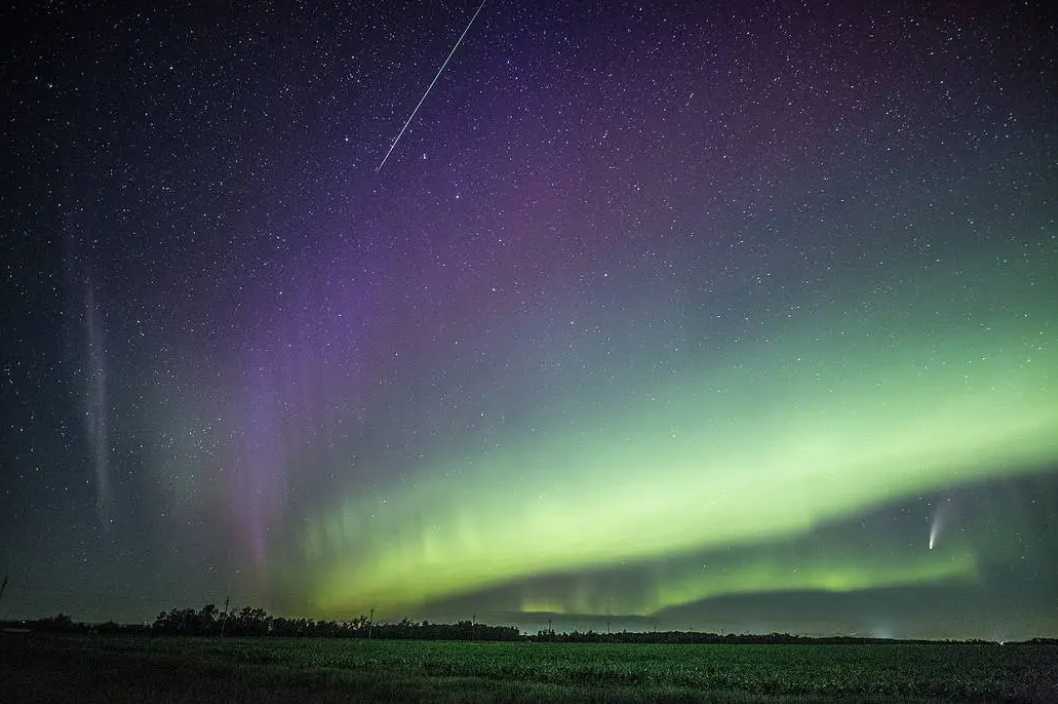
- The project has made a number of discoveries in collaboration with participatory scientists and the scientific community. For example, Aurorasaurus collaborated with participatory scientists and the scientific community to publish the first modern scientific study of STEVE (Strong Thermal Emission Velocity Enhancement), an aurora-like phenomenon that appears closer to the equator and flows from east to west.
What do I get?
Our community values reciprocity and collaboration.
- Registered users receive location-based email aurora notifications—one when a model predicts aurora may be visible, and another when other people report seeing auroras nearby
- Registered users also receive the monthly Aurorasaurus newsletter.
- All users have access to a real-time monitor of space weather activity, answers to science and aurora questions, and more.
There are also opportunities to get more involved:
- Aurorasaurus Ambassadors are superusers and community leaders who share about the project and aurora science with their communities around the world. Fascinating presentations at monthly meetings are shared on YouTube.
- Students and early career scientists can join our biweekly early career meeting. Contact us at aurorasaurus.info@gmail.com for more information.
- Aurorasaurus holds semiannual community engagement events like Report-A-Thons and Journal Clubs. These are announced via newsletter and social media (Facebook and X/Twitter).
- Educators and participatory scientists can collaborate with us on special projects! Contact us at aurorasaurus.info@gmail.com if you have an idea.
Do you have resources for educators?
As part of NASA Science Activation and to help prepare the next generation of participatory scientists, Aurorasaurus generates activities for formal and informal learning environments. Auroras are phenomena to investigate per NGSS 1-ESS1-2, 3-PS2-3 PS2.B, 4-PS3-3, MS-PS2 PS2.B, HS-ESS1-1 ESS1.A, HS-PS2-5 PS2.B, and more.
Our team has subject matter experts and informal educators who want to work on pilot testing and are eager for classroom feedback. If you are an educator interested in co-creating or piloting an activity or lesson plan, please let us know at aurorasaurus.info@gmail.com.
 | Virtual Field Trip Take your class to Alberta, Canada for a virtual aurora chase! Check data to decide whether the Northern Lights are likely to appear, find a prime location, and learn about the science behind these natural wonders.Students will be better able to explain the most basic chemistry and physics concepts behind the Northern Lights. They will gain a taste of the process of doing science, as well as the real-life applications of math and science concepts as they relate to becoming an aurora chasing citizen scientist. Ages 11 and up. |
 STEVE, photo by Catalin Tapardel | Aurora 101 Glossary Talk like an aurora chaser! Learn basic vocabulary and concepts to help explain the Northern and Southern Lights with this beginner-level glossary. Packed with educational videos and resources to use in the classroom. |
 | Card Game: Aurora Chasers! While playing a collaborative game, students identify factors that help or hinder aurora chasers in seeing the Northern or Southern Lights. Free printable files include instructions, cards, and a reflection worksheet. Watch this space for future editions and/or expansions.Students will be better able to answer the surprisingly complex question, “how can I see the aurora” with reference to scientific, geographic, meteorological, and other factors. Ages 11 and up. |
 | HelioZines: Share Sun Science, YOUR Way! Empower your students to learn and communicate science through the grassroots medium of handmade booklets called zines. HelioZines is a three-part activity that provides a multimodal, multisensory avenue for learning and engages multiple STEAM principles. In order to better understand both sun science and science communication, students will research and create a handmade publication called a “zine” showcasing an area of heliophysics: the study of the Sun and all it influences. These can be added to existing zine collections at local libraries, or you can create your own classroom zine library! |
 | 3D Printed Magnetosphere Model The regions of the Earth’s magnetic field, or magnetosphere, are invisible and can be challenging for students to abstract. You can build a 3D printed classroom tactile to help students visualize the areas of the magnetosphere, which are important to understanding the basic physics of the aurora and how the Sun relates to the Earth. Free files and step-by-step, intermediate-level instructions help you or your local print lab create your own! Ages 11 and up. |
 | Aurorasaurus Learn What causes auroras? Where and when do they occur? What causes their colors? What shapes can they be? Why are they important? How can someone photograph them? This guide gives brief answers to aurora science questions at a beginner level. |
 | Aurorasaurus Blog More in-depth, beginner-intermediate explorations of aurora science. The Aurorasaurus blog contains resources for the general public, students, and teachers. These include a Q&A with fourth graders, a list of family-friendly resources, stories from aurora chasers, STEVE at the science fair, space weather snacks, and students building satellites! |
 | Aurorasaurus YouTube In-depth, beginner-intermediate adult explanations, presentations, and resources on aurora science. Students can explore from home, learn about the cultural and scientific aspects of aurora, find out more about citizen and community science, and meet quirky subauroral phenomenon STEVE. Undergraduate students can take a deep dive into real scientific papers, with each paragraph explained by a NASA scientist. |
Aurorasaurus is part of the nationwide NASA Science Activation community, and often collaborates with other Science Activation teams like NASA HEAT, ASTRO CAMP, and others. For example, you can also find our educational resources on the Infiniscope website. Be sure to also check out some wonderful hands-on resources from our colleagues at the Museum of the North and the University of Alaska Fairbanks. You can find hands-on activities from Aurorasaurus in our blog.
How can I access Aurorasaurus science?

The Aurorasaurus team with an American Geophysical Union poster by Aurorasaurus Ambassador and co-researcher Michael Hunnekuhl
Cleaned Aurorasaurus data is available online for download and study on Zenodo. Please contact us at aurorasaurus.info@gmail.com with data requests.
Aurorasaurus has published many peer-reviewed studies. We have summarized several of these and other studies in plain language on our blog. Open access links and brief summaries to key papers are below.
COMING SOON: A new data release and paper centered on the May and October 2024 aurora superstorms.
MacDonald, E. A., Case, N. A., Clayton, J. H., Hall, M. K., Heavner, M., Lalone, N., Patel, K. G., and Tapia, A. (2015), Aurorasaurus: A citizen science platform for viewing and reporting the aurora, Space Weather, 13, 548– 559, doi:10.1002/2015SW001214.
This is the first, comprehensive paper about the Aurorasaurus platform and how it works.
Case, N. A., Kingman, D., and MacDonald, E. A. (2016), A real-time hybrid aurora alert system: Combining citizen science reports with an auroral oval model, Earth and Space Science, 3, 257–265, https://doi.org/10.1002/2016EA000167.
This paper describes how Aurorasaurus combines data from the OVATION Prime auroral oval model with real-time observational data provided by a global network of citizen scientists, in order to provide more accurate and localized alerts for auroral visibility.
MacDonald, E. A., Donovan, E., Nishimura, Y., Case, N. A., Gillies, D. M., Gallardo- Lacourt, B., Archer, W. E., Spanswick, E. L., Bourassa, N., Connors, M., Heavner, M., Jackel, B., Kosar, B., Knudsen, D. J., Ratzlaff, C., Schofield, I. (2018), New science in plain sight: Citizen scientists lead to the discovery of optical structure in the upper atmosphere.Science Advances, 4, https://doi.org/10.1126/sciadv.aaq0030
This is the first modern paper published on the famed subauroral phenomenon, STEVE. The paper was written as a collaboration between the aurora chasing and scientific communities.
Kosar, B. C., MacDonald, E. A., Case, N. A., & Heavner, M. (2018). Aurorasaurus database of real-time, crowd-sourced aurora data for space weather research. Earth and Space Science, 5, 970– 980. https://doi.org/10.1029/2018EA000454
This technical report documents the details of Aurorasaurus citizen science data for 2015–2016, as well as the way the project filters data.
Kosar, B.C., MacDonald, E.A., Case, N.A., Zhang, Y., Mitchell, E.J., Viereck, R. (2018), A case study comparing citizen science aurora data with global auroral boundaries derived from satellite imagery and empirical models Journal of Atmospheric and Solar-Terrestrial Physics, 177, 274–282, https://www.sciencedirect.com/science/article/pii/S1364682617303413.
This study compares data gathered by Aurorasaurus participants with satellite data.
Hunnekuhl, M., & MacDonald, E. (2020). Early ground-based work by auroral pioneer Carl Størmer on the high-altitude detached subauroral arcs now known as “STEVE”. Space Weather, 18, e2019SW002384. https://doi.org/10.1029/2019SW002384
This paper provides historical context for the study of STEVE, noting that it had been observed and published by Western scientists in the historical record.
Semeter, J., Hunnekuhl, M., MacDonald, E., Hirsch, M., Zeller, N., Chernenkoff, A., & Wang, J. (2020). The mysterious green streaks below STEVE. AGU Advances, 1, e2020AV000183. https://doi.org/10.1029/2020AV000183
This study uses time lapse images recorded by citizen scientists to examine relatively small structures in the green areas of STEVE, especially narrow streaks commonly observed underneath the picket fence.
Di Mare, F., & MacDonald, E. (submitted 2025). Unveiling the Dynamic Nature of STEVE: Turbulence and Intermittency at Swarm Altitudes. Geophysical Research Letters. Under revision.
This study investigates the chaotic turbulence within STEVE, using data from the Swarm satellites.
You can find more papers by and about Aurorasaurus on Google Scholar. Aurorasaurus also contributed to white papers for the Heliophysics Decadal Survey, and our educational efforts, and STEVE were noted in the final publication.


