As loved ones gathered to celebrate the winter holidays, we were thinking about the many relationships between aurora and aurora-like phenomena in the sky. In this post, we introduce the aurora and some of the amazing phenomena related to it, closely or distantly. If you have a photo and wonder which phenomena might be present in it, one way you can find out is to make a backdated report to Aurorasaurus, then compare your report with others in your area. If you’re still not sure, you are also welcome to reach out and ask us.

“Classic” Aurora
We often talk about types of aurora and aurora-like phenomena in terms of the ways they relate to the aurora itself. Doing so not only emphasizes the connections between them, it brings together our wonderful community of participatory scientists, scientists, students, and members of the public. Studying the aurora together has been key to getting to know other phenomena like STEVE and the dunes.
The ”classic” aurora that sets the night sky ablaze with green, red, pink, and blue colors is made when particles from the Sun are caught in Earth’s magnetic field, moved around the planet, and accelerated toward the North and South Poles. They go so fast that they rain down into the Earth’s upper atmosphere, imparting energy to atoms and molecules, which in turn give off light. This light can take many forms, such as discrete ribbons, diffuse glows, and pulsating displays. It carries deep meaning for many people around the world. You can find out more about “classic” aurora on the Aurorasaurus Learn page.
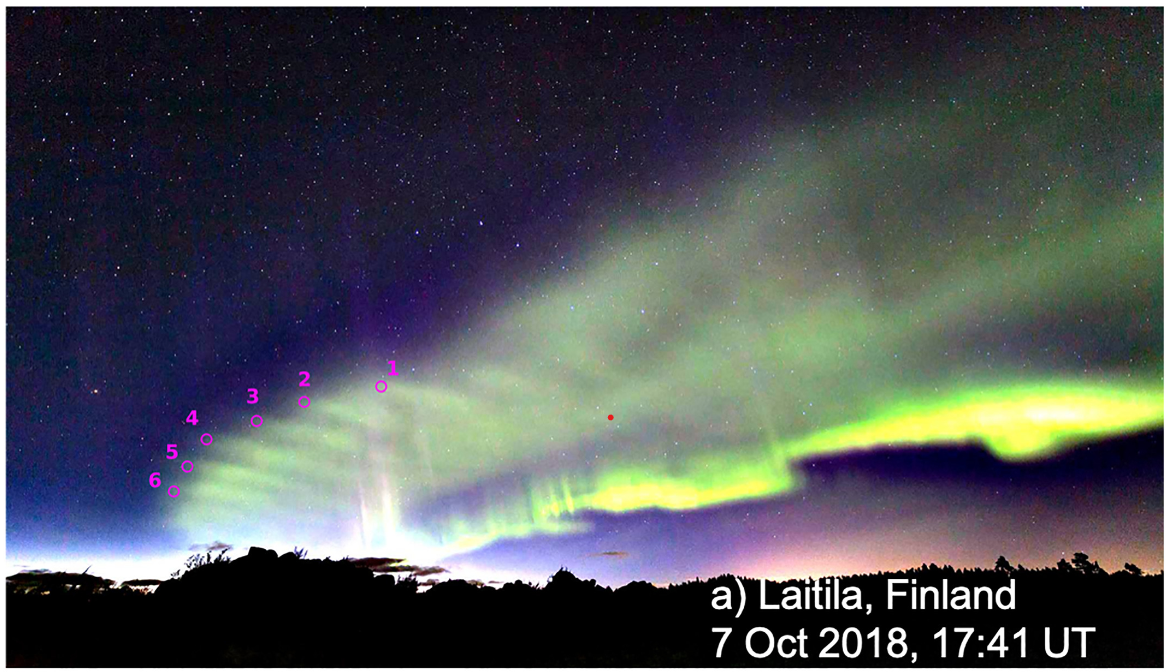
Auroral Dunes
The auroral dunes are newly-investigated features of diffuse “classic” auroras. They were brought to the attention of scientists by participatory scientists in Finland. They are still actively being studied, but seem to be a relatively rare type of wave pattern in the atmosphere called a “mesospheric bore.” You can find out more about the dunes on the Aurorasaurus blog.

SAIDs, SAR Arcs, and STEVEs
Sometimes siblings have at least one who is particularly extraverted and theatrical, and on this score auroras are no different. The Earth’s upper atmosphere is a swirling soup of plasma: the fourth state of matter, made of charged particles called ions. Sometimes, the flowing plasma can form brief, fast-moving streams that move east to west and occur equatorward of the aurora. These are called subauroral ion drifts, or SAIDs, and while they’re evident and interesting in satellite data, they are invisible to those watching from the ground. Every once in a while though, a particularly fast kind of SAID flows so strongly it becomes visible, greeting skywatchers with a glam mauve and purple display. These glimmering lights are called STEVE (Strong Thermal Emission Velocity Enhancement.) From 2016-2018, volunteers in the Alberta Aurora Chasers group and scientists worked together to publish the first modern paper on STEVE. The phenomenon is now world-famous, and research continues with collaborations between scientists and participatory scientists! There has even been a study on Stable Auroral Red arcs, or SAR arcs, which are faint red auroras that hang out in the same places as STEVEs, turning into STEVEs themselves! Dr. Carlos Martinis, the lead author, delved into the study in a presentation to the Aurorasaurus Ambassadors, watchable online on the Aurorasaurus YouTube channel.

Sprites
Distant but particularly flashy cousins, sprites are brief bursts of red and purple light associated with lightning. They dance above the clouds, up to heights near the lower edge of the aurora. While auroras are organized via magnetic fields, sprites are sparked from electric fields. They are part of a family of phenomena called TLEs, or Transient Luminous Events: ELVES, Halos, Blue Jets, Gigantic Jets, and more. Green GHOSTs are a newer designation that may even occur up in the altitude range of auroral light! Find out more and take part in participatory science on sprites and TLEs at Spritacular, and via an Aurorasaurus guest blog post by Spritacular lead Dr. Burcu Kosar.

Noctilucent Clouds
Sometimes family aren’t physically related, but loved just the same. Noctlilucent, or “night-shining” clouds are the highest-altitude clouds, occuring in the coldest layer of Earth’s upper atmosphere, just below where the aurora occurs. Their altitude means they are still lit by the sun just after sunset, and glow against the darkening sky. They aren’t related to aurora, but may be related to climate change. Noctilucent cloud season often coincides with months when auroras are less frequent at high altitudes, so they are a beloved and beautiful summer subject for aurora photographers. You can find out more about them and see beautiful photos by Aurorasaurus Ambassadors on the Aurorasaurus blog, and learn more from Project PoSSUM about studying noctilucent clouds.
Relationship With the Sky
The aurora family are not only related by characteristics; they’re also part of the larger relationship between the Earth and Sun expressed in the solar wind, resonating magnetic fields, and the sunshine we enjoy on a beautiful day. We’re part of that relationship, too. As Annette S. Lee says in the new book Spirits Dancing: The Night Sky, Indigenous Knowledge, & Living Connections to the Cosmos on p. 46:
Aurora displays are occurring literally everywhere we look. This detail is important, and not only because it shows a critical relationship between the Sun and the rest of the solar system. It also serves as a reminder that Earth (and human beings) are part of the larger “solar family.” Before gravity took hold, more than 4.6 billion years ago, our solar system was a gigantic nebula, a floating interstellar cloud of gas and dust. All the planets and our star, the Sun, were created out of this nebula. So when we marvel at the dancing lights called aurora here on Earth . . . we marvel at the same physics, and that’s part of the same story. The importance of what we learn from studying space is in some part what we learn about our own human identity.
So here’s to families near and far, born and chosen, and best new year’s wishes to all!


